On this page
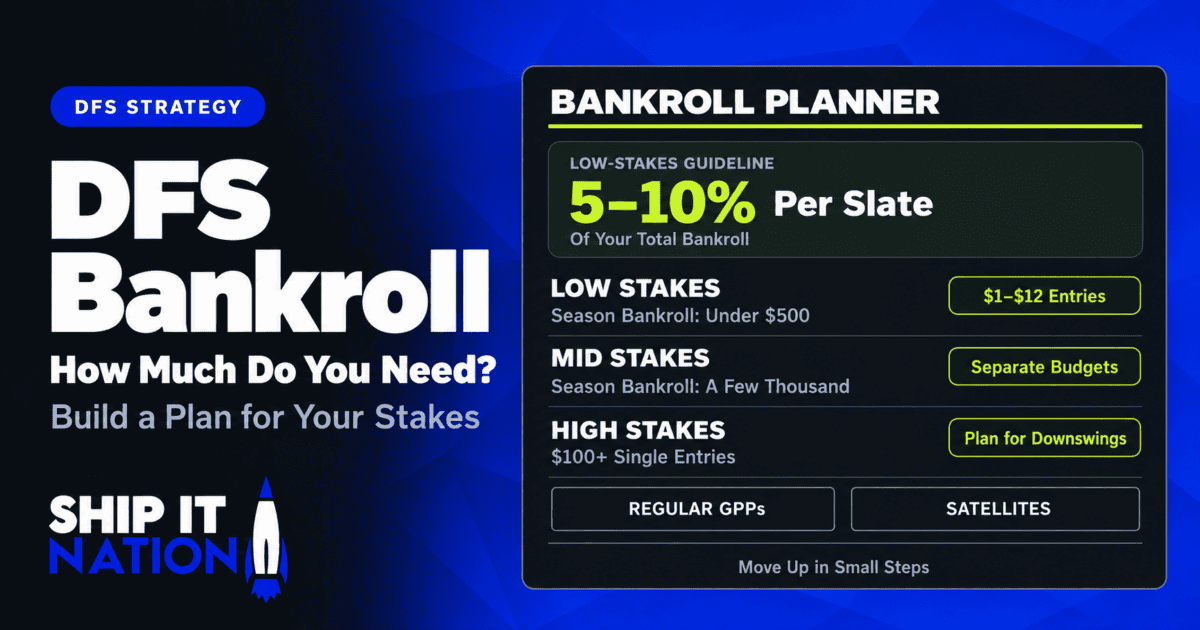
There is no single bankrollBankroll ManagementBankroll management is how you size your DFS spending relative to the money you have set aside to play, called your bankroll, so normal losing streaks do not wipe you out.Write down your per-slate limit before the season starts. Spending rules are much easier to keep when you set them before a losing streak, not during one. that works for everyone. A common starting point is to risk no more than 5 to 10 percent of your bankroll on any one slate, play smaller contests while you learn, and keep satelliteSatelliteA satellite, also called a qualifier, is a contest whose prizes are tickets into a more expensive contest or a live final instead of cash. Tickets are free entries into that bigger event.Before building, compare the number of seats to the size of the field. The share of entries that win a ticket tells you whether to build like a cash game or a tournament. money in its own bucket. Move up in stakes slowly, and only after your process holds up.
Key takeaways
- Build your bankroll plan around your goals, stakes, and comfort with risk.
- Keep satellite and qualifier spending separate from your regular GPP budget.
- Move up in smaller steps and prove your process works at each new stakes level.
Let’s break down how to actually think about this, by stakes level and by goal.
| Stage | Season bankroll | Typical contests | Max per slate (5 to 10 percent) |
|---|---|---|---|
| Low stakes | $100 | $1 to $12 single entries, 3-max, or 20-max | $5 to $10 |
| Low stakes | $250 | $1 to $12 single entries, 3-max, or 20-max | $12.50 to $25 |
| Low stakes | $500 | $1 to $12 single entries, 3-max, or 20-max | $25 to $50 |
| Mid stakes | $1,000 | Mix of 3-max, MME, and some satellites | $50 to $100 |
| Mid stakes | $2,500 | Mix of 3-max, MME, and some satellites | $125 to $250 |
| Mid stakes | $5,000 | Mix of 3-max, MME, and some satellites | $250 to $500 |
| High stakes | $10,000 or more | $100+ single entries or high dollar MME | $500 to $1,000 |
Start With the Goal, Not the Dollar Amount
Before you assign a number to your bankroll, figure out what you’re actually trying to do. Someone chasing a live final qualifier needs a completely different plan than someone trying to grind out consistent profit in $5 double upsDouble-UpA double-up is a cash game that pays every winner exactly twice the entry fee. Because the site keeps a fee, slightly less than half the field gets paid.Look at cash lines from similar past slates before you build. They tell you how many points you realistically need, which keeps you from reaching for upside you do not need.. Someone playing three max needs a different setup than someone firing 150 lineups a week.
Ask yourself a few questions. Am I trying to build long term, sustainable profit? Am I chasing a specific milestone, like qualifying for a live final? Am I fine with more varianceVarianceVariance in DFS describes how widely fantasy scores or contest returns can swing around their expected outcomes. It explains why a sound lineup can lose and a poor decision can sometimes win.Track results by contest type and slate, and review opportunity separately from touchdowns or other rare scoring events. Entering the same lineup in ten contests does not give you ten independent performance samples. If you build with an optimizer, its randomness setting nudges projections up or down on each build, so your lineups spread across different players instead of repeating the same top projections. in exchange for a shot at a life changing score?
Your answer changes everything downstream. How much you set aside, how you divide it, and which contests you should even be looking at.
Grab your FREE copy of the DFS Blueprint. A 59-page PDF guide teaching you how to play DFS, gain leverage and maximize profits.Get the BlueprintLow Stakes: Building Reps Without Blowing Up
If you’re newer to DFS or working with a smaller bankroll, say under $500 for a season, your job right now isn’t to get rich. It’s to build reps and figure out where your actual edge lives.
At this level, stick to $1 to $12 single entries or small max contests like 3-max or 20-max. Avoid the temptation to jam your whole bankroll into one Milly Maker because the ceiling looks tempting. Track every entry. At low stakes, the value isn’t the money. It’s the data you’re building on yourself.
A good rule of thumb here: no single slate should risk more than 5 to 10 percent of your total bankroll. That gives you enough swings to actually learn something before you’re back to zero.
Mid Stakes: Where Structure Starts to Matter
Once you’re playing with a few thousand dollars for a season, structure becomes non-negotiable. This is usually where players start mixing formats. Some 3-max, some MME, maybe a satellite push here and there.
At this level, don’t treat every slate the same. You’ll have weeks where your read is strong, a clear edge, a slate that fits your strengths, and weeks where it’s murkier. Weight your allocation accordingly instead of firing the same flat amount every single week regardless of conviction.
This is also the point where separating your budgets starts to pay off. If part of your goal includes chasing a satellite ticket, that money should live in its own bucket, not bleed out of your regular GPP budget without you noticing. Nothing wrecks a season faster than a bankroll that quietly disappears into contests you didn’t plan for.
High Stakes: Playing Against the Sharpest Version of the Field
If you’re deep enough into DFS to be playing $100 plus single entries or high dollar MME, you already know you’re not just playing against casuals anymore. The field is sharper, the ownership is tighter, and the downswings can be longer and uglier than anything you dealt with at lower stakes.
At this level, expect and prepare for extended cold stretches. Six to eight weeks with little to show for it isn’t rare, it’s normal. Don’t let one big score talk you into moving up in stakes before you’ve proven you can repeat the result. Your edge needs to come from process and construction, not from outplaying the field on raw sports knowledge. Everyone at this level knows the sport.
The Mistake Almost Everyone Makes: Moving Up Too Fast
This is worth its own section because it’s the single most common way players torch a bankroll. You hit a big score at $20 entries, and suddenly you’re firing $555 single bullet GPPs the next week because the money’s there now.
Here’s the problem. The process that got you the win was built for a $20 field. You haven’t actually proven anything about how you perform at $555 stakes yet. If you want to scale up, do it in smaller steps, and treat the new stakes level as a chance to build proof, not a reward you’ve already earned.
Building Your Own Bankroll Plan
There’s no shortcut that replaces sitting down and actually mapping this out for yourself. A few questions worth answering before your next slate:
- What’s my total bankroll for this sport, this season?
- What percentage am I comfortable risking on any single slate?
- Do I need a separate bucket for satellites or qualifiers?
- What does scaling up actually look like for me, step by step?
If you want a deeper walkthrough of this, including how bankroll ties into contest selection and lineup construction, the free DFS Process 101 courses at Ship It Nation cover bankroll management sport by sport, and the SaberSim optimizer tool can help you test lineup builds across different stakes before you commit real money to them.
Bankroll management isn’t the exciting part of DFS. But it’s the part that determines whether you’re still playing, and still improving, six months from now.
Go further: DFS PROcess 101 Members
Full video courses on bankroll management, contest selection, roster construction and more, free for members.
Common Questions
How much bankroll do you need for DFS?
Your bankroll should reflect your goals, stakes, contest choices, and comfort with variance. Most players start with $100 to $500 for a season, playing $1 to $12 contests. A few thousand dollars fits mid stakes, and $100 plus entries call for a much larger bankroll. At any level, risk no more than 5 to 10 percent of your bankroll on a single slate, and move up in stakes slowly.
How much of your DFS bankroll should you risk per slate?
For low-stakes players, the article suggests risking no more than 5 to 10 percent of your total bankroll on a single slate.
When should you move up in DFS stakes?
Move up in smaller steps after proving your process, rather than treating one big score as permission to jump. Treat each new stakes level as a chance to build evidence of how you perform.
Need a term explained? The Ship It Nation DFS glossary covers every DFS term we use in plain language. All articles

About the author
Tyler Tamboline
Tyler Tamboline co-founded Ship It Nation and is the face of the brand across our shows and community. He is also the Founder of DFS Mastermind, helping hundreds of DFS players find their own process. He has played DFS since 2012, focusing primarily on PGA and NFL, and has created DFS content full-time since 2018 at different sites across the industry. He is known for strategy, game theory and leverage in large-field tournaments. He has been a regular on many Fantasy Sports podcasts, including weekly PGA and NFL shows with Pat Mayo.
More from Tyler Tamboline