NFL
Stars and Scrubs vs. Balanced Builds in NFL DFS
Published by Tyler Tamboline · 6 min read
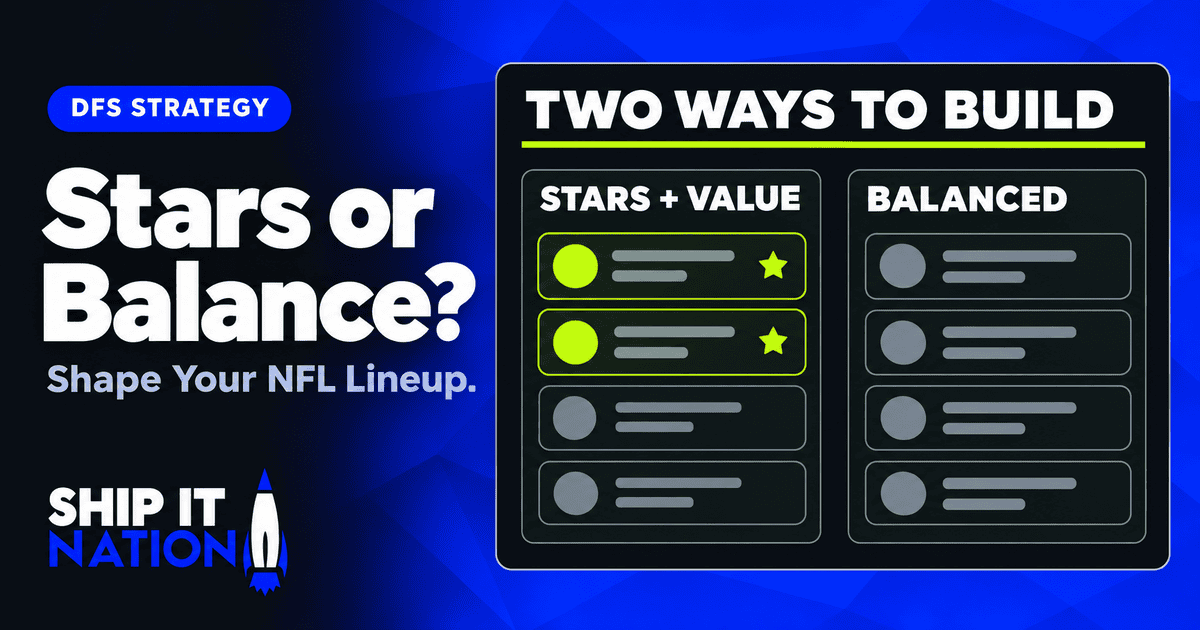
A stars and scrubsStars and ScrubsStars and scrubs is a DFS lineup structure where you spend heavily on several expensive players and fill other roster spots with low-salary players. The cheap players free up salary for the stars; they are not necessarily bad players.Compare the points you gain by upgrading to a star with the points you sacrifice at the cheap spot. Check whether both players still fit your lineup's scoring scenario. build allocates a massive chunk of your salary cap to two or three premium, elite players while filtering the remaining spots with cheap valueValueValue is the fantasy production you expect from a player relative to his salary. A value play offers more production or upside than his price suggests, whether he is cheap or expensive.Identify why the salary looks wrong: workload, matchup, scoring ability or a pricing error. Then check whether that reason still holds when you submit your lineup. plays. Conversely, a balanced buildBalanced BuildA balanced build spreads salary fairly evenly across a lineup, using mostly mid-priced players instead of a few stars and several minimum-salary players.Go balanced when the slate lacks trustworthy cheap plays. Forcing stars and scrubs without real value just fills your lineup with players who have no role. distributes pricing evenly, focusing entirely on high-probability mid-tier options. Neither roster construction is superior by default; the optimal build is entirely dependent on individual slate value and contest type.
Key takeaways
- Geometric Allocation: A stars and scrubs build compromises floor to lock in elite premium ceilings, while a balanced build evenly spreads capital to maximize baseline consistency.
- Contest Mapping: Cash formats heavily favor balanced structures to preserve floor, while massive tournament fields consistently reward users who build a roster shape that is doing the opposite of what the field is doing.
- Cohesive Construction: Roster geometry and team stacking are deeply intertwined; always plan your financial allocation and your player correlations together as a singular, unified blueprint.
Analyzing the Roster Shapes
The strategy behind a stars and scrubs lineup is built on maximizing elite talent. You are betting that your high-priced superstars possess an unmatchable ceiling, and that their explosive output will easily cover the lower floor of your bargain-bin savings options. The structural risk is that if a single cheap value play posts a complete dud, your lineup’s baseline is severely compromised.
A balanced lineup avoids the volatility of bottom-tier options by completely locking in high-floor, mid-priced players across every slot. This construction creates a highly stable floor, but it frequently lacks the explosive, slate-breaking scoring power required to conquer massive field tournaments.
Roster Construction by Contest Format
| Contest Type | Optimal Build Shape | Core Strategic Reason |
|---|---|---|
| Cash Game (50/50, H2H) | Balanced | Stable, mid-tier touches maximize your baseline floor to beat the median |
| Small-Field / Single-Entry | Slate Dependent | Driven entirely by the presence of high-quality value plays from injuries |
| Large-Field Tournament | Flipped Structure | Deviating from the chalk roster shape creates massive field leverage |
What Is a Balanced Build?
A balanced lineup distributes your salary cap evenly across the board, focusing almost exclusively on strong, mid-tiered assets. By completely avoiding bottom-priced “scrubs” and top-tier “megastars,” you insulate your roster against individual variance. Because your budget is spread smoothly, your baseline scoring floor becomes far steadier, and the overall success of the build is never entirely dependent on a single player.
The main challenge with balanced builds is that they are highly intuitive. Many casual players default to this build shape naturally because it allows them to draft an entire roster of familiar, comfortable starters. If the general public collectively builds in the exact same mid-tier salary range, thousands of lineups end up looking nearly identical. In large tournaments, this heavy overlap can drastically limit your ability to climb to the top of the leaderboard.
Which Build Fits Which Contest?
In cash games, a balanced build is almost always the optimal structural fit because maximizing a secure, high-probability point floor is your only goal. In large-field tournaments, however, your priority shifts to completely separating your lineup from the masses. Intentionally choosing a highly distinct roster shape is one of the most effective ways to build a unique lineup without having to select low-probability, bad football players.
Build Style by Contest Matrix
| Tournament Type | Common Structural Fit | Core Strategic Advantage |
|---|---|---|
| Cash Game (50/50, H2H) | Balanced Build | Spreading salary across steady, mid-tier touches maximizes your floor. |
| Small-Field / Single-Entry | Slate Dependent | Driven entirely by the quality of injury value vs. the ceiling of top stars. |
| Large-Field GPP | Flipped / Unusual Shape | Building an unconventional roster geometry creates massive field leverage. |
The Power of “Flipping the Build”
Flipping the build is the process of deliberately constructing a roster shape that runs entirely opposite to the general public’s collective behavior on a given slate. For example, if a slate features three elite, cheap value running backs due to sudden injuries, 80% of the tournament field will plug those cheap backs in and use their extra cap space to stack expensive wide receivers.
To gain structural leverage, you can flip this build: fade the popular value backs, pay up for premium, low-owned workhorse running backs, and save cap space by rostering cheap, high-upside value wide receivers. This gives your lineup a completely unique structural build. Even if your individual players overlap with some popular options, your overall lineup geometry ensures that if the chalk value backs fail, your lineup rapidly scales past the field.
How Do You Know What the Field Is Doing?
To accurately read the general public’s intentions, look closely at projected ownership and identify exactly where the primary salary pressure is on the slate. If an injury opens up a massive role for a bargain tight end or a cheap backup running back, the public will flock to those savings. This influx of cheap chalk leaves thousands of lineups with a massive surplus of cash to spend elsewhere. Conversely, if a handful of premium superstars are overwhelmingly popular, the field will be collectively forced to squeeze cheap punts into their remaining slots.
Ask a simple question on every slate: Where is the rest of the field getting their financial savings? Once you spot where the crowd is clumping, evaluate whether you can build a highly differentiated roster geometry without sacrificing too much of your expected projection baseline.
When Does Stars and Scrubs Work Best?
A stars and scrubs framework is lethal when a slate features two or three historic, unmissable high-ceiling alpha options alongside a high-quality pool of cheap value plays, usually unlocked by late-breaking injuries. When low-priced players inherit clear, locked-in starting volume, the inherent risk of playing “scrubs” is heavily mitigated, allowing your premium superstars to carry you to an elite tournament finish.
This structure works incredibly poorly when the low-priced player pool is thin, highly volatile, or locked into unpredictable time-shares. Forcing a stars and scrubs build in that environment requires you to play low-probability options with near-zero floors, which drastically compromises your entire lineup.
When Does a Balanced Build Work Best?
A balanced build thrives on a tight, competitive slate featuring fair across-the-board pricing and zero obvious baseline bargains. In this scenario, attempting a stars and scrubs build forces you to draft highly toxic, bottom-tier players who possess very little upside.
Balanced builds are also exceptionally strong whenever you need to secure a stable point baseline, such as in high-stakes double-ups or small-field winner-take-all contests where consistent point-per-dollar efficiency matters far more than extreme tournament variance.
How Does This Connect to Correlation?
Your roster shape and your stack are connected by a direct financial string. Building a premium team stack anchored by an expensive elite quarterback and a top-tier wide receiver burns an immense amount of salary cap. This instantly applies massive pressure to the rest of your slots, forcing your roster geometry into a top-heavy stars and scrubs shape. Conversely, executing a cheaper game stack immediately leaves you with a huge bankroll to lock in premium workhorse assets across your remaining running back and wide receiver slots.
Never select your players in a vacuum. Map out your macro-roster shape and your correlation stack simultaneously. Decide exactly where you intend to spend your capital on a slate, and then systematically select the specific players who fit that blueprint.
What Should You Do Next?
Review your entry history from the last few slates and audit your tendencies. Note whether you have been default-building balanced or top-heavy lineups without a clear plan. On your next active slate, choose your macro-roster geometry completely on purpose rather than allowing the salary cap to dictate your choices for you. Always cross-reference the FanDuel contest rules or DraftKings lobby guidelines to confirm your live caps and positions, and intentionally deploy the exact build shape that leverages the slate.
Full video courses on bankroll management, contest selection, roster construction and more, free for members.
Common Questions
What is a stars and scrubs build in NFL DFS?
A stars and scrubs build is a roster strategy where you allocate a massive premium of your salary cap to draft two or three elite, high-priced superstars, and fill out your remaining slots with cheap, bottom-tier value plays. The risk is that if a single cheap option posts a low score, you have zero insulation. The reward is an elite, slate-breaking ceiling when your stars and values hit simultaneously.
Is a balanced build better for cash games?
Yes. A balanced build is highly optimal for cash games because it prioritizes consistent mid-tier volume across all nine slots, elevating your baseline floor. Because cash games simply require you to beat the field median, minimizing single-player variance is a vastly superior strategy to chasing high-risk, top-heavy lineups.
What does it mean to flip the build in NFL DFS?
Flipping the build means constructing a lineup using a salary geometry that runs completely opposite to how the general public is building on a specific slate. If the entire field is using cheap value running backs to fund expensive wide receivers, flipping the build means paying premium prices for low-owned workhorse backs and saving cap space with cheap, high-upside value wideouts.
Need a term explained? The Ship It Nation DFS glossary covers every DFS term we use in plain language.

About the author
Tyler TambolineTyler Tamboline co-founded Ship It Nation and is the face of the brand across our shows and community. He is also the Founder of DFS Mastermind, helping hundreds of DFS players find their own process. He has played DFS since 2012, focusing primarily on PGA and NFL, and has created DFS content full-time since 2018 at different sites across the industry. He is known for strategy, game theory and leverage in large-field tournaments. He has been a regular on many Fantasy Sports podcasts, including weekly PGA and NFL shows with Pat Mayo.
More from Tyler Tamboline →Keep reading