Lineup Building
DFS Correlation Explained: Why Stacking Isn’t Just About QB and WR
Last updated October 7, 2026 by Tyler Tamboline · 3 min read
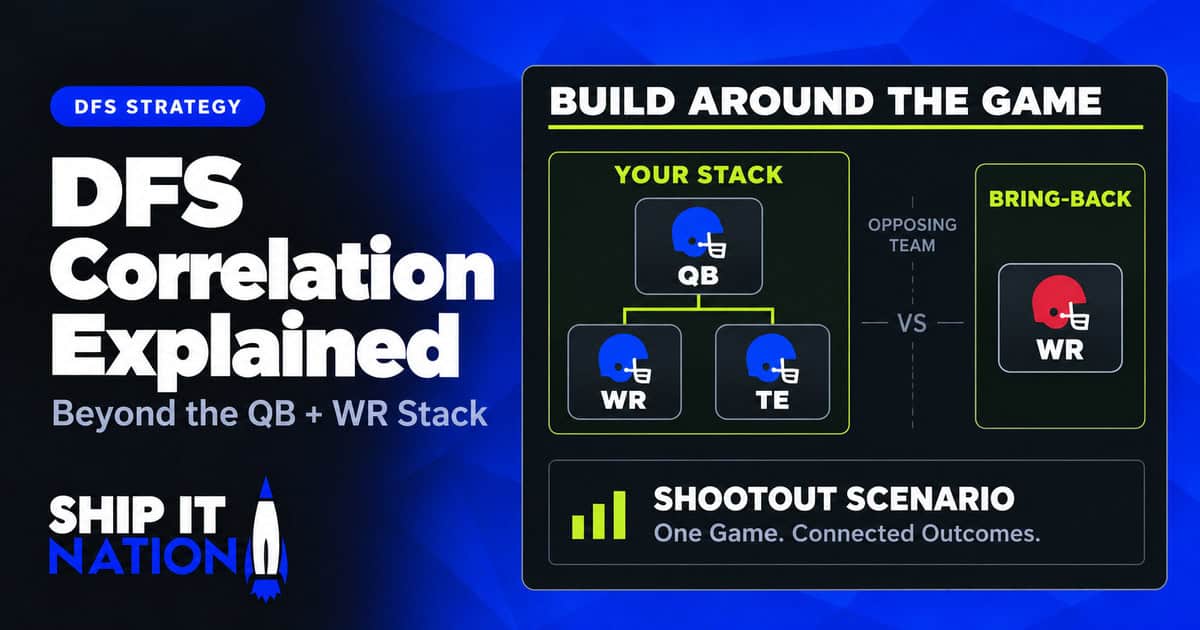
If you ask a newer DFS player what stacking means, most will describe pairing a quarterback with one of his wide receivers and call it a day. That’s a fine starting point, but it barely scratches the surface of what correlationCorrelationCorrelation describes how two players' fantasy scores move together. Positively correlated players tend to have big games at the same time, usually because one player's success directly adds points for the other.When you build a tournament lineup, ask which of your players need the same thing to happen. The more of them that do, the higher your lineup's ceiling.Full explanation ↗ actually offers once you understand how much further the concept can be pushed.
- Stacking captures multiple pieces of connected outcomes instead of relying on unrelated players to succeed independently.
- Bring backs can capture both offenses trading scores when the expected game script supports a shootout.
- Differentiate by changing the players within a logical stack rather than abandoning its correlated structure.
What Correlation Actually Means
Correlation is simply the idea that certain outcomes are connected to each other. If a quarterback throws for a big game, it’s likely that at least one of his pass catchers benefited from that production too. Stacking is just the practical application of building a lineup that captures multiple pieces of the same positive outcome instead of hoping several unrelated players all have good games independently.
Beyond the Basic QB Plus WR Stack
The classic quarterback and receiver pairing is popular because it’s simple and it works, but it’s far from the only correlated relationship worth considering. A running back can be correlated with game scriptGame ScriptGame script is how a game's score and time remaining influence its pace, play choices and player opportunities. In football, teams protecting a lead often run more, while teams chasing a deficit often pass more.Before locking a lineup, ask who keeps playing if your expected script reverses. Check passing-down roles and backup rotations instead of assuming a team's leading rusher handles every situation.Full explanation ↗ in a way that’s different from the passing game entirely. A defense can be correlated with a struggling opposing offense. A second pass catcher added to a quarterback stack can capture more of the overall passing volume rather than betting everything on one specific target.
Bring backsBring-BackA bring-back is a player from the opposing team added to a stack, so your lineup benefits if the other side answers with scoring of its own.Pick the bring-back who gains the most when his team falls behind. In football that's usually the opponent's top pass catcher, not a running back who loses carries in a comeback.Full explanation ↗, where you add a player from the opposing team to a stack, are another layer of correlation worth understanding. If you expect a shootout, pairing your quarterback stack with a piece from the other team’s offense captures the scenario where both sides are trading scores, rather than only benefiting if one team’s offense goes off in isolation.
Staying Correlated While Still Getting Different
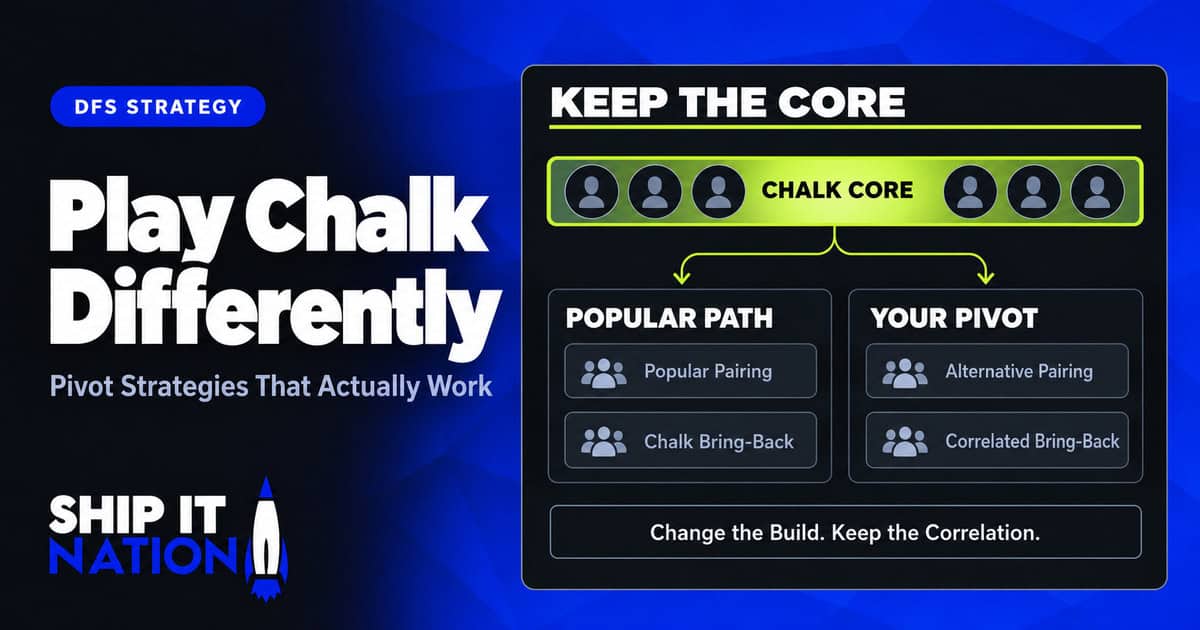
This is where a lot of the more advanced game theory concepts intersect with correlation. You don’t have to abandon a logical stacking structure just to be different from the fieldThe FieldThe field is everyone else entered in a contest, the group of lineups you are competing against.Before you build, picture the typical lineup in your contest. Then decide on purpose where you'll match it and where you'll step away from it.Full explanation ↗. If most of the field is building the obvious version of a stack, a sharper approach might be swapping in a different, still correlated piece rather than throwing out the correlation altogether.
For example, if the field is universally pairing a quarterback with his top receiver, a contrarianContrarianA contrarian play or lineup is one built around choices most of the field will not make, such as low-owned players, unpopular teams or an unusual salary structure.Pick one or two contrarian spots per lineup and ground each in a real reason. The rest of the roster can look like the field.Full explanation ↗ but still correlated build might use a different pass catcher from the same team, or bring in a different bring back piece from the opposing offense. You’re still capturing the same underlying game environment, just through a less crowded combination of players.
Why Correlation Matters More in Tournaments Than Cash Games
In large field GPPsGPP (Guaranteed Prize Pool)A GPP is a tournament whose prize pool is guaranteed to pay out in full even if the contest does not fill. Payouts are steep: a small group at the top wins most of the money.Before you enter a tournament lineup, ask how it finishes first, not just how it cashes. If you cannot name that scenario, rebuild it.Full explanation ↗, you’re not just trying to score a good total, you’re trying to reach a ceiling that separates you from thousands of other entries. A correlated lineup has a higher ceiling than an equivalent lineup built from unrelated, independent player outcomes, because when the correlated pieces hit together, your score compounds in a way an uncorrelated lineup simply can’t match.
In smaller field or cash game formats, correlation matters less, since the goal shifts toward consistency rather than chasing a maximum ceiling outcome.
Practical Ways to Apply This
Before finalizing a stack, ask whether you’re capturing the full picture of a favorable game environment or just one narrow slice of it. Consider whether a bring back piece makes sense given the expected game script. And when you’re looking to differentiate from the field, look for ways to stay logically correlated while shifting which specific players represent that correlation, rather than abandoning the structure altogether in the name of being different.
Correlation isn’t a single tactic, it’s a lens you can apply to almost every lineup decision you make, and understanding it beyond the basic quarterback and receiver pairing is one of the clearest ways to start building lineups with real tournament upside.
Full video courses on bankroll management, contest selection, roster construction and more, free for members.
Common Questions
What is correlation in DFS?
Correlation means certain outcomes are connected. Stacking applies that idea by building a lineup with multiple players who can benefit from the same positive outcome.
Does DFS stacking only mean pairing a quarterback with a wide receiver?
No. The article also describes adding another pass catcher, using an opposing offensive player in a shootout, and considering how running backs relate to game script.
Why does correlation matter more in DFS tournaments than cash games?
Large field tournaments require a ceiling outcome that separates your lineup from other entries, and correlated pieces can succeed together. Correlation matters less in smaller fields or cash games, where the goal shifts toward consistency.
Keep reading