CBB
How to Read a College Basketball DFS Slate: Size, Totals, and Game Environments
Published by Ship It Nation Staff · 4 min read
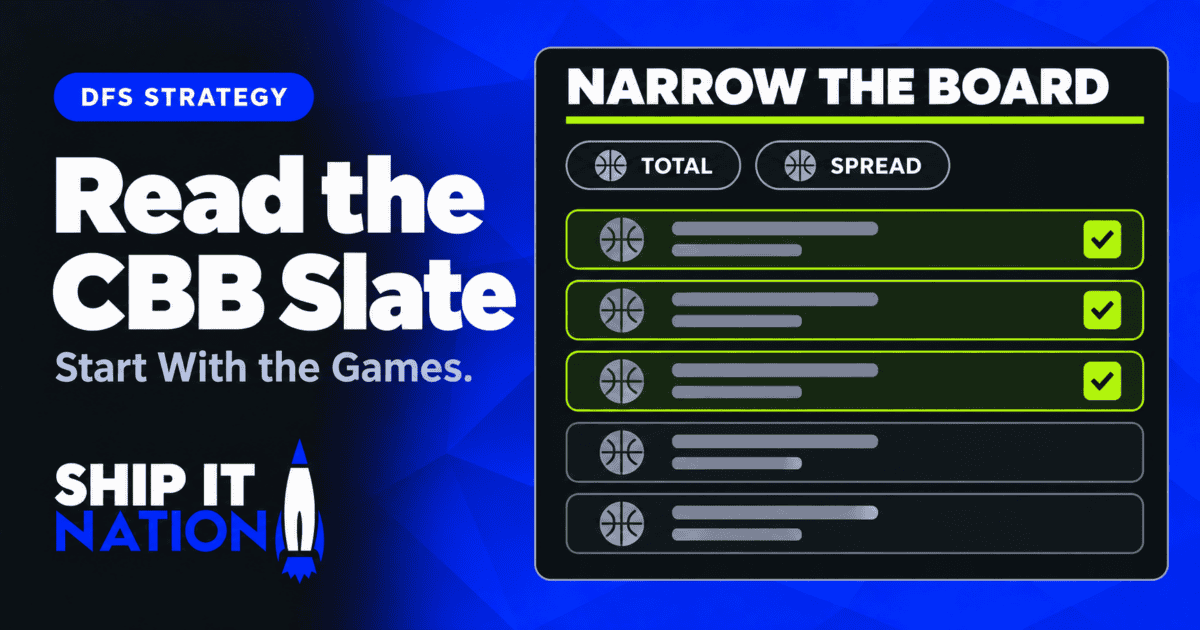
To build consistent college basketball DFS lineups, you must learn how to filter the game slate efficiently. Instead of researching hundreds of individual players, top players narrow the board by evaluating betting totals, point spreads, and slate contexts. Start with the games, not the players.
Key takeaways
- Count the games first. Small slates reward lineup construction, and large slates reward finding mispriced players.
- Rank games by total and spread. High totals and close spreads give you the best shot at fantasy points and starters who stay in.
- Stacking matters less than in football, so take two or three players from your favorite game and check news before lock.
How Does Slate Size Change Your Strategy?
The number of games on a given slate changes how the entire fantasy field builds lineups.
| Slate Size | Expected Field Behavior | Core Strategic Edge |
|---|---|---|
| Small Slates (A few games) | High lineup overlap and chalky builds | Focus on unique roster construction and ownership leverage |
| Medium Slates (Moderate game count) | Balanced mix of shared core plays and variant builds | Deep understanding of player roles and game selection |
| Large Slates (Dozens of games) | High lineup fragmentation and low player overlap | Uncovering mispriced values and tracking late breaking news |
On massive slates, do not waste energy analyzing every team. Filter out unfavorable game environments first so you can dedicate your research to the highest-yielding situations.
How Do You Narrow the Board With Betting Lines?
Vegas betting lines condense massive amounts of team data into two crucial numbers: the over/under game total and the point spread.
- Look for High Game Totals: A high point total signals an environment rich in possessions, points, and assists.
- Target Close Point Spreads: A narrow spread implies a competitive contest where coaches keep their starting players on the floorFloorIn daily fantasy sports (DFS), a player's floor is an estimate of the low end of their realistic fantasy scoring range. It describes downside, not a guaranteed minimum or their average projected score.Before trusting a floor estimate, check what could change the player's role today: a returning teammate, a minutes restriction, a lineup change or a different game script. for maximum minutes.
A high game total paired with a massive point spread introduces substantial blowout risk. The favored team may pull its star players early in the second half, capping their fantasy ceilings. Conversely, low-total games should generally be avoided unless a cheap backup inherits a massive role due to a teammate’s sudden injury.
How Do You Rank the Games on a Large Slate?
A simple process keeps a big slateSlate SizeSlate size is the number of games or matchups included in a DFS contest's schedule. In sports built around one event, it can instead describe the number of eligible competitors; it does not mean the number of contest entries.Before building, count the credible alternatives at each position. A slate with plenty of games can still leave you with very few appealing choices at one position. manageable:
- List every game with its total and spread.
- Sort by total and mark the games with a spread you trust to keep starters in.
- Pick your top three environments as your core games.
- Treat every other game as a place to hunt for a cheap valueValueValue is the fantasy production you expect from a player relative to his salary. A value play offers more production or upside than his price suggests, whether he is cheap or expensive.Identify why the salary looks wrong: workload, matchup, scoring ability or a pricing error. Then check whether that reason still holds when you submit your lineup., not as a place to build around.
Revisit the list close to lock. Lines move, and a shift in a total or spread can promote a game into your core or drop it out.
How Should You Stack Players From the Same Game?
StackingStackingStacking means rostering multiple players connected by the same team, game or expected conditions. You usually build a stack so one favorable outcome helps several lineup spots, although the connection works differently across sports.Before locking a stack, explain how its players benefit together. Then check their actual roles, combined salary and whether adding another player strengthens that connection or just fills a spot. involves playing multiple players from the exact same game to maximize correlated fantasy points. While vital in football DFS, stacking is secondary in college hoops. Basketball teammates actively compete for the same field goal attempts, rebounds, and usage.
A safe baseline strategy is to limit your selections to two or three players from a high-total shootout. Ideally, target key pieces from both sides of the ball to capture the full back-and-forth scoring environment. DraftKings classic slates require you to pick players from at least two different games to form a valid lineup.
How Do Cash Games and Tournaments Change Your Slate Plan?
In cash gamesCash GameA cash game is a contest that pays a large share of the field, usually close to half, the same flat prize. Fifty-fifties, double-ups and head-to-heads are the common cash games.Treat cash games as the steady base of your bankroll. Use one safe core across your cash entries on a slate, and save riskier ideas for tournaments., you only need to beat roughly half the field. Build around games you trust, with close spreads and starters who play heavy minutes, and avoid big risks.
In tournaments, you need to beat the field, not just finish above the middle. A game that most lineups ignore, such as a moderate total with one player in a clear role, can be a way to separate from the crowd. Take that risk only when you have a specific reason for it.
How Do Staggered Game Times Help You?
On DraftKings, each player locks at the start of his own team’s game, so games that start later stay open for edits. That gives you a chance to react to news from earlier games. If you are unsure about a late game, you can fill that roster spot last and adjust when lineups are confirmed.
What Should You Check Before Lock?
Set a repeatable routine to check for late news before the contests lock:
- Confirm that all selected players are officially locked into the starting lineup.
- Monitor late shifts in betting lines to see if game totals are rising or falling.
- Track injury updatesInjury NewsInjury news is information about a player's health that can change whether they compete, how much they play or how effectively they perform. In DFS, it also affects opportunities for teammates and opponents.Before an uncertain player's game locks, identify an alternative you can afford at each affected position. Check whether making that change would require another player whose game starts earlier. to exploit cheap backup values when starters are ruled out.
- Keep alternative options mapped out for late-afternoon games if your platform supports late-swap adjustments.
After the slate, write down which game environments played out and which did not. A few weeks of notes will show you which signals you can trust.
Full video courses on bankroll management, contest selection, roster construction and more, free for members.
Common Questions
How do you pick games on a college basketball DFS slate?
Rank the games by betting total and spread. A high total points to more possessions and scoring, and a close spread points to starters staying on the floor. Use those games as your core, then look for value elsewhere.
How many players should you take from one college basketball game?
Two or three from your favorite game is a reasonable default. Teammates compete for the same shots, so stacks matter less than in football.
Does slate size change college basketball DFS strategy?
Yes. Small slates produce similar lineups across the field, so construction and ownership matter. Large slates have many unfamiliar players, so role knowledge and news matter more.
Need a term explained? The Ship It Nation DFS glossary covers every DFS term we use in plain language.

About the author
Ship It Nation StaffShip It Nation was founded in 2023 by Tyler Tamboline and Mike Petta to give DFS players the tools, projections, content, and community they need to build a winning process. Today, we're a fully remote team of active DFS players, analysts, and builders.
More from Ship It Nation Staff →Keep reading