NFL
NFL DFS Cash Games: How to Build a Floor Lineup
Published by Tyler Tamboline · 6 min read
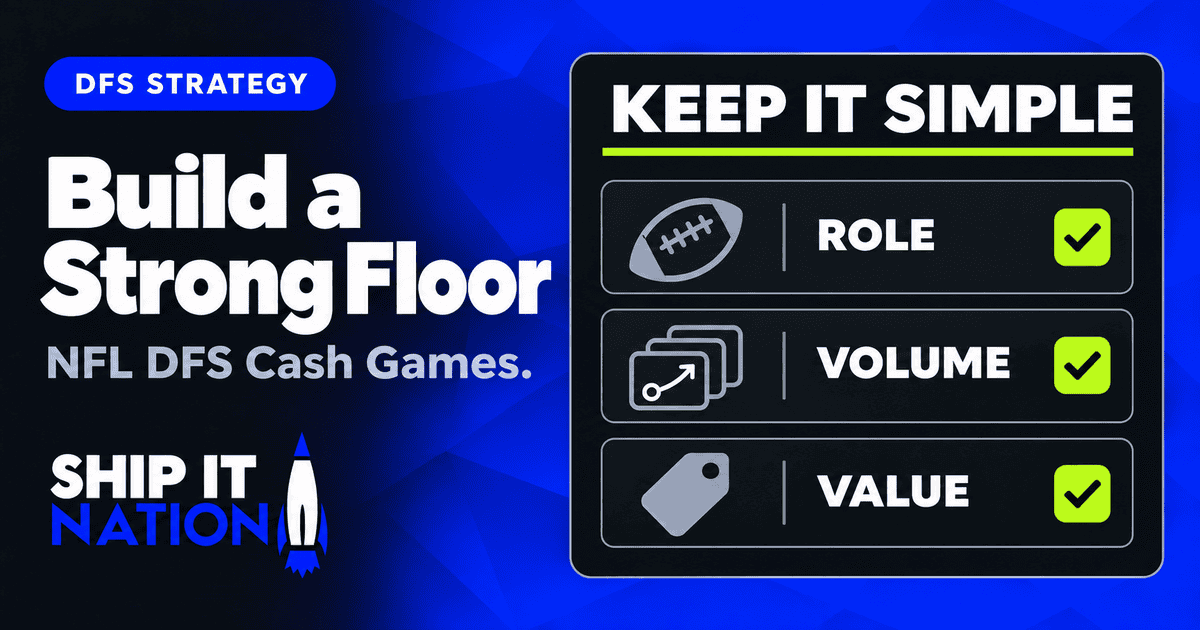
An NFL DFS cash gameCash GameA cash game is a contest that pays a large share of the field, usually close to half, the same flat prize. Fifty-fifties, double-ups and head-to-heads are the common cash games.Treat cash games as the steady base of your bankroll. Use one safe core across your cash entries on a slate, and save riskier ideas for tournaments. lineup must be constructed entirely around high-probability production: players with locked-in volume, consistent targets, and heavy red-zone utilization on elite offenses. Because your objective is simply to beat roughly half of the field, prioritizing a high mathematical floorFloorIn daily fantasy sports (DFS), a player's floor is an estimate of the low end of their realistic fantasy scoring range. It describes downside, not a guaranteed minimum or their average projected score.Before trusting a floor estimate, check what could change the player's role today: a returning teammate, a minutes restriction, a lineup change or a different game script. over an elusive, high-risk ceilingCeilingCeiling is the high end of a player's or lineup's realistic range of fantasy scores. It describes a big performance that could happen when things go well, not the expected score or an absolute maximum.Describe what must happen for each player to have a huge game. Then check whether those conditions help or hurt the other players in your lineup. is the fundamental key to long-term success.
Key takeaways
- Floor over Ceiling: A cash game lineup is explicitly engineered for a high mathematical floor, targeting stable, projectable touches on teams with elite implied point totals.
- Capitalize on Injuries: Premium points-per-dollar value is organically unlocked when injuries open up clear starting volume for highly discounted backups.
- Bankroll Discipline: While cash formats feature a smoother historical curve than volatile tournaments, strict entry sizing and a firm weekly budget remain mandatory to survive natural downswings.
The Objective of a Cash Game Lineup
Cash game formats such as Head-to-Heads, 50/50s, and Double-Ups, payout flat amounts to roughly the top 45-50% of the field. There are no extra rewards for finishing in 1st place versus finishing in 40th place. Therefore, your strategy shifts from maximizing pure volatility to eliminating risk. You do not need an explosive, low-probability performance; you simply need to build a stable roster that completely avoids a catastrophic zero-point floor.
How Do You Find the Best Value Plays?
Cash game success is built entirely on mathematical value efficiency. You must identify players who’s projected, expected point production is significantly high relative to their assigned salary cap price tag. The single most reliable source of premium cash game value comes from late-breaking injuries. When a high-priced, starting workhorse running back or a primary alpha wide receiver is ruled out, a cheap backup steps into a massive, immediate workload at a highly discounted price tag.
When hunting for value, analyze volume on a stable, multi-week basis rather than chasing individual, fluky box scores. A player who has consistently logged a 20% target share or 15+ touches for four consecutive weeks represents a highly stable, projectable cash asset. Conversely, a volatile deep-threat receiver coming off a single two-touchdown game on only three targets is a classic variance trap that should be completely avoided in floor-oriented builds.
Identifying Optimal Cash Plays by Position
Evaluate your roster on a strict volume-per-dollar basis across every individual slot:
- Running Backs: Focus heavily on workhorse backs who project for 15+ carries and possess clear pass-catching roles. Receptions provide vital point insulation that protects against poor rushing efficiency.
- Wide Receivers: Prioritize high-volume targets, particularly slot receivers or primary options with high target-shares. Consistent targets are the single most stable, projectable metric at the position.
- Quarterbacks: Target dual-threat quarterbacks who possess a defined rushing floor alongside a high team implied point total. Rushing yards significantly elevate a quarterback’s baseline score.
- Tight Ends: Secure a cheap, high-route-participation player to maximize salary savings, or lock in an elite high-volume star if no reliable value exists.
- Defenses: Pay down for a cheap home favorite playing against an error-prone quarterback or a backup offensive line to maximize sack and turnover opportunities.
Cash Lineup Positional Matrix
| Position | What to Prefer | What to Avoid |
|---|---|---|
| Running Back | High target volume, locked-in goal-line touches | Volatile committee backs with zero pass-catching roles |
| Wide Receiver | Consistently high target share and short-area routes | Volatile, deep-threat wideouts dependent on one long catch |
| Quarterback | Elite passing floor combined with rushing upside | Overpriced, immobile pocket passers in low-total games |
| Tight End | Locked-in route participation and steady targets | Bottom-tier options with zero projection for targets |
| Defense | Cheap home favorites facing high implied sack rates | Paying premium prices for highly volatile defensive units |
Strategic Constraints: Team Totals and Ownership
Always anchor your cash selections to high implied team totals. Teams expected to score a high volume of points naturally generate more red-zone trips, raising the touchdown probability for every player on that roster. Point spreads are equally vital: large home favorites feature safe, run-heavy second-half scripts for their starting running backs.
In cash games, completely ignore ownershipOwnershipOwnership is the percentage of lineups in a contest that include a given player. Projected ownership is an estimate made before lock; actual ownership is posted once the contest locks.Ownership isn't something to avoid; it's something to build around. The goal is understanding how the field is likely to build, then finding your edge relative to that. percentages. If a cheap, injury-thumped starting running back is projected to be 75% owned by the field, you should roster him without hesitation. Being different provides zero utility in cash formats as failing to play high-volume chalk that hits puts you at a severe, irreversible disadvantage against the rest of the field.
How Much Do Tools Matter?
In cash games, mathematical projections and advanced tracking tools are highly useful, but they serve a fundamentally different purpose than they do in large tournaments. Because cash game strategy is not driven by game theory, most optimal point-per-dollar values on a slate are mathematically obvious to the entire field. Use reliable projection systems primarily as an operational safety net to scan for unexpected role changes, double-check injury fills, and ensure you have not missed a glaring value play.
Projected ownership metrics matter significantly less in cash games than in tournaments. Your sole objective is to finish above the field median, meaning there is zero competitive advantage to building a contrarian roster. If an elite value back is projected to be 80% owned by the cash field, you should comfortably lock him into your lineup. Failing to play highly popular, locked-in chalk that performs well creates an irreversible mathematical deficit against the rest of the field.
What Should You Avoid?
- “Cute” Contrarian Plays: Completely avoid over-indexing on low-priced players who possess a poor role, a thin ceiling, or highly volatile depth-chart status. Taking unnecessary risks on unproven players in cash games exposes your roster to a devastatingly low zero-point floor.
- Over-Correlating a Roster: Avoid heavy game-stacking or stacking a quarterback with multiple receivers. While correlation is king in tournaments, it introduces too much multi-player downside if that specific game turns into a sluggish, low-scoring defensive battle.
- Blindly Copying Lineups into GPPs: Never copy a high-floor cash game lineup directly into a large tournament without major structural modifications. If you love the core of your cash lineup, you must execute at least two or three sharp pivots to lower-owned options to give your roster the explosive leverage needed to conquer an entire tournament field.
How Should You Manage Your Bankroll?
Because cash game distributions pay out to roughly half the field, they carry significantly less statistical volatility than top-heavy tournaments. Consequently, you can safely deploy a larger percentage of your weekly bankroll into cash formats. However, even the safest on-paper cash game builds can lose due to random occurrences like mid-game injuries or unexpected weather shifts.
Maintain strict bankroll discipline by sizing your entries carefully according to your total allocation. Establish a firm weekly entry budget and commit to staying inside it at all times. If you encounter a negative-variance week, never attempt to “chase losses” by arbitrarily raising your stakes on the next slate; instead, step back, trust your process, and let the mathematical edge smooth out over a larger sample size.
What Does a Good Cash Process Look Like?
An elite cash game routine is built entirely on patience, discipline, and execution. Start by carefully reviewing the NFL injury report to identify premium backup value opportunities. Next, anchor your core build around teams with high implied totals and locked-in player touches. Confirm the final inactive reports 90 minutes before kickoff, and keep your overall lineup shape simple and balanced. Judge the success of your cash game process over a rolling multi-week sample size rather than panicking over a single-slate result.
Review the NFL roster and scoring rules before building.
Full video courses on bankroll management, contest selection, roster construction and more, free for members.
Common Questions
What is the goal of an NFL DFS cash game lineup?
The core objective is to finish above roughly half of the total field to secure a flat payout. Because 1st place pays identical money to the median cash-line finisher, your strategy shifts entirely to building a high-floor roster that minimizes risk and completely avoids low-scoring dud performances. Always check the current rules on the site to verify exact contest payouts.
Which players make good NFL DFS cash plays?
The gold standard for cash games includes running backs with locked-in pass-catching volume, wide receivers commanding high target shares, dual-threat quarterbacks with a rushing baseline, and cheap tight ends with stable route participation. Always focus your core salary allocation on highly efficient offenses with high implied team totals.
Should you stack in NFL DFS cash games?
No. Stacking is not a priority in cash games because you do not need to maximize extreme correlation volatility to beat half the field. While pairing a quarterback with his primary wide receiver is completely fine if they naturally represent the best point-per-dollar values, you should focus your energy on securing the safest, highest-floor volume available at every individual positional slot.
Need a term explained? The Ship It Nation DFS glossary covers every DFS term we use in plain language.

About the author
Tyler TambolineTyler Tamboline co-founded Ship It Nation and is the face of the brand across our shows and community. He is also the Founder of DFS Mastermind, helping hundreds of DFS players find their own process. He has played DFS since 2012, focusing primarily on PGA and NFL, and has created DFS content full-time since 2018 at different sites across the industry. He is known for strategy, game theory and leverage in large-field tournaments. He has been a regular on many Fantasy Sports podcasts, including weekly PGA and NFL shows with Pat Mayo.
More from Tyler Tamboline →Keep reading