NFL
How to Use Game Totals and Weather in NFL DFS
Published by Tyler Tamboline · 5 min read
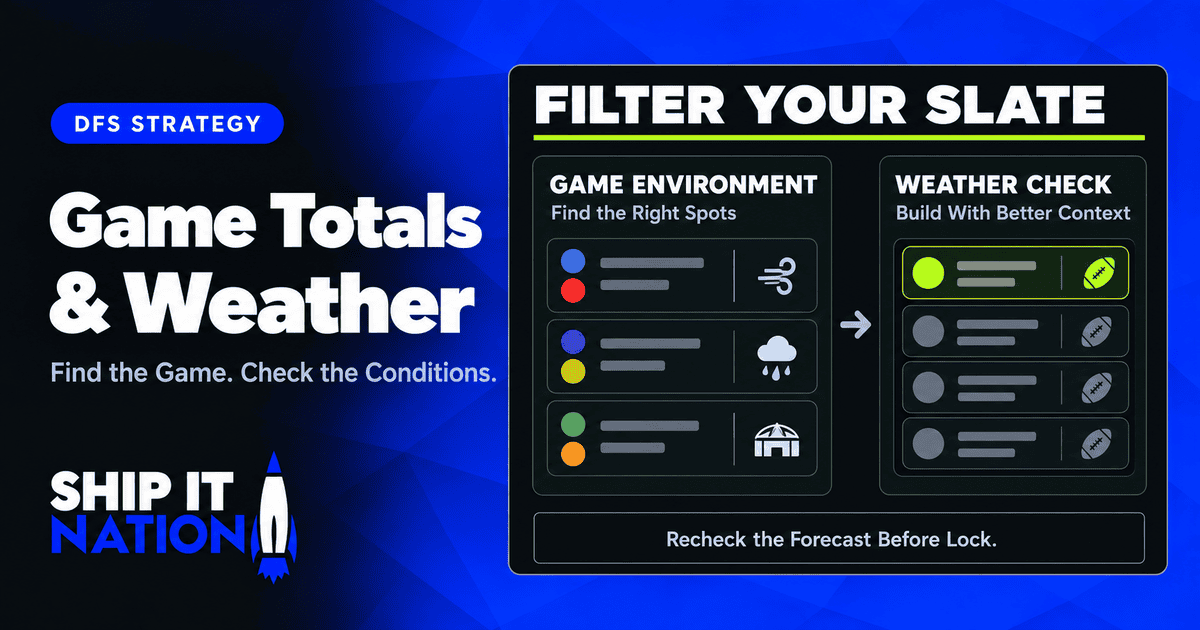
To use game totals and weather in NFL DFS, use totals first to find the games worth targeting, then use weather as a filter on which players you trust inside them. Wind is the most important factor, since it hurts deep passing and kickers. Check the forecast close to lock, and remember that totals often already reflect the weather.
Key takeaways
- Use game totals first to find the games worth targeting, then use weather as a filter on which players you trust inside them.
- Wind is the most important weather factor because it hurts deep passing and kickers, so check the forecast close to lock.
- Totals often already reflect the weather, so your edge comes from details such as which players still have good roles.
What Is a Game Total?
A game total is the combined number of points the betting market expects both teams to score. Alongside the point spread, it lets you estimate how many points each team should score. A team favored by a touchdown in a game with a total of 50 is expected to score noticeably more than its opponent.
You do not need to do the math by hand to benefit from it. Many DFS sites and tools show implied team totalsTeam TotalA team total is a betting-market estimate of how many points, runs or goals one team will score. In DFS, it usually means an implied team total calculated from betting odds, rather than a projection of fantasy points.Recheck team totals after major news, then ask which players actually benefit. If your projections already reflect the change, avoid adding another automatic boost., which split the game total between the two teams based on the spread. Those numbers are a quick way to see which offenses have the best scoring outlook.
Why Do Totals Matter for DFS?
More points means more chances for touchdowns, and touchdowns drive fantasy scoring. A game with a high total usually has more plays, more passing, and more scoring from both teams. A game with a low total tends to be slower and more run heavy.
That makes totals a useful starting filter. When you build a lineup, you are asking where the fantasy points will come from, and the highest totals are the first place to look.
How Do You Use Totals in Practice?
Start by ranking the games on your slateSlateA slate in DFS is the set of games, races, fights or tournament rounds covered by a contest. It determines which events your player selections can come from and which performances count toward your score.Before building, open the contest details and check the included events, scoring period and lock rules. Do not assume two sites offer identical slates just because both call them the main slate. by total. Then look at how each team’s implied total compares across the slate.
- Build your player pool starting with the highest total games.
- Look for teams with strong implied totals and an offense that fits the matchup.
- Pick a stack from the best environments, with a bring-back from the opponent.
- Use lower total games for contrarianContrarianA contrarian play or lineup is one built around choices most of the field will not make, such as low-owned players, unpopular teams or an unusual salary structure.Pick one or two contrarian spots per lineup and ground each in a real reason. The rest of the roster can look like the field. or valueValueValue is the fantasy production you expect from a player relative to his salary. A value play offers more production or upside than his price suggests, whether he is cheap or expensive.Identify why the salary looks wrong: workload, matchup, scoring ability or a pricing error. Then check whether that reason still holds when you submit your lineup. pieces.
Totals are not a guarantee. High total games often draw heavy ownershipOwnershipOwnership is the percentage of lineups in a contest that include a given player. Projected ownership is an estimate made before lock; actual ownership is posted once the contest locks.Ownership isn't something to avoid; it's something to build around. The goal is understanding how the field is likely to build, then finding your edge relative to that., since everyone sees the same numbers. A game with a slightly lower total can be a better tournament target if it carries much less ownership.
What Do Totals Miss?
A game total is an average expectation, not a prediction of what will happen. Plenty of games with low totals produce big fantasy days, and plenty with high totals disappoint. Totals also say nothing about who within an offense will score.
Use the total to pick the environment, then use matchup and role to pick the player. A high total with a quarterback who does not throw much downfield might favor a running back. Context matters.
How Does Weather Affect NFL DFS?
Weather matters most for the passing game and the kicking game. Wind, rain, snow, and extreme cold can all change how teams play.
Wind. Strong wind is the most important factor. It makes deep passes and field goals harder, and it can push teams toward the run. Wind speed above a moderate level is worth treating as a real downgrade for passing offenses and kickers.
Rain and snow. Wet conditions can make the ball harder to handle, which sometimes lowers passing efficiency and increases the importance of the run game.
Temperature. Cold alone is usually a smaller factor than wind or precipitation, and many teams play in cold weather every year without trouble.
Dome games. Indoor games remove weather entirely, which makes them a stable environment for passing offenses.
| Condition | Who it hurts | Who it helps | How to adjust |
|---|---|---|---|
| Strong sustained wind | Deep passing offenses and kickers | Running backs on the favored side | Shift toward the run game, treat kickers as riskier |
| Rain or snow | Passing efficiency, ball handling | Run game importance | Downgrade ceilings, keep roles in mind |
| Cold alone | Usually little | Not applicable | Do not overreact |
| Dome game | Nobody | Passing offenses | Stable environment, weigh the total first |
| Light breeze or small chance of rain | Nothing meaningful | Not applicable | Do not overreact, wait for clear signals |
Where Do You Find Weather Information?
Check a reliable forecast for the stadium city and look at the hourly forecast near kickoff. Many DFS tools and sites show weather summaries, but forecasts change, so check close to lock.
Do not overreact to a small chance of rain or a light breeze. Look for clear, strong signals, such as sustained high wind, before changing your approach.
How Should You Adjust Your Lineups?
If weather looks bad, shift your lineup toward the run game and away from deep passing. Running backs on the favored side gain value. Passing offenses lose some of their ceilingCeilingCeiling is the high end of a player's or lineup's realistic range of fantasy scores. It describes a big performance that could happen when things go well, not the expected score or an absolute maximum.Describe what must happen for each player to have a huge game. Then check whether those conditions help or hurt the other players in your lineup., and kickers in strong wind become riskier.
If a game has bad weather and a high total, ask whether the total already reflects the weather. Betting markets often adjust totals for wind and rain, so a lower total in a windy game may just be the market doing its job. Your edge comes from the details, such as which players still have good roles.
How Do Totals and Weather Work Together?
Use totals first, then check weather as a filter. A game with a high total and good conditions is the most attractive place to stack. A game with a high total but strong wind deserves a second look before you commit.
Weather can also create leverage. If the fieldThe FieldThe field is everyone else entered in a contest, the group of lineups you are competing against.Before you build, picture the typical lineup in your contest. Then decide on purpose where you'll match it and where you'll step away from it. avoids a game because of a mild weather concern, and you believe the concern is overblown, you may get a good player at lower ownership.
Make It a Routine
Each week, list your games by total, note the weather for each outdoor game, and write one sentence about the likely script. That takes a few minutes and gives you a clear starting point for your player pool. Over time, you will learn how much each factor matters for the type of contests you play.
Check the official injury report before deciding which roles to trust.
Full video courses on bankroll management, contest selection, roster construction and more, free for members.
Common Questions
How do you use game totals in NFL DFS?
Rank the games on your slate by total and by implied team total, then build your player pool starting with the highest total games. Pick a stack from the best environments with a bring-back from the opponent. Remember high total games often draw heavy ownership, so a slightly lower total with less ownership can be a better tournament target.
What weather matters most for NFL DFS?
Wind matters most, because strong wind makes deep passes and field goals harder and can push teams toward the run. Rain and snow can lower passing efficiency, cold alone is usually a smaller factor, and dome games remove weather entirely. Look for clear, sustained signals before changing your approach.
Do game totals already include weather?
Often yes. Betting markets frequently adjust totals for wind and rain, so a lower total in a windy game may just be the market doing its job. Do not count the weather twice. Look at which players still have strong roles and check the forecast close to lock.
Need a term explained? The Ship It Nation DFS glossary covers every DFS term we use in plain language.

About the author
Tyler TambolineTyler Tamboline co-founded Ship It Nation and is the face of the brand across our shows and community. He is also the Founder of DFS Mastermind, helping hundreds of DFS players find their own process. He has played DFS since 2012, focusing primarily on PGA and NFL, and has created DFS content full-time since 2018 at different sites across the industry. He is known for strategy, game theory and leverage in large-field tournaments. He has been a regular on many Fantasy Sports podcasts, including weekly PGA and NFL shows with Pat Mayo.
More from Tyler Tamboline →Keep reading