NFL
How to Handle Sunday Morning News and Inactives in NFL DFS
Published by Tyler Tamboline · 5 min read
To handle Sunday morning news and inactives in NFL DFS, check the inactive lists as soon as they are released, about ninety minutes before kickoff, then adjust your lineups based on the roles that actually open up. Make the smallest change that fixes the problem. Have a plan before the news arrives so you react calmly.
Key takeaways
- Check the inactive lists as soon as they are released, about ninety minutes before kickoff, and confirm the exact timing with the league.
- Make the smallest change that fixes the problem, and have a written plan for uncertain players before the news arrives.
- When a key player is out, look at who steps into the role, what the price is, and how the rest of the offense is affected.
What Are Inactives?
Inactives are the players a team has decided will not play in that game. Teams submit these lists about ninety minutes before kickoff. Check the league’s official source for the exact timing, since it can vary.
The list tells you who is definitely out, which is more reliable than injury reportsInjury NewsInjury news is information about a player's health that can change whether they compete, how much they play or how effectively they perform. In DFS, it also affects opportunities for teammates and opponents.Before an uncertain player's game locks, identify an alternative you can afford at each affected position. Check whether making that change would require another player whose game starts earlier. during the week. A player listed as questionable might play or might not. The inactive list ends the guessing.
Why Does Morning News Matter So Much?
One player out can change a whole offense. If a starting running back is inactive, his backup gains touches. If a top wide receiver is out, the remaining receivers see more targets. These changes shift projectionsProjectionsDFS projections estimate a player's fantasy points for an upcoming slate using expected opportunities, performance and the contest's scoring rules. They describe an expected result, not a guaranteed score.Check the projection's update time and assumed role before using it. If news is already included, adjusting again for that same news can double-count its effect. and ownership.
The players who benefit often become popular quickly, which means you want to react fast but with some thought. ValueValueValue is the fantasy production you expect from a player relative to his salary. A value play offers more production or upside than his price suggests, whether he is cheap or expensive.Identify why the salary looks wrong: workload, matchup, scoring ability or a pricing error. Then check whether that reason still holds when you submit your lineup. created by news tends to disappear from the market as prices and ownership catch up.
What Should You Do Before Sunday?
Preparation is what makes a calm morning possible.
- Build your lineups early in the week, then update them as news arrives.
- Identify the players with uncertain status and write down what you will do in each case.
- Learn which backups would take over each role.
- Decide your backup plans for each key position.
This turns a stressful morning into a checklist. If a player is ruled out, you already know who you would use.
How Do You Read an Injury Designation?
Teams and the league use labels such as questionable, doubtful, and out. The exact wording and meaning can vary, so check the current definitions from the league. In general, a doubtful player is unlikely to play, and a questionable player is uncertain.
Beyond labels, look at practice participation and any comments from the team. A player who practiced fully is more likely to play than one who did not practice at all. Beat reporters and team sources often add helpful context.
Where Do You Find the News?
Use a few trusted sources rather than many. Official team and league accounts, established reporters, and your DFS tool’s news feed are good places to start. Be careful about unverified rumors, which spread fast on Sunday mornings.
Set a time to check, such as about ninety minutes before the early games, and then check again closer to lock. You do not need to refresh constantly. Overchecking leads to panic decisions.
How Do You Adjust Your Lineups?
When a key player is ruled out, look at three things.
Who steps into the role? The direct backup is the obvious choice, but also look at who gets extra targets or touches beyond him.
What is the price? If the backup is cheap and the role is real, he may be a good value. If his price has already jumped, the value may be gone.
How does it affect the rest of the offense? Losing a receiver can help a running back, and losing a running back can help the passing game.
Then adjust your lineup. If you had the player who was ruled out, replace him with a player who fits your plan. If you were already on the backup, you may want to leave your lineup alone.
| News scenario | First question | Likely action | Watch out for |
|---|---|---|---|
| Your player is ruled out | Who fits my plan as a replacement? | Swap one player, leave the rest | Rebuilding the whole lineup |
| Backup running back steps in | Is the price already up and is the role real? | Use if cheap and role is clear | Ownership spike on the obvious backup |
| Top receiver is out | Who gets the extra targets? | Look beyond the direct backup | Ignoring effects on the running back |
| You already own the beneficiary | Does the news change my plan? | Leave the lineup alone | Fixing what is not broken |
What About Late Swap?
If your site allows late swap, you can use it for players in later games. News about early games can inform the rest of your lineup, and the inactive lists for later games come out after the early ones. Check the current rules for your contest.
Plan which players you might swap and why. That way, if an inactive list changes a game environment, you can act quickly.
How Do You Avoid Overreacting?
The biggest mistake is changing too much. One piece of news rarely justifies rebuilding your lineup. Make the smallest change that fixes the problem, and leave the rest alone.
Another mistake is following the crowd. If everyone moves to the same cheap backup, ownership spikesOwnershipOwnership is the percentage of lineups in a contest that include a given player. Projected ownership is an estimate made before lock; actual ownership is posted once the contest locks.Ownership isn't something to avoid; it's something to build around. The goal is understanding how the field is likely to build, then finding your edge relative to that.. In a large tournament, you may prefer a different way to use the news, such as a secondary beneficiary in the same offense.
Finally, avoid making decisions in a rush. If you have a plan, you can take a minute to think. If you do not, you will make worse choices than usual.
Build a Morning Checklist
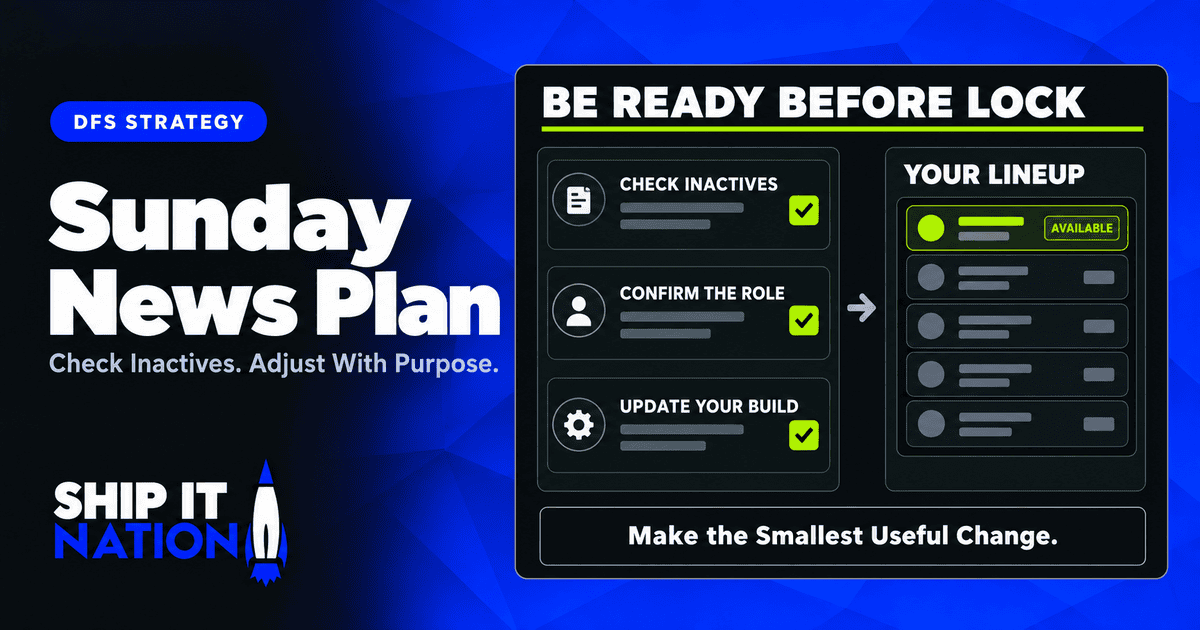
On Sunday, check inactives, review your uncertain players, update your player pool, adjust your lineups, and confirm your late swap options. Keep the list short and follow it in the same order every week.
Over time, you will get faster and calmer. You will also learn which news matters and which is just noise, and that skill separates steady players from frantic ones.
Build your player pool before choosing your final lineup.
Use the same checklist for Thursday and Monday night slates.
Check the hourly forecast before making late swap decisions.
Full video courses on bankroll management, contest selection, roster construction and more, free for members.
Common Questions
When are NFL inactives released?
Teams submit inactive lists about ninety minutes before kickoff, though the exact timing can vary, so check the league’s official source. Unlike a questionable tag on the injury report, the inactive list tells you who is definitely out and ends the guessing.
How should you adjust NFL DFS lineups after a key player is ruled out?
Look at three things: who steps into the role, whether the price still offers value, and how the loss affects the rest of the offense. Then make the smallest change that fixes the problem. If you were already on the backup, you may want to leave your lineup alone.
What is the biggest mistake with Sunday morning DFS news?
Changing too much. One piece of news rarely justifies rebuilding your lineup, and following the crowd to the same cheap backup spikes ownership. Make the smallest fix, consider a secondary beneficiary in large tournaments, and avoid rushed decisions by having a plan before the news arrives.
Need a term explained? The Ship It Nation DFS glossary covers every DFS term we use in plain language.

About the author
Tyler TambolineTyler Tamboline co-founded Ship It Nation and is the face of the brand across our shows and community. He is also the Founder of DFS Mastermind, helping hundreds of DFS players find their own process. He has played DFS since 2012, focusing primarily on PGA and NFL, and has created DFS content full-time since 2018 at different sites across the industry. He is known for strategy, game theory and leverage in large-field tournaments. He has been a regular on many Fantasy Sports podcasts, including weekly PGA and NFL shows with Pat Mayo.
More from Tyler Tamboline →Keep reading