NFL
NFL DFS Basics: Roster Rules, Scoring, and How DraftKings and FanDuel Differ
Published by Tyler Tamboline · 4 min read
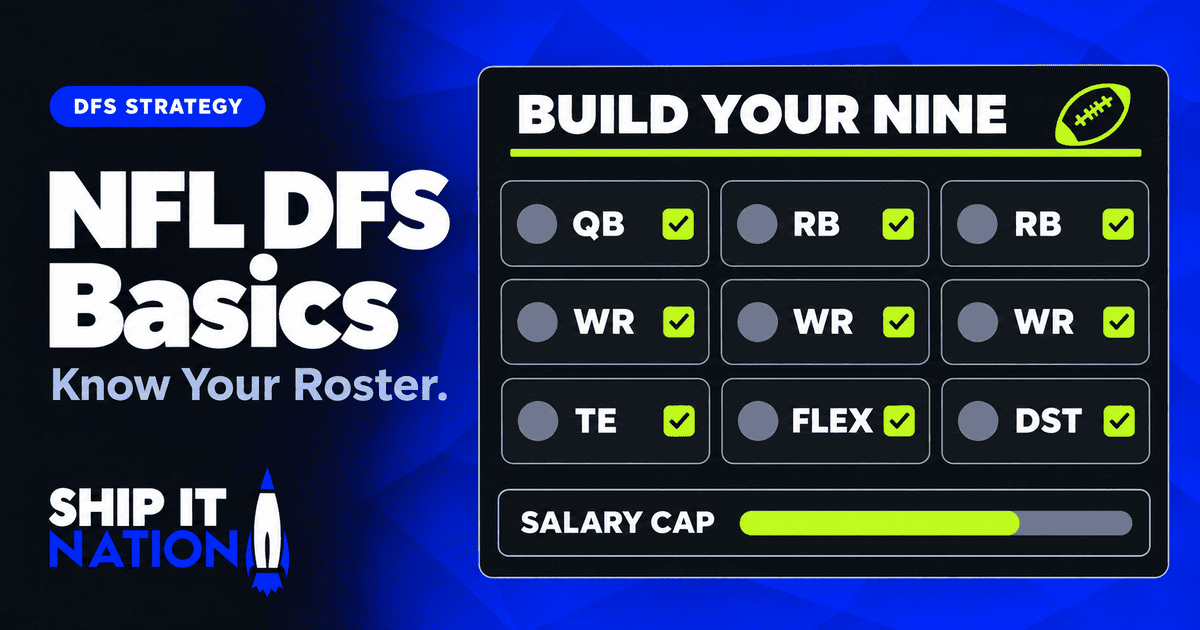
NFL DFS requires you to fill nine roster spots under a salary cap, earning points for yards, touchdowns, receptions, and defensive plays. While DraftKings and FanDuel use highly similar rosters, they score receptions and fumbles differently, which fundamentally changes player values. Always check the live rules on each platform before building your lineups.
Key takeaways
- The Roster Blueprint: A classic NFL DFS lineup consists of nine distinct slots (QB, 2 RB, 3 WR, TE, FLEX, and DST) bound to a rigid salary cap that forces every pricing compromise.
- Scoring Adjustments: DraftKings and FanDuel utilize fundamentally different calculations for receptions, yardage milestones, and fumbles. A player's fantasy viability is deeply dependent on the platform you are playing.
- Verify in the Lobby: Scoring criteria, roster structures, and late-swap configurations can change over time. Always double-check live rules in the platform lobby before submitting entries.
How Does an NFL DFS Roster Work?
A classic NFL lineup requires nine players: one quarterback (QB), two running backs (RB), three wide receivers (WR), one tight end (TE), one FLEX, and one Defense/Special Teams (DST)Defense/Special Teams (DST)Defense/Special Teams (DST) is a roster selection representing one NFL team's combined defense and special teams, rather than an individual player. It earns fantasy points through sacks, takeaways, defensive and return touchdowns, and other plays, with adjustments for points allowed.Compare what a DST upgrade costs elsewhere in your lineup. If paying more forces you off an important offensive role, check whether a cheaper defense offers a credible path through sacks and turnovers.. The FLEX spotFlex and UTILFlex and UTIL (utility) are roster slots that accept players from multiple eligible positions. Eligibility depends on the sport and contest; in single-game formats, these labels commonly identify the regular-scoring slots alongside a Captain or MVP.Before lock, identify affordable replacements for your latest starter. An open FLEX or UTIL slot helps only if suitable unlocked players remain within your budget. can be filled by a running back, wide receiver, or tight end, giving you the strategic flexibility to decide where to spend your remaining budget.
Every player is assigned a specific salary, and your completed lineup must fit under a strict salary cap. This cap drives every decision. You cannot simply roster the best player at every single position, forcing you to strategically decide where to pay up for premium stars and where to save with valueValueValue is the fantasy production you expect from a player relative to his salary. A value play offers more production or upside than his price suggests, whether he is cheap or expensive.Identify why the salary looks wrong: workload, matchup, scoring ability or a pricing error. Then check whether that reason still holds when you submit your lineup. options. Historically, DraftKings utilizes a $50,000 salary cap, whereas FanDuel operates with a $60,000 salary cap.
How Does Scoring Work on DraftKings?
DraftKings utilizes a full Point Per Reception (PPR) scoring system and rewards players for hitting specific yardage milestones:
- Passing Touchdown: +4 Points
- Passing Yards: +0.04 Points per yard (with a +3 Point bonus for reaching 300+ yards)
- Interception Thrown: -1 Point
- Rushing & Receiving Yards: +0.1 Points per yard (with a +3 Point bonus for reaching 100+ yards)
- Rushing & Receiving Touchdown: +6 Points
- Reception: +1.0 Point (Full PPR)
- Fumble Lost: -1 Point
Defenses earn points for sacks, interceptions, fumble recoveries, safeties, blocked kicks, and return touchdowns. They also earn or lose points based on total points allowed, ranging from a maximum of +10 points for a shutout down to -4 points if they allow 35 or more points in a game.
How Does FanDuel Scoring Differ?
The most critical divergence between the platforms is how they score receptions and turnovers:
- Half-PPR Structure: FanDuel awards 0.5 points per reception, exactly half of what DraftKings scores.
- Turnover Penalties: FanDuel heavily punishes mistakes, docking -2 points for a lost fumble compared to DraftKings’ -1 penalty.
- No Yardage Milestones: FanDuel does not award +3 point bonuses for 300-yard passing or 100-yard rushing/receiving games.
- Kicker Integration: FanDuel classic slatesClassic ContestsClassic contests are the standard salary-cap DFS format: you select a full lineup from a designated set of games or events within a fixed budget. Roster requirements and scoring depend on the sport and site.Check the included games before building. A Classic contest can cover a small afternoon slate rather than the full day, changing your available players and lineup options. historically include a dedicated kicker position, scoring 3 points for field goals under 40 yards, 4 points for 40–49 yards, and 5 points for kicks of 50+ yards.
Why Do Receptions Change Your Player Pool?
Because a reception is worth a full point on DraftKings and only half a point on FanDuel, high-volume pass-catchers see a massive value boost on DraftKings.
Same Stat Line, Two Scoring Systems
| Stat Line Example | DraftKings Points | FanDuel Points |
|---|---|---|
| Wide Receiver: 6 catches, 80 yards, 1 touchdown | 20.0 | 17.0 |
| Running Back: 18 carries for 90 yards, 4 catches for 30 yards | 16.0 | 14.0 |
| Quarterback: 275 yards, 2 TDs, 1 INT, 20 rushing yards | 20.0 | 20.0 |
The quarterback scores identically across both sites because passing and rushing metrics map cleanly. However, the high-volume receiver and the pass-catching running back drop significantly in value on FanDuel due to the half-PPR format. A slot receiver who is an absolute bargain on DraftKings can become a trap on FanDuel, where heavy-volume, touchdown-dependent goal-line backs hold their value much better.
What Is the Same on Both Sites?
The foundational logic of football analytics remains identical across platforms. Touchdowns dictate the highest weekly ceilings, yardage accumulation provides a steady baseline, and opportunity drives everything. Players who dominate their team’s target shares, expected carries, and high-value red-zone touches are the lifeblood of your player pool. Furthermore, the overall game environment is universally critical; game scripts with high over/under totals naturally afford every player on the field more opportunities to score.
DFS ownershipOwnershipOwnership is the percentage of lineups in a contest that include a given player. Projected ownership is an estimate made before lock; actual ownership is posted once the contest locks.Ownership isn't something to avoid; it's something to build around. The goal is understanding how the field is likely to build, then finding your edge relative to that. percentages also behave similarly on both platforms. Superb on-paper values naturally become highly popular across the industry. In a large tournament, you must constantly play game theory in deciding when to embrace the popular “chalk” plays and when to pivot to lower-owned alternatives to differentiate your lineup.
How Should a Beginner Start?
If you are new to football DFS, pick one platform and master its specific roster and scoring matrix first. Play small contests to get a feel for how a fixed salary cap forces critical value trade-offs. Establish a consistent weekly baseline routine: analyze injury reports, target games with high implied totals, and map out exactly where you want to deploy your premium salary.
Once you are comfortable, introduce the second platform, but crucially, do not copy your exact lineups from one site to the other. Because of the massive chasm between DraftKings’ full-PPR scoring and FanDuel’s half-PPR format, along with vastly different historical pricing algorithms, a player who represents a phenomenal value on one platform can easily be an absolute salary trap on the other.
What Should You Check Before Every Slate?
Before the slate locks, execute a strict pre-flight checklist. Confirm the roster rules, the scoring, and the slate you are entering to ensure you haven’t accidentally entered a specialty format with a custom roster build. Verify weather impacts like severe high winds, and monitor the official active/inactive reports released 90 minutes before kickoff. Building disciplined habits around late-breaking news is infinitely more valuable than any individual player evaluation you make during the week.
Full video courses on bankroll management, contest selection, roster construction and more, free for members.
Common Questions
How many players are on an NFL DFS roster?
A standard classic slate lineup requires nine players: one quarterback, two running backs, three wide receivers, one tight end, one FLEX position (RB/WR/TE), and a Defense/Special Teams unit. Always review the contest lobby before drafting, as short-slate showdown formats use entirely different configurations.
How is NFL DFS scoring different on DraftKings and FanDuel?
The most critical difference is the reception value: DraftKings awards a full 1.0 point per reception (Full PPR) plus a 3-point bonuses for yardage milestones, while FanDuel awards 0.5 points per reception (Half PPR) with no milestone bonuses. Turnover penalties also differ, as a lost fumble costs -1 point on DraftKings but a more severe -2 points on FanDuel.
Should beginners play NFL DFS on one site first?
Yes. It is highly recommended to learn the nuances of a single scoring system and salary structure before expanding. When you do branch out to a second site, always build your lineups completely from scratch to account for the mathematical differences in how receptions and turnovers are valued.
Need a term explained? The Ship It Nation DFS glossary covers every DFS term we use in plain language.

About the author
Tyler TambolineTyler Tamboline co-founded Ship It Nation and is the face of the brand across our shows and community. He is also the Founder of DFS Mastermind, helping hundreds of DFS players find their own process. He has played DFS since 2012, focusing primarily on PGA and NFL, and has created DFS content full-time since 2018 at different sites across the industry. He is known for strategy, game theory and leverage in large-field tournaments. He has been a regular on many Fantasy Sports podcasts, including weekly PGA and NFL shows with Pat Mayo.
More from Tyler Tamboline →Keep reading