Contest Selection
GPP Payout Structures Explained: Top Heavy vs. Flat, and Which Fits Your Bankroll
Last updated October 7, 2026 by Tyler Tamboline · 3 min read
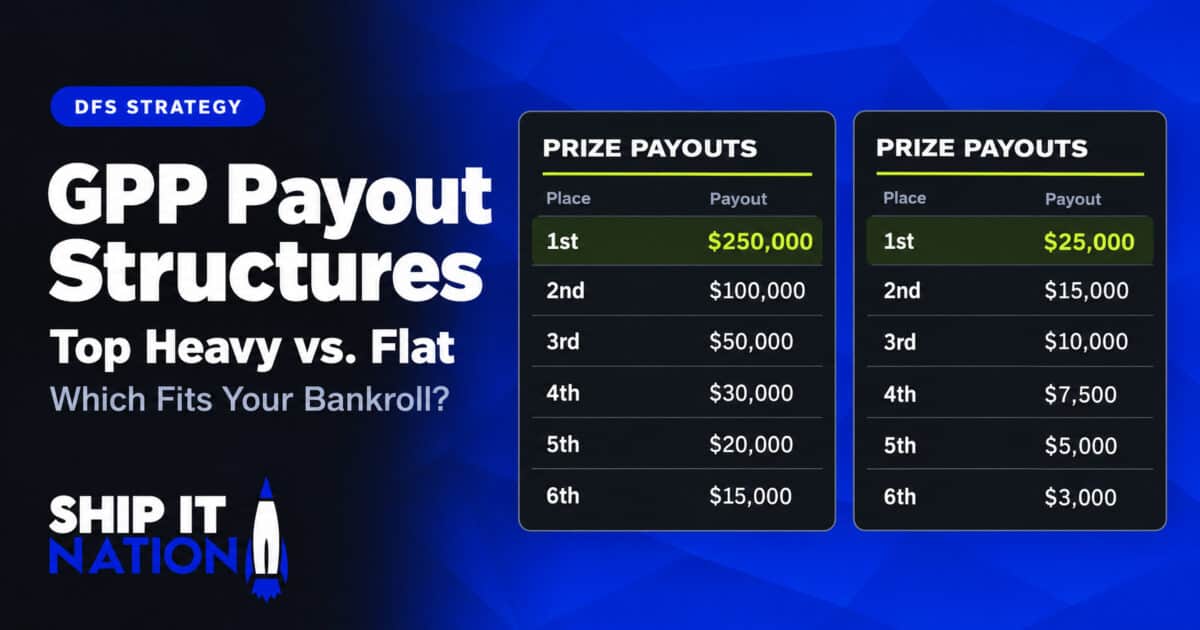
Two players can enter the exact same GPPGPP (Guaranteed Prize Pool)A GPP is a tournament whose prize pool is guaranteed to pay out in full even if the contest does not fill. Payouts are steep: a small group at the top wins most of the money.Before you enter a tournament lineup, ask how it finishes first, not just how it cashes. If you cannot name that scenario, rebuild it.Full explanation ↗ field with the exact same lineup and still be playing two completely different games, just because of how the prize pool is structured. If you’ve never actually studied a payout table before clicking enter, you’re missing a piece of the puzzle that changes how you should be building.
- Flatter payouts support safer builds, while top heavy contests call for differentiation and ceiling.
- Favor flatter structures while building your bankroll, then mix in top heavy contests as your cushion grows.
- Check the payout table before entering and let it guide your lineup construction.
What a Flat Payout Structure Looks Like
A flat structure spreads the money out. Instead of the entire prize pool getting swallowed by first place, you’ll see something closer to 20 to 25 percent of the fieldThe FieldThe field is everyone else entered in a contest, the group of lineups you are competing against.Before you build, picture the typical lineup in your contest. Then decide on purpose where you'll match it and where you'll step away from it.Full explanation ↗ getting paid, with a min cashMin-CashA min-cash is the smallest prize in a contest, earned by finishing just inside the paid places. In tournaments it is usually a small multiple of the entry fee.Do not judge a tournament slate by how many lineups min-cashed. Track your top finishes, since that is where tournament profit actually comes from.Full explanation ↗ sitting around two times your buy-in and a more gradual climb toward the top prize.
These structures reward consistency. You don’t need a miracle lineup to see a return. A solid, well built roster that avoids disaster picks has a real shot at cashing even without a top three finish.
What a Top Heavy Structure Looks Like
A top heavy structureTop-Heavy PayoutsA top-heavy payout structure gives a large share of a contest's prize pool to the top few finishers, leaving smaller prizes for everyone else who cashes.Read the payout table, not just the prize pool. The share of prizes that goes to first place should decide how much risk your lineup takes.Full explanation ↗ is a lottery. Most of the prize pool sits at the very top, first place alone might account for a huge chunk of the total pool, and your min cash is often just barely above your entry fee.
Think about something like a Milly Maker. There’s a reason people call the seven figure prize the headline and not the reality for most entrants. These contests are worth playing, but only if you understand what you’re actually signing up for.
Why Structure Should Change How You Build
This is where a lot of players leave value on the table. They build the same style of lineup regardless of which contest they’re entering.
In a flat structure, you can afford to build safer. You don’t need extreme leverageLeverageLeverage is the edge you gain by rostering a play the field is underweight on, compared with how often it ends up in winning lineups. When that play outscores the popular option most lineups chose instead, you gain ground on those lineups, though the rest of your roster still decides where you finish.Look for leverage on players connected to the chalk, like the other side of a popular game or a teammate who can steal the popular player's touches.Full explanation ↗ to get paid, so a tighter, more consensus based build with a couple of smart pivots is often enough.
In a top heavy structure, safe is the enemy. You need real differentiation, real ceiling, and a willingness to be wrong in a way that still gives you a shot at being right in a huge way. Chasing a min cash in a Milly Maker with a chalkyChalkChalk is the most popular, highly owned play on a slate. The term comes from sports betting, where the favorite is called the chalk.Don't label chalk good or bad. Ask whether each popular play deserves its ownership, then decide which chalk you'll eat and which you'll fade.Full explanation ↗, low ceiling build defeats the purpose of entering in the first place.
Matching Structure to Your Bankroll Stage
If you’re still building your bankroll, lean toward flatter structures more often. The steadier cash flow keeps you in the game and gives you more reps to sharpen your process without needing a home run every week.
Once you’ve got a bigger cushion, top heavy contests become more reasonable to mix in. You can afford the extended cold stretches that come with chasing a life changing score, because a bad month in a top heavy lottery won’t wipe you out.
Reframe How You Think About Second Place
One mental shift that changes everything: stop thinking of anything other than first place as a loss.
If a top heavy contest pays a million to first and a hundred thousand to second, that gap looks brutal on paper. But flip the framing. Think of the million at the top as the bonus, not the plan. Coming in second for a hundred thousand dollars should feel like winning six figures, not like losing nine hundred thousand.
That mindset keeps you level headed after near misses, and it keeps you from making reckless decisions chasing a number that was always a long shot to begin with.
Building Structure Awareness Into Your Process
Before you enter any GPP, get in the habit of actually looking at the payout table. Ask yourself what percentage of the field cashes, where the min cash sits relative to your buy-in, and how quickly the payouts ramp toward the top.
That thirty seconds of research should directly influence how you build. Inside DFS Mastermind, this is one of the first things we cover when working through contest selection, because payout structure and lineup construction are never really separate decisions. They’re the same decision looked at from two angles.
Full video courses on bankroll management, contest selection, roster construction and more, free for members.
Common Questions
What is the difference between flat and top heavy GPP payouts?
Flat structures spread the money more evenly and offer a more gradual climb toward the top prize. Top heavy structures concentrate most of the prize pool at the top, with a min cash often barely above the entry fee.
How should GPP payout structures affect lineup construction?
Flatter structures allow safer, more consensus based builds with a few smart pivots. Top heavy structures call for more differentiation and ceiling rather than chasing a min cash.
Which GPP payout structure fits a smaller bankroll?
The article recommends leaning toward flatter structures while building your bankroll. Top heavy contests become more reasonable to mix in once you have enough cushion to handle extended cold stretches.
Keep reading