Contest Selection
Is DFS Dying? What the Data Actually Shows
Published by Tyler Tamboline · 4 min read
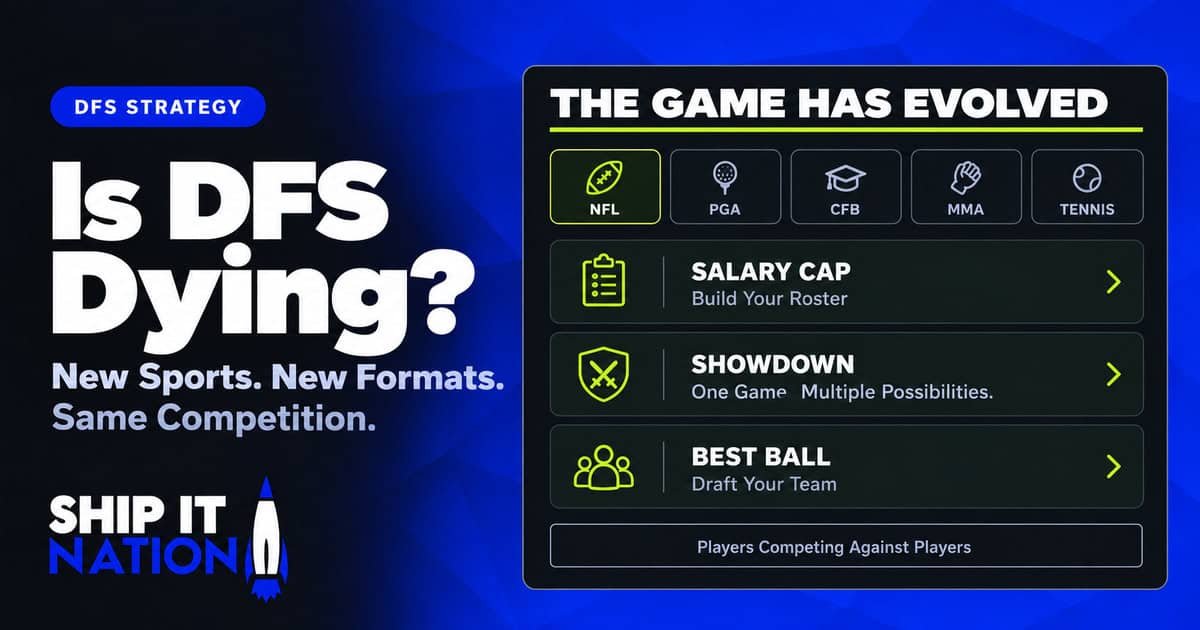
If you’ve spent any real time around daily fantasy sports content, you’ve probably seen some version of this claim floating around for years. DFS is dying, DFS is dead, nobody plays anymore. It’s been a recurring talking point since well before most of today’s active players even started playing, and it’s worth taking a clear eyed look at whether there’s actually anything behind it.
Key takeaways
- The article argues DFS is evolving through new sports, contest formats, and platforms.
- Peer to peer competition and lineup building remain central reasons players find DFS appealing.
- As tools become widely available, applying information matters more than simply having access to it.
The Claim Has Been Around Longer Than You Might Think
This isn’t a new narrative. Versions of this exact argument have circulated for years, often tied to specific moments like a slow stretch in a particular sport, a shift in sports betting regulation, or a wave of layoffs at a DFS media company. And yet, contest fields keep filling, marquee tournaments keep running, and new players keep entering the ecosystem every season.
Where Growth Is Actually Happening
Rather than shrinking, DFS has continued expanding into areas that didn’t have the same footprint a decade ago. Golf has grown into a legitimate, well supported DFS sport with a dedicated and increasingly sophisticated player base. College football has become a meaningful part of the DFS calendar for major operators. Niche sports like tennis and mixed martial arts have carved out real, if smaller, audiences that didn’t have much DFS presence in the earlier years of the industry.
Showdown formats deserve specific credit here too. By turning a single game into its own standalone slateSlateA slate in DFS is the set of games, races, fights or tournament rounds covered by a contest. It determines which events your player selections can come from and which performances count toward your score.Before building, open the contest details and check the included events, scoring period and lock rules. Do not assume two sites offer identical slates just because both call them the main slate., showdown contests effectively multiplied the number of playable opportunities each week without requiring an entirely new sport to be added to the calendar.
New Platforms Are Expanding the Definition of DFS
Beyond the traditional operators, newer platforms have introduced alternative formats like best ball and head to head style games that apply the same core DFS skills, projectionsProjectionsDFS projections estimate a player's fantasy points for an upcoming slate using expected opportunities, performance and the contest's scoring rules. They describe an expected result, not a guaranteed score.Check the projection's update time and assumed role before using it. If news is already included, adjusting again for that same news can double-count its effect., leverage, and roster constructionRoster ConstructionRoster construction is how you organize a DFS lineup within its salary cap and roster rules. It includes where you spend or save, which positions you prioritize, and how your players fit together.Build two versions around your biggest spending decision, then compare every player who changes. Revisit the comparison when injury news changes the available value., to new competitive structures. These formats have brought in players who might never have tried a traditional single day salary cap contest, while still relying on fundamentally the same skill set that’s always defined DFS.
DFS Versus the Growth of Sports Betting
It’s true that sports betting has expanded rapidly and captured a meaningful amount of attention and spending that might have otherwise gone toward DFS. But the two aren’t really direct substitutes for each other in the way some early predictions assumed they’d be.
Sports betting, particularly straightforward point spread and total based betting, tends to offer a thinner long term skill based edge compared to DFS, where roster construction, leverage, and game theory create considerably more room for a sharp player to consistently separate themselves from an average one. That distinction matters, because it means DFS retains an appeal to players specifically drawn to a game where skill and process play a larger long term role.
Why Peer to Peer Competition Still Matters
There’s also something specifically appealing about peer to peer competition that doesn’t fully translate to betting against a sportsbook. Beating other players directly, climbing a leaderboard, and being able to point to a lineup you personally built and say you won with it, carries a different kind of satisfaction than simply beating a betting line. That competitive, skill affirming element has kept a dedicated core of DFS players engaged even as other forms of sports wagering have grown around them.
Where the Real Opportunity Sits Going Forward
As tools and optimizers become more widely available and more players have access to solid projections, the real differentiator increasingly comes down to how well a player understands how to actually apply that information, rather than who simply has access to the best raw data. That shift favors education focused content and community driven learning over simple pick distribution, since picks alone don’t teach anyone how to build a repeatable, sustainable process.
The Bottom Line
DFS isn’t dying. It’s evolved considerably from where it was a decade ago, expanding into new sports, new formats, and new platforms while retaining the core skill based, peer to peer competition that made it appealing in the first place. Players and communities that adapt alongside that evolution are the ones who continue to find real, sustainable success in the game, regardless of how many times the same tired obituary gets written.
Full video courses on bankroll management, contest selection, roster construction and more, free for members.
Common Questions
Is DFS dying?
The article argues that DFS is evolving rather than dying. It points to continued contests, expansion into additional sports, and alternative formats and platforms.
Where does the article identify growth in DFS?
It highlights golf, college football, tennis, and mixed martial arts, alongside showdown contests. It also describes newer platforms offering formats such as best ball and head to head style games.
How do widely available DFS tools change the opportunity for players?
The article says the differentiator increasingly becomes how players apply projections and other information. It favors education and community learning that develop a repeatable process over simply distributing picks.
Need a term explained? The Ship It Nation DFS glossary covers every DFS term we use in plain language.

About the author
Tyler TambolineTyler Tamboline co-founded Ship It Nation and is the face of the brand across our shows and community. He is also the Founder of DFS Mastermind, helping hundreds of DFS players find their own process. He has played DFS since 2012, focusing primarily on PGA and NFL, and has created DFS content full-time since 2018 at different sites across the industry. He is known for strategy, game theory and leverage in large-field tournaments. He has been a regular on many Fantasy Sports podcasts, including weekly PGA and NFL shows with Pat Mayo.
More from Tyler Tamboline →Keep reading