Lineup Building
How to Build DFS Lineups in Sets for Showdown Slates
Last updated October 7, 2026 by Tyler Tamboline · 3 min read
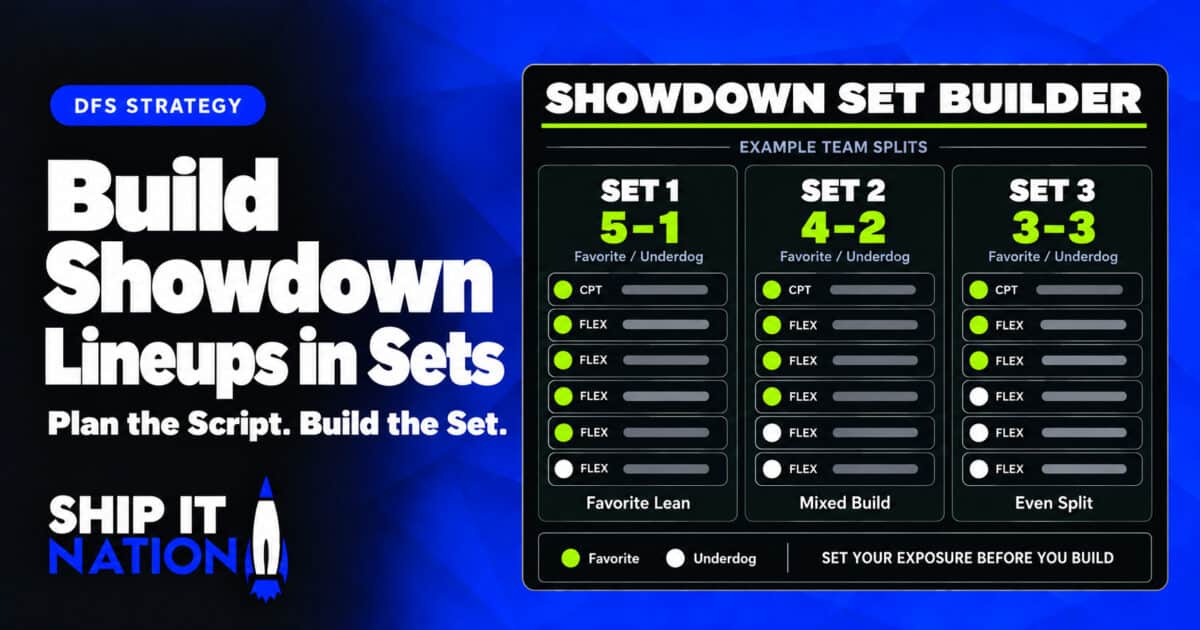
Most players build showdownShowdown (Captain and MVP)Showdown is a single-game DFS format where you build a lineup under a salary cap. In Captain or MVP formats, you assign one player to a special roster slot that multiplies their fantasy points and can increase their salary.Compare complete lineups with different players in the multiplier slot. Leaving salary unused can reduce duplication, but do not sacrifice meaningful scoring potential just to make your lineup unusual.Full explanation ↗ lineups one at a time, picking a captain, filling out the flex spots, and repeating that process over and over until they hit their entry limit. It works, but it leaves a lot of structure on the table. Building in sets is a more intentional approach that treats your lineup pool as a deliberate story about how the game might play out, rather than a pile of individual guesses.
- Group lineups around realistic scenarios and decide how much of your pool each scenario should represent.
- Cover alternate outcomes while keeping most builds aligned with the side your data supports.
- Review each set against its intended scenario to understand why it underperformed.
What Building in Sets Actually Means
Building in sets means grouping your lineups by scenario and controlling the ratio of exposureExposureExposure is the percentage of your lineups in a contest, or across a slate, that include a particular player, team or stack.Set exposure caps before you build, not after. Decide the most you're willing to have on any one player, then let your lineups fill in around those limits.Full explanation ↗ across those scenarios on purpose, instead of letting an optimizer spit out whatever combination of players happens to fit your salary cap and rules.
Instead of asking an optimizer to generate 150 random showdown builds, you’re deciding ahead of time how many of your lineups should reflect one team dominating, how many should reflect a closer game, and how many should hedge against the underdog pulling off an upset.
A Practical NFL Showdown Example
Say you’re building for a showdown slate where one team is a heavy favorite. Instead of just letting the fieldThe FieldThe field is everyone else entered in a contest, the group of lineups you are competing against.Before you build, picture the typical lineup in your contest. Then decide on purpose where you'll match it and where you'll step away from it.Full explanation ↗’s implied ownershipOwnershipOwnership is the percentage of lineups in a contest that include a given player. Projected ownership is an estimate made before lock; actual ownership is posted once the contest locks.Ownership isn't something to avoid; it's something to build around. The goal is understanding how the field is likely to build, then finding your edge relative to that.Full explanation ↗ dictate your builds, you might structure your pool something like this: a chunk of your lineups lean heavily into the favorite with five players from that team and one from the underdog, another chunk balances things out a bit more with four and two, and a smaller group hedges with a more even three and three split in case the game scriptGame ScriptGame script is how a game's score and time remaining influence its pace, play choices and player opportunities. In football, teams protecting a lead often run more, while teams chasing a deficit often pass more.Before locking a lineup, ask who keeps playing if your expected script reverses. Check passing-down roles and backup rotations instead of assuming a team's leading rusher handles every situation.Full explanation ↗ flips.
You could also intentionally split your overall exposure, putting the majority of your builds on the favorite’s side while still committing a meaningful minority to the underdog’s side in case the game doesn’t go the way the market expects. That gives you real coverage if the favorite disappoints, without abandoning the side the data actually supports.
A Practical PGA Example
The same logic applies outside of NFL. Say there’s a clear weather edge in a golf tournament favoring players in the morning wave. You might build the bulk of your lineups entirely around AM golfers to capture that edge, while setting aside a smaller portion of your pool with a rule forcing exactly one PM golfer into the build, covering the scenario where someone from the afternoon wave still goes low and needs to be accounted for.
Why This Beats Uniform Builds
The advantage of building in sets is that you’re not fully contrarianContrarianA contrarian play or lineup is one built around choices most of the field will not make, such as low-owned players, unpopular teams or an unusual salary structure.Pick one or two contrarian spots per lineup and ground each in a real reason. The rest of the roster can look like the field.Full explanation ↗ and you’re not fully consensus either. You’re adjusting your exposure within a structure that still makes logical sense given the slate, which is a very different approach than either blindly following the field or trying to get as different as possible for the sake of being different.
This also gives you a clearer way to explain your own decisions after the slate is over. If a set underperforms, you can look back and see whether the scenario you built around simply didn’t happen, rather than wondering whether your builds were just randomly generated with no real thesis behind them.
Getting Started With Sets
If you’ve never built this way before, start small. Pick your next showdown slate, identify two or three realistic game scripts, and decide roughly what percentage of your lineup pool should reflect each one before you start locking in players. An optimizer with group and exposure rules makes this process much easier to execute cleanly, since you can set hard caps on player exposure by scenario rather than trying to track it manually across dozens of builds.
Building in sets takes a bit more upfront planning than just mashing generate on an optimizer, but it turns your lineup pool into something with an actual thesis behind it, which makes both your results and your post slate review a lot more useful going forward.
Full video courses on bankroll management, contest selection, roster construction and more, free for members.
Common Questions
How do you build showdown lineups in sets?
Identify realistic game scripts and decide how much of your lineup pool should reflect each before selecting players. Use optimizer group and exposure rules to execute that plan.
Why build showdown lineups in sets?
Sets give your lineup pool a deliberate structure that covers different outcomes. They also make post slate review clearer because you can assess whether each set's intended scenario happened.
Can you build DFS lineup sets outside NFL showdown?
Yes. The article's PGA example builds most lineups around an AM weather advantage while reserving a smaller set that includes a PM golfer.
Keep reading