On this page
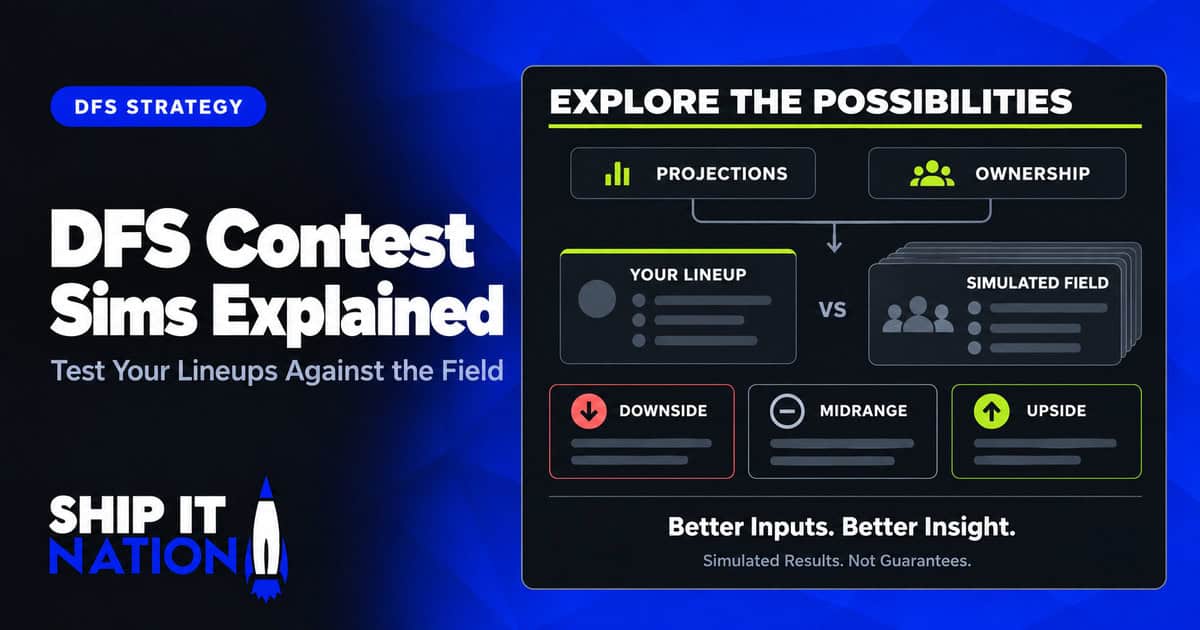
A DFS contestDaily Fantasy Sports (DFS)Daily fantasy sports (DFS) are fantasy contests that last a single day, week or event. You pick a new lineup under a salary cap, players score fantasy points from real stats, and you win cash based on your finish.Start with low buy-in cash games while you learn pricing and roster rules. They give steadier feedback than big tournaments, where long losing streaks are normal even for good players. sim runs your lineups through thousands of simulated slates. It generates each player’s outcome from a projected range, builds a simulated field from projected ownershipOwnershipOwnership is the percentage of lineups in a contest that include a given player. Projected ownership is an estimate made before lock; actual ownership is posted once the contest locks.Ownership isn't something to avoid; it's something to build around. The goal is understanding how the field is likely to build, then finding your edge relative to that., and shows how your lineups finish. The results are only as good as the projection and ownership inputs you feed in.
Key takeaways
- Contest sims test your lineups against simulated opponents across a range of player outcomes.
- Simulation results depend on accurate projections and ownership assumptions, including how the field reacts to shared signals.
- Use sim results alongside your own slate analysis rather than automatically accepting or rejecting a lineup.
The Basic Idea Behind Sims
A contest sim takes your projected player pool, along with expected ownership across the field, and runs a large number of simulated versions of the contest. Each simulationSimulationsSimulations play out a slate thousands of times using each player's range of outcomes, then record what happened. Contest sims go further and score your lineups against a simulated field to estimate how often they cash or win.Use sims to compare close decisions, not to replace your read. If a sim result surprises you, check the input that caused it before trusting it. randomly generates outcomes for every player based on their projected performance range, then builds a simulated field of opponent lineups based on projected ownership, and sees how your lineups would have performed against that simulated field across each version of the slate.
Run enough of these simulations and you start to get a picture of how your lineups perform not just on average, but across a wide range of realistic outcomes, including the boom and bust scenarios that a single point projection can’t capture on its own.
What Sims Can Actually Tell You
A well built sim can show you how often your lineups finish in the top one percent of a contest, which is often the more useful number in a large field GPP than your average finishing position. It can help identify where your realistic return on investment is coming from across your pool, whether that’s a handful of high ceiling builds carrying the rest or a more evenly distributed set of lineups.
Sims can also highlight which of your lineups are best suited for which type of contest, showing you that a build with a higher floor but lower ceiling might actually be better suited for a smaller field contest than the massive GPP you originally built it for.
Why Sims Are Only as Good as Their Inputs
This is the part that gets overlooked constantly. A sim is built entirely on the ownership and projection inputs you feed into it. If those inputs are inaccurate, the output is going to be misleading no matter how sophisticated the simulation engine is behind it.
Accurate ownership projections matter enormously here. If a sim assumes a player will be owned at a certain percentage and the actual field ends up rostering that player far more or less often, the simulated results won’t reflect what actually happens in the real contest.
The Meta Game Problem
There’s an added wrinkle that more advanced players need to be aware of. If a sim shows that a certain player is a great leverage spot, and that information becomes widely known or widely used, the ownership on that player often shifts as the field reacts to the same signal. That shift can quietly remove the exact edge the sim originally identified.
This is why more experienced sim users don’t just take default ownership inputs at face value. They adjust their ownership assumptions to reflect what they expect will actually happen once a meaningful portion of the field reacts to the same widely available signals, rather than assuming the field will remain static.
Using Sims Without Over Relying on Them
Sims are a genuinely useful tool for understanding your realistic range of outcomes, but they work best as one input alongside your own read on a slate, not as a replacement for it. Treat a strong sim result as confirmation worth considering, not as an automatic green light, and treat a weak sim result as a prompt to dig deeper into your assumptions rather than an automatic reason to scrap a lineup you have real conviction in.
Used properly, sims add a layer of structure and realistic expectation setting to your process. Used blindly, they can just as easily lead you into a false sense of precision about a game that still has plenty of randomness built into it.
If your optimizer includes contest sims, such as SaberSim, use them to compare builds, not to pick a winner.
Go further: DFS PROcess 101 Members
Full video courses on bankroll management, contest selection, roster construction and more, free for members.
Common Questions
How do DFS contest sims work?
They generate player outcomes from projected performance ranges and opponent lineups from expected ownership. They then evaluate how your lineups perform against that simulated field across different versions of the slate.
How accurate are DFS contest sims?
Sims are only as accurate as the projections and ownership you feed them. They show a realistic range of outcomes and how often a lineup might finish near the top, but they cannot predict one slate, because the sport has a lot of randomness. Use them to compare builds, not to pick a winner.
How should you use DFS contest sim results?
Use them to assess your range of outcomes and which contests fit your builds. Treat strong results as confirmation to consider and weak results as a reason to review your assumptions.
Need a term explained? The Ship It Nation DFS glossary covers every DFS term we use in plain language. All articles

About the author
Tyler Tamboline
Tyler Tamboline co-founded Ship It Nation and is the face of the brand across our shows and community. He is also the Founder of DFS Mastermind, helping hundreds of DFS players find their own process. He has played DFS since 2012, focusing primarily on PGA and NFL, and has created DFS content full-time since 2018 at different sites across the industry. He is known for strategy, game theory and leverage in large-field tournaments. He has been a regular on many Fantasy Sports podcasts, including weekly PGA and NFL shows with Pat Mayo.
More from Tyler Tamboline