Lineup Building
Virtual Hand Building: How to Use an Optimizer Without Losing Your Personal Style
Last updated October 7, 2026 by Tyler Tamboline · 3 min read
There’s a common fear among hand builders that using an optimizer means giving up control over their lineups and letting software make all the decisions for them. Virtual hand building solves that problem directly. It’s a way to combine your personal read on a slateSlateA slate in DFS is the set of games, races, fights or tournament rounds covered by a contest. It determines which events your player selections can come from and which performances count toward your score.Before building, open the contest details and check the included events, scoring period and lock rules. Do not assume two sites offer identical slates just because both call them the main slate.Full explanation ↗ with the speed and structure an optimizer provides, without handing over the keys entirely.
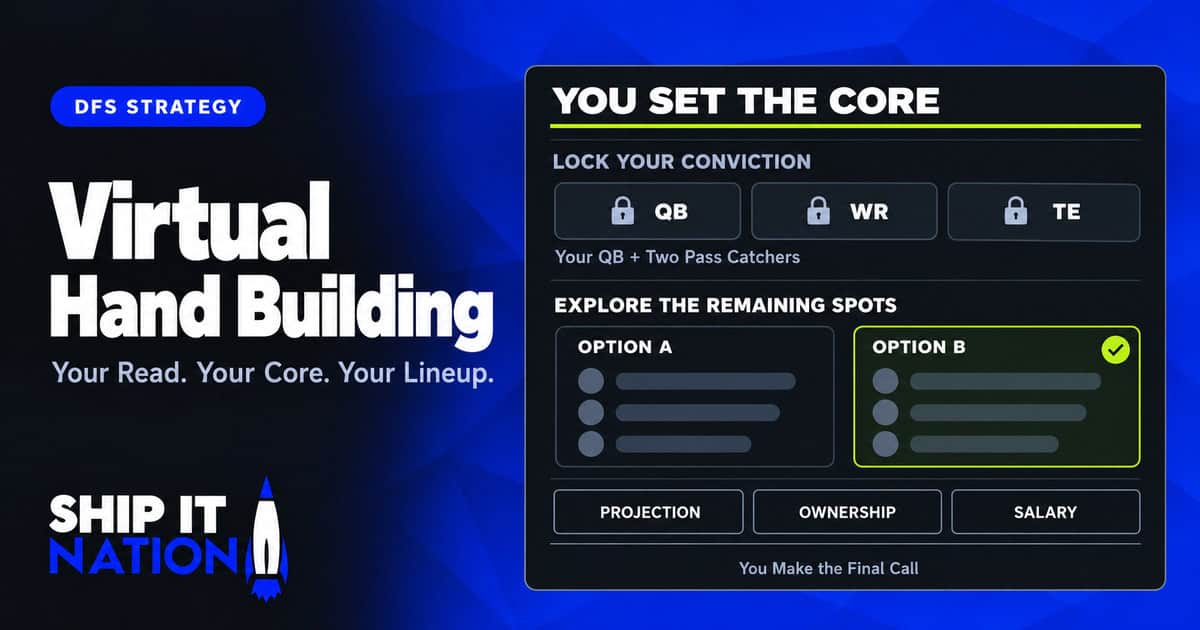
- Lock your strongest player or stack idea into the optimizer before generating the remaining roster spots.
- Compare resulting builds using projection, ownership, and salary data before choosing your final lineup.
- Keep control of your core decisions while using the optimizer to explore combinations around them.
What Virtual Hand Building Actually Is
Virtual hand building means constructing your lineup by hand, but doing it inside an optimizer rather than on a blank spreadsheet or a betting site’s roster page. Instead of guessing which combinations will fit your salary cap while flipping between browser tabs, you use the optimizer’s structure to guide your choices in real time while you’re still the one making every meaningful decision.
The Basic Process
Start with your favorite value play or your strongest correlationCorrelationCorrelation describes how two players' fantasy scores move together. Positively correlated players tend to have big games at the same time, usually because one player's success directly adds points for the other.When you build a tournament lineup, ask which of your players need the same thing to happen. The more of them that do, the higher your lineup's ceiling.Full explanation ↗ idea for the slate, the piece you’re most confident belongs in your final lineup. Lock that player, or that stack, directly into the optimizer.
From there, let the optimizer generate the remaining roster spots based on your locked pieces and whatever constraints you’ve set. This gives you a range of possible combinations built around your core conviction rather than a single blind guess at how to fill out the rest of the roster.
Review the resulting builds using projectionProjectionsDFS projections estimate a player's fantasy points for an upcoming slate using expected opportunities, performance and the contest's scoring rules. They describe an expected result, not a guaranteed score.Check the projection's update time and assumed role before using it. If news is already included, adjusting again for that same news can double-count its effect.Full explanation ↗, ownershipOwnershipOwnership is the percentage of lineups in a contest that include a given player. Projected ownership is an estimate made before lock; actual ownership is posted once the contest locks.Ownership isn't something to avoid; it's something to build around. The goal is understanding how the field is likely to build, then finding your edge relative to that.Full explanation ↗, and salary data, and finalize the combination that fits both your original read and the additional context the optimizer surfaced.
Why This Beats Both Extremes
Fully manual hand building, done entirely outside any tool, is slow and prone to overlooking combinations you simply didn’t think of. Fully automated optimizer output, generated without any personal input, can produce technically efficient lineups that don’t reflect any real conviction or thesis about the slate.
Virtual hand building sits in the middle. You keep your personal read on the slate front and center by locking in the pieces you actually believe in, while still benefiting from the optimizer’s ability to quickly test combinations you might not have considered on your own.
A Practical Example
Say you’ve identified a quarterback and two of his pass catchers as your core conviction stack for the week. Lock all three into the optimizer. From there, let it test different combinations for your remaining running back, flex, and value spots, based on your salary constraints and the rest of your player pool.
You end up with several viable full lineups, all built around the exact core idea you started with, giving you options to compare rather than a single lineup you built blind.
Where This Fits for Different Player Types
This approach works well regardless of how many lineups you’re building. A single entrySingle-EntryA single-entry contest allows each user exactly one lineup. It can be a cash game or a tournament.In single-entry, one or two contrarian decisions are usually enough. Pair a strong, popular core with a lower-owned piece instead of fading everything the field likes.Full explanation ↗ player can use virtual hand building to test their one core idea against multiple roster combinations before locking their final choice. An MME player can use the same process across multiple different core ideas, effectively running several virtual hand builds in parallel to construct a wider, more intentional pool.
Keeping Your Style Intact
The biggest advantage of this approach is that it prevents the optimizer from becoming the sole author of your lineups. You’re still the one deciding what belongs at the center of your build. The tool is there to help you explore the space around that decision more efficiently, not to replace the decision itself.
If you’ve been hesitant to use an optimizer because you don’t want to lose your personal touch, virtual hand building is the practical middle ground that lets you keep your process intact while still working faster and smarter than building entirely by hand.
Full video courses on bankroll management, contest selection, roster construction and more, free for members.
Common Questions
What is virtual hand building in DFS?
Virtual hand building means constructing your lineup inside an optimizer while retaining control over the meaningful decisions. You choose the core pieces, and the tool helps test combinations around them.
How do you virtually hand build a DFS lineup?
Lock your preferred player or stack into the optimizer, then generate the remaining spots using your constraints. Review projection, ownership, and salary data to select the build that fits your original read.
Does virtual hand building work for single entry and MME?
Yes. Single entry players can compare multiple combinations around their core, while MME players can repeat the process across different core ideas to build a wider, intentional pool.
Keep reading