On this page
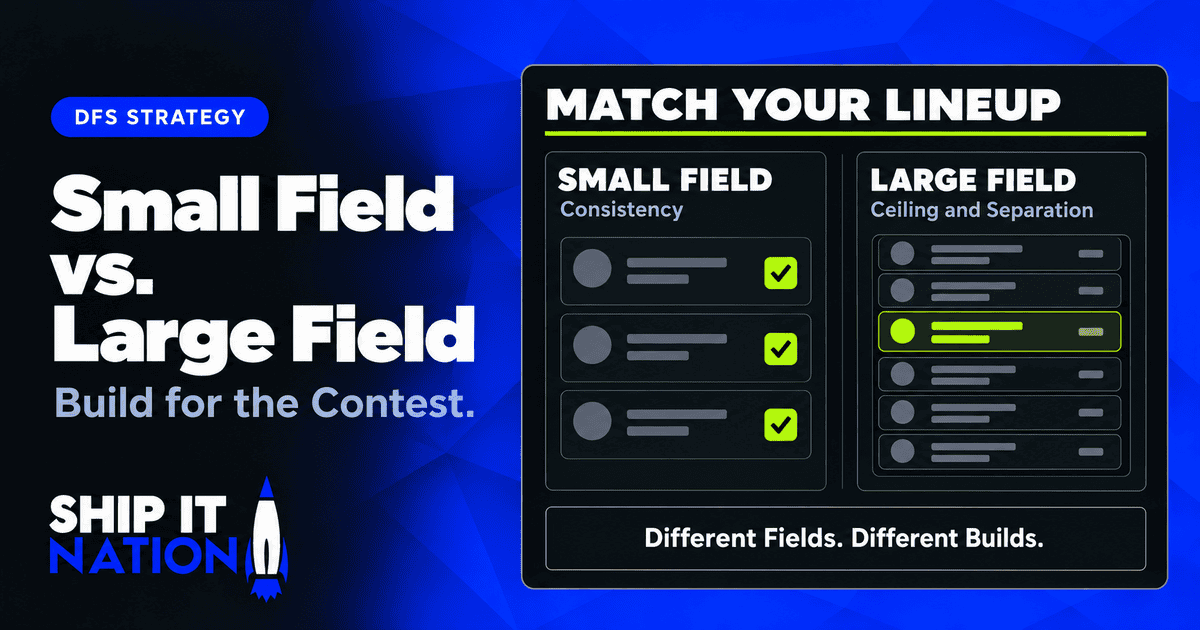
In small-field GPPsGPP (Guaranteed Prize Pool)A GPP is a tournament whose prize pool is guaranteed to pay out in full even if the contest does not fill. Payouts are steep: usually only the top 20 to 25 percent of entries get paid, and a small group at the top wins most of the money.Before you enter a tournament lineup, ask how it finishes first, not just how it cashes. If you cannot name that scenario, rebuild it., build for consistency: tighter, consensus-driven lineups that avoid disaster picks can win without extreme leverage. In large-field GPPsGPP (Guaranteed Prize Pool)A GPP is a tournament whose prize pool is guaranteed to pay out in full even if the contest does not fill. Payouts are steep: usually only the top 20 to 25 percent of entries get paid, and a small group at the top wins most of the money.Before you enter a tournament lineup, ask how it finishes first, not just how it cashes. If you cannot name that scenario, rebuild it., build for ceiling and separation with stronger correlation and thoughtful leverage, since the winning lineup usually has to hit nearly everything and duplicates split payouts. Make that choice on purpose for each contest.
Key takeaways
- In small-field GPPs, build for consistency with tighter, consensus-driven lineups that avoid disaster picks.
- In large-field GPPs, build for ceiling and separation with stronger correlation and thoughtful leverage, because duplicates split payouts.
- Choose the build on purpose for each contest instead of entering the same lineup out of habit.
What Changes With Field Size
The size of the field changes the score you need to win and the number of lineups you have to beat. In a small field, you need to outscore a few dozen opponents. In a large field, you need to outscore tens of thousands, many of whom have built very similar lineups.
That has real consequences for how you should build.
| Factor | Small-field GPP | Large-field GPP |
|---|---|---|
| Opponents to beat | A few dozen | Tens of thousands |
| Build priority | Consistency, avoiding disaster picks | Ceiling and separation |
| Leverage | One thoughtful pivot may be enough | Two or three pieces away from chalk, correlated |
| Duplication risk | Low | High, payouts get split |
Small Fields: Room for Margin
In a small-field contest, you can afford to be less perfect. The winning score is often lower, because there are fewer lineups and fewer chances for an extreme outcome. A few things follow from that:
- You don’t need extreme leverage to win
- You can miss on one roster spot and still compete
- Tighter, more consensus-driven builds have a real shot
- Safer plays carry more value than they do in a big field
If you’re playing a 100-entry qualifier or a small three-max, a well-constructed lineup that avoids disaster picks can easily finish near the top.
Large Fields: Upside Rules
In a large-field GPP, the winning lineup usually has to hit nearly everything. That requires a ceiling build, and it often requires being different enough from the field that you don’t share a top finish with hundreds of duplicates.
In big fields you want:
- Stronger correlation, so the upside compounds when it hits
- Thoughtful leverage, so your lineup isn’t a copy of the most common build
- Willingness to take on some risk at a roster spot or two
A safe build in a 100,000-person contest is mostly a bet on a mediocre finish.
Duplicates Matter More Than You Think
In a big contest, a lot of lineups are going to look alike, especially on popular builds. If you share a top finish with several other entries, your payout gets split. In a small field, duplication is much less of an issue.
Part of building for a large field is asking not only whether your lineup can score well, but whether it can score well in a way that many other lineups can’t.
How Many Contrarian Pieces?
A reasonable starting point is to think in terms of how many pieces of the lineup are different from the field. In a small field, one thoughtful pivot might be plenty. In a large field, you might want two or three pieces that separate you from the chalk, while keeping them tied together by correlation.
Treat this as a guideline, not a law. The best number depends on the slate, the projected ownership, and the format.
Build Separate Lineups for Separate Contests
If you’re entering both a small-field qualifier and a large GPP on the same slate, don’t enter the same lineup in both just out of habit. Ask which of your builds fits each contest. The lower-variance lineup might belong in the small field, and the higher-ceiling version might belong in the big one.
Sometimes the same lineup really is the right play for both, and that’s fine. The point is to make the choice on purpose.
Check the FanDuel contest rules and entry limits before building.
A Quick Gut Check
Before building, ask how many people you’re trying to beat and how many lineups in this field will look like yours. If the answers are a few dozen and very few, you can build for consistency. If the answers are tens of thousands and a lot, build for ceiling and separation.
Match Your Expectations Too
Small-field contests should hit more often, which makes them a good fit for building bankroll and confidence. Large-field contests hit rarely and pay a lot, which makes them a better fit for a defined budget and a long time horizon. Knowing which game you’re playing keeps you from judging a lottery-style contest by a small-field yardstick.
Review the DraftKings contest rules and entry limits too.
Go further: DFS PROcess 101 Members
Full video courses on bankroll management, contest selection, roster construction and more, free for members.
Common Questions
Should I build lineups differently for small-field and large-field GPPs?
Yes. In a small field you need to beat a few dozen lineups, so consistency and safer plays carry real value. In a large field you need to beat tens of thousands, so build for ceiling, correlation and separation from the most common builds. Decide which game you are playing first.
How many contrarian players should I use in a large-field GPP?
Treat it as a guideline, not a law: one thoughtful pivot may be plenty in a small field, while two or three pieces that separate you from the chalk fit a large field. Keep those pieces tied together by correlation, and let the slate, projected ownership and format set the final number.
Why do duplicate lineups matter in big DFS tournaments?
If you share a top finish with several other entries, the payout gets split. In a big contest many lineups look alike, especially popular builds, so a lineup should score well in a way many others cannot. In a small field, duplication is much less of an issue.
Need a term explained? The Ship It Nation DFS glossary covers every DFS term we use in plain language. All articles

About the author
Tyler Tamboline
Tyler Tamboline co-founded Ship It Nation and is the face of the brand across our shows and community. He is also the Founder of DFS Mastermind, helping hundreds of DFS players find their own process. He has played DFS since 2012, focusing primarily on PGA and NFL, and has created DFS content full-time since 2018 at different sites across the industry. He is known for strategy, game theory and leverage in large-field tournaments. He has been a regular on many Fantasy Sports podcasts, including weekly PGA and NFL shows with Pat Mayo.
More from Tyler Tamboline