Contest Selection
How to Qualify for Live Finals Through Satellites
Published by Tyler Tamboline · 3 min read
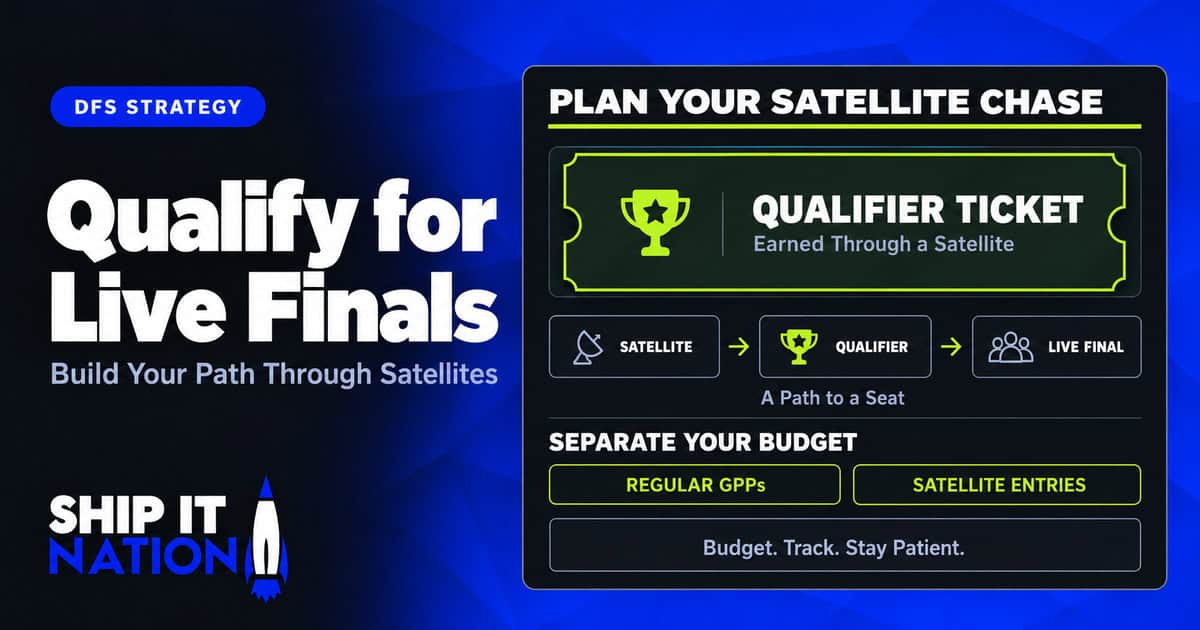
Live finals represent the dream scenario for a lot of DFS players. Travel covered, a shot at a life changing prize, and the chance to compete against a room full of other serious grinders on the biggest stage the game offers. But getting there requires understanding satellites as their own distinct pursuit, not just another GPPGPP (Guaranteed Prize Pool)A GPP is a tournament whose prize pool is guaranteed to pay out in full even if the contest does not fill. Payouts are steep: a small group at the top wins most of the money.Before you enter a tournament lineup, ask how it finishes first, not just how it cashes. If you cannot name that scenario, rebuild it. you happen to enter along the way.
Key takeaways
- Set a dedicated satellite budget and track it separately from your regular tournament spending.
- Enter your strongest lineup into both your regular GPP and a satellite that fits your budget.
- Keep the process that earned your ticket while accounting for stronger opponents in the next contest.
Satellites Need Their Own Budget
The biggest mistake players make when chasing a live final is treating satelliteSatelliteA satellite, also called a qualifier, is a contest whose prizes are tickets into a more expensive contest or a live final instead of cash. Tickets are free entries into that bigger event.Before building, compare the number of seats to the size of the field. The share of entries that win a ticket tells you whether to build like a cash game or a tournament. entries like they’re part of the same budget as their regular weekly GPP play. They’re not. Satellites and live final chases deserve a separate, dedicated bankroll carved out specifically for that pursuit.
If your overall weekly DFS budget is a fixed amount, decide upfront how much of that is earmarked for satellite attempts and treat that portion as separate from your standard tournament play. Without that separation, it’s easy to bleed money into satellite entries without realizing how much of your overall bankroll has quietly gone toward chasing a ticket.
You Don’t Need to Play Dozens of Lineups to Make This Work
A common misconception is that satellites only make sense for players entering large volumes of lineups. That’s not true. Even a single strong lineup can serve two purposes at once. Enter your best build into your regular single entry GPP, and also enter that same lineup into a satellite that fits your budget.
This gives your best idea two separate paths to a positive outcome. On a good day, that one lineup might cash respectably in the standard GPP while also being sharp enough to win a ticket in the smaller satellite field.
Why Satellites Reward Patience
The nature of satellites means you never really know which slate is going to be your breakout performance. That’s exactly why playing a handful of satellite entries over time, rather than trying to predict a single perfect slate, is the more realistic path.
If your best lineup doesn’t quite crack the top of a massive field GPP, it can still be plenty good enough to win a satellite ticket in a much smaller field. That ticket becomes your foot in the door to a bigger contest the following week, and the cycle can compound from there. A modest satellite entry fee turning into entry to a much larger contest is a realistic path that’s played out for plenty of players over the years.
What Changes Once You’ve Won a Ticket
Winning a satellite ticket doesn’t mean you need to completely rethink your approach for the bigger contest ahead. The process that got you the ticket is still valid. What changes is the sharpness of the field around you, since you’re now competing against a room full of players who are also serious enough to have won or paid their way into the same event.
Stay aware that you’re facing more multi entry players and a generally stronger field, and adjust your awareness of leverage and ownershipOwnershipOwnership is the percentage of lineups in a contest that include a given player. Projected ownership is an estimate made before lock; actual ownership is posted once the contest locks.Ownership isn't something to avoid; it's something to build around. The goal is understanding how the field is likely to build, then finding your edge relative to that. accordingly, but don’t scrap the fundamental process that earned you the seat in the first place.
Building Toward a Live Final Long Term
If qualifying for a live final is a real goal rather than a passing thought, treat it the way you’d treat any other long term DFS objective. Set aside a specific budget, track your satellite entries the same way you’d track any other contest, and be honest with yourself about how much you’re willing to commit to the chase before reassessing.
The path from a modest single entry to a seat at a live final isn’t instant, and it isn’t guaranteed. But it’s a realistic outcome for a player who treats the satellite process with the same discipline they’d apply to any other part of their DFS strategy.
Full video courses on bankroll management, contest selection, roster construction and more, free for members.
Common Questions
How do you qualify for DFS live finals through satellites?
Pursue satellite tickets with a dedicated budget and track your attempts over time. The article recommends patience and discipline rather than trying to predict one perfect slate.
Do you need many lineups to play DFS satellites?
No. You can enter your strongest lineup into your regular single entry GPP and also use it in a satellite that fits your budget.
Should you change your DFS strategy after winning a satellite ticket?
Keep the fundamental process that earned your ticket. Account for the stronger field and more multi entry players by paying closer attention to leverage and ownership.
Need a term explained? The Ship It Nation DFS glossary covers every DFS term we use in plain language.

About the author
Tyler TambolineTyler Tamboline co-founded Ship It Nation and is the face of the brand across our shows and community. He is also the Founder of DFS Mastermind, helping hundreds of DFS players find their own process. He has played DFS since 2012, focusing primarily on PGA and NFL, and has created DFS content full-time since 2018 at different sites across the industry. He is known for strategy, game theory and leverage in large-field tournaments. He has been a regular on many Fantasy Sports podcasts, including weekly PGA and NFL shows with Pat Mayo.
More from Tyler Tamboline →Keep reading