Contest Selection
3-Max vs. Single Entry vs. MME: Which DFS Format Should You Play?
Last updated October 7, 2026 by Tyler Tamboline · 3 min read
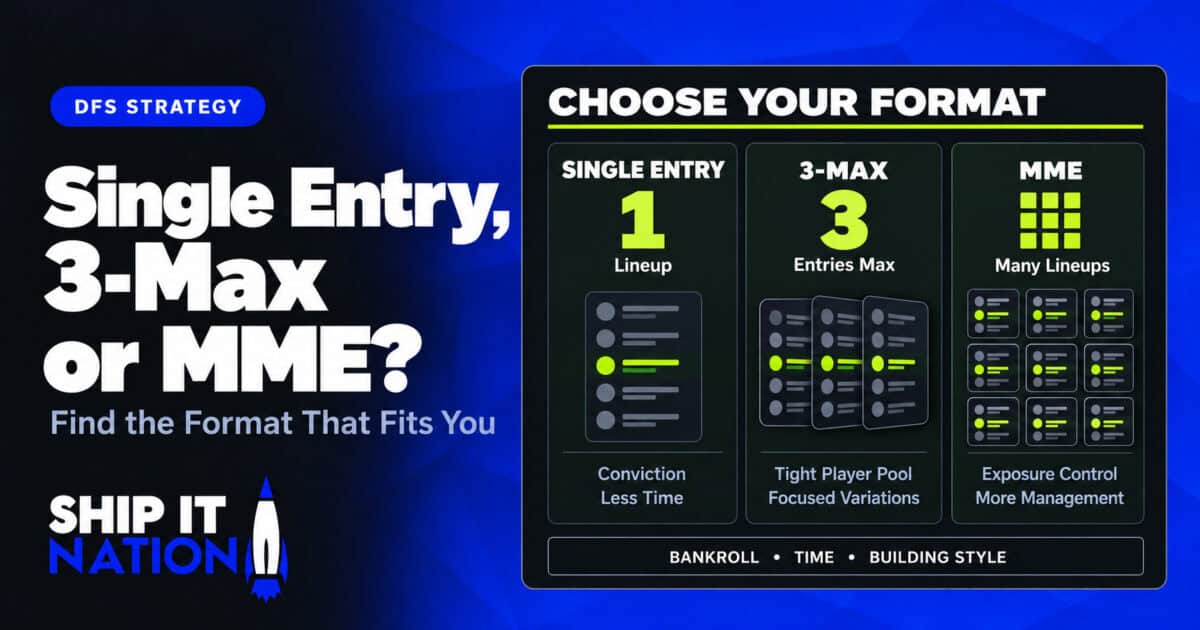
One of the most common questions newer DFS players ask is which format they should actually be playing. Should you go all in on mass multi entryMulti-EntryMulti-entry means entering more than one lineup into the same contest. A contest's entry limit, such as 3, 20 or 150, sets how many lineups one user can submit.Set your total spend for the slate first, then divide it into entries. Multi-entry should spread a fixed budget across more outcomes, not raise how much you put at risk.Full explanation ↗, keep it simple with a single lineup, or land somewhere in the middle with three maxThree-MaxA three-max contest lets each user enter up to three lineups. It is a small step up from single-entry.Give each of your three lineups a clear role. Make sure they differ in at least one major decision, like the main stack or the most expensive player.Full explanation ↗? The honest answer is that it depends entirely on your bankrollBankroll ManagementBankroll management is how you size your DFS spending relative to the money you have set aside to play, called your bankroll, so normal losing streaks do not wipe you out.Write down your per-slate limit before the season starts. Spending rules are much easier to keep when you set them before a losing streak, not during one.Full explanation ↗, your available time, and how your brain naturally approaches building lineups.
- Single entry suits a confident slate read and players with less time to manage multiple builds.
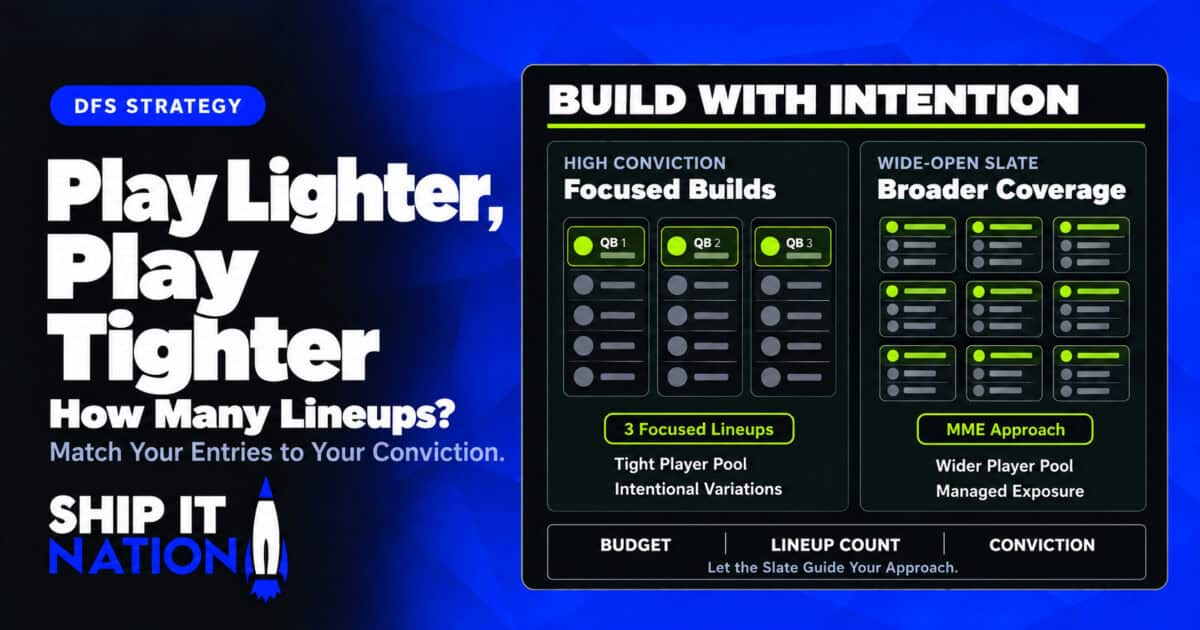
- Three max works best with a tight player pool and deliberate variations around your strongest ideas.
- MME requires exposure management, patience, and enough bankroll to handle extended stretches without standout results.
Single Entry: One Shot, No Room to Hide
Single entrySingle-EntryA single-entry contest allows each user exactly one lineup. It can be a cash game or a tournament.In single-entry, one or two contrarian decisions are usually enough. Pair a strong, popular core with a lower-owned piece instead of fading everything the field likes.Full explanation ↗ means exactly what it sounds like. One lineup, one shot. There’s nowhere to hide a mistake and no way to average your way into a good week across multiple builds.
This format rewards conviction. You need to trust your read on a slate enough to put everything behind one roster. It also tends to suit players with less time to dedicate to DFS each week, since you’re not managing dozens of exposures across a pool of lineups.
The tradeoff is variance. Your lineup either hits or it doesn’t, and over a long enough sample, you will lose more slates than you win, even with a strong process.
3-Max: A Middle Ground With Real Structure
Three max gives you a little room to hedge without turning into a full scale MME operation. You might build three variations around a core idea, maybe shifting one piece of the roster between builds to cover a couple of different outcomes.
This format still demands a fairly tight player pool. If you’re bringing ten quarterbacks or sixty golfers into a three max slate, you’re not actually using the format correctly. Three max works best when you’ve narrowed your convictions down to a handful of real options and you’re using your three entries to responsibly diversify around them.
MME: Volume, Exposure, and Patience
Mass multi entry is a completely different mindset. Instead of trying to nail one build, you’re managing exposureExposureExposure is the percentage of your lineups in a contest, or across a slate, that include a particular player, team or stack.Set exposure caps before you build, not after. Decide the most you're willing to have on any one player, then let your lineups fill in around those limits.Full explanation ↗ across dozens or even over a hundred lineups, trying to capture a wide range of outcomes across your player pool.
MME tends to suit players who enjoy working with data, exposure caps, and optimizer rules. It also requires patience. You might go weeks without a standout result before one big week covers the stretch and then some. If you don’t have the bankroll or the mental discipline to ride out that variance, MME can wear you down fast.
Matching the Format to Your Player Pool
Here’s a simple gut check. If you can’t narrow your player pool down to something tight for the slate in front of you, you’re probably not built for single entry or three max that week. Either scale back, treat it as a lower exposure practice slate, or shift into a wider MME approach where a bigger pool actually makes sense.
On the flip side, if your read on a slate is narrow and confident, don’t spray that conviction across 150 lineups where it gets diluted. Use it where it counts, in a single entry or a small max contest.
Can You Mix Formats?
Absolutely, and a lot of experienced players do exactly that. A common approach is building a wider MME pool for a large field GPPGPP (Guaranteed Prize Pool)A GPP is a tournament whose prize pool is guaranteed to pay out in full even if the contest does not fill. Payouts are steep: a small group at the top wins most of the money.Before you enter a tournament lineup, ask how it finishes first, not just how it cashes. If you cannot name that scenario, rebuild it.Full explanation ↗ while also tagging your favorite build from that pool to enter separately in a three max or single entry contest. That way your best idea gets multiple paths to pay off instead of getting buried inside a hundred other lineups.
Choosing What Fits You
There’s no format that makes you a better player just by playing it. The players who do well long term are the ones who match their format to their actual strengths, their bankroll, and how much time they can realistically commit each week. If you’re not sure which lane fits you, the DFS Process 101 courses at Ship It Nation walk through format selection sport by sport, which is a good starting point before you commit real money to a style that might not actually fit how you think about the game.
Full video courses on bankroll management, contest selection, roster construction and more, free for members.
Common Questions
Should I play single entry, 3-max, or MME in DFS?
Choose based on your bankroll, available time, and approach to building lineups. Single entry rewards conviction, three max allows controlled variation, and MME suits players who enjoy managing data and exposures.
How should I build lineups for 3-max DFS contests?
Keep your player pool tight and build variations around a core idea. Use your entries to cover different outcomes among the options you have the most conviction in.
Can I play single entry and MME on the same slate?
Yes, the article describes building a wider MME pool and entering your favorite build separately in a single entry or three max contest. This gives your strongest idea another path to pay off.
Keep reading