NHL
Power Play Units in NHL DFS: Why They Matter and How to Stack Them
Published by Ship It Nation Staff · 5 min read
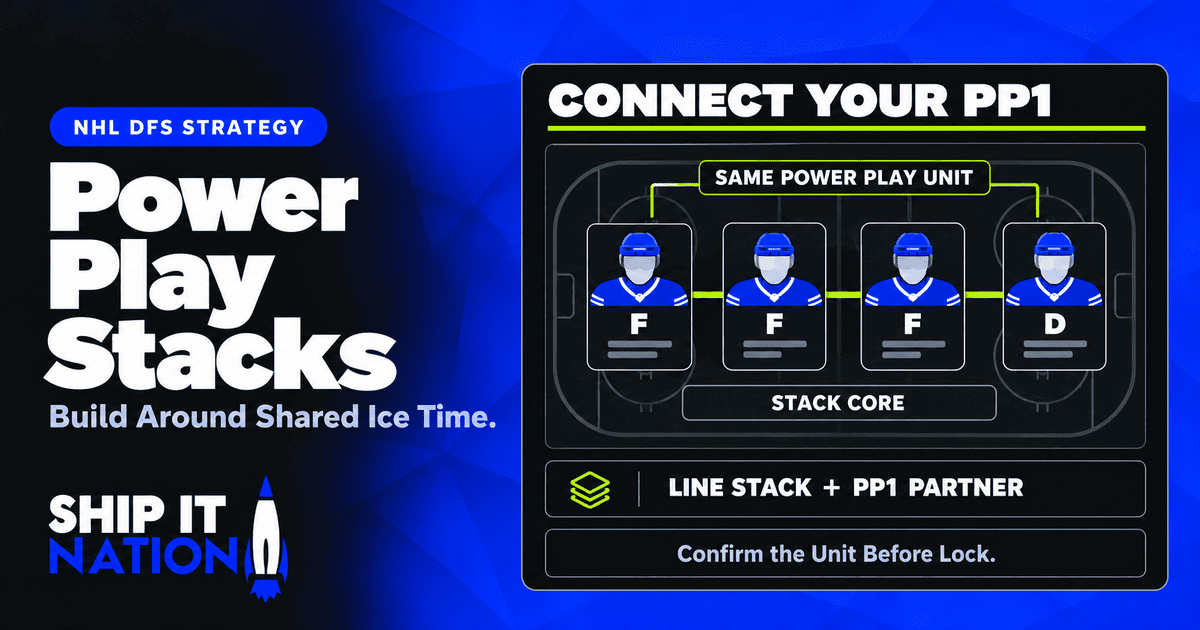
A power play unit is the group of skaters a team sends out when the opponent has a penalty, and those players produce far more points per minute than they do at even strength. In NHL DFS, you stack them by pairing forwards from the same unit with the defenseman who plays alongside them.
Key takeaways
- Stack players from the same PP1 unit because one power play goal can pay the shooter and both assisters at once.
- Check which power play unit a skater is on, how much time it gets and whether it recently changed, since assignments can shift.
- As a default, keep your goalie and skaters aligned and avoid rostering skaters who face your own goalie.
Most teams run two power play units, and the gap between them is large. Knowing who is on PP1 is one of the cheapest edges in the sport.
Why the Power Play Matters for Scoring
Hockey is a low-scoring game, so every goal has to pay as many of your roster spots as possible. The power play is where that happens most often. A team skating five against four creates better shots, cleaner passing lanes, and more rebounds, and the same handful of players are on the ice for all of it.
Scoring rules vary by site, so check the current rules on the site you play. On DraftKings, goals and assists carry big point values, and shots on goal and blocked shots add smaller amounts that accumulate. A power play goal can score for the shooter and two assisters at once, which is exactly the kind of shared outcome you want in a tournament lineupGPP (Guaranteed Prize Pool)A GPP is a tournament whose prize pool is guaranteed to pay out in full even if the contest does not fill. Payouts are steep: a small group at the top wins most of the money.Before you enter a tournament lineup, ask how it finishes first, not just how it cashes. If you cannot name that scenario, rebuild it..
That is the whole logic of stacking in hockey: one event, several paychecks.
PP1 Versus PP2
The first power play unit usually gets the majority of the penalty time. The second unit often gets the leftovers, sometimes a minute or less per opportunity, and some teams barely use it. Two forwards with similar salaries can have very different upside simply because one is on PP1 and the other is not.
When you evaluate a skater, ask three questions:
- Which unit is he on right now?
- How much power play time does that unit usually get?
- Has the unit changed recently because of injury or a coaching decision?
Power play assignments can shift, and projected lines can change late, so check news close to lock rather than trusting a lineup from the morning before.
| Question | PP1 skater | PP2 skater | Why it matters |
|---|---|---|---|
| Power play time | Usually the majority | Often the leftovers | More time means more chances |
| Typical upside | Higher for similar salary | Lower for similar salary | Salary may not reflect the gap |
| Stack use | Natural partner for a line stack | Rarely worth a stack spot | Shared outcomes pay several spots |
| Risk | Unit can change with injury or coaching | Role can disappear | Check news close to lock |
How Stacks Are Built
A common NHL stack is built around a forward line. Linemates share even-strength ice time, so a single goal can score for multiple players you roster. The power play adds a second layer, because the same line is often partly or fully on the PP1 unit.
Here is a simple way to think about the layers:
- Line stack: two or three forwards who skate together at even strength.
- Power play add: a forward or defenseman who is not on that line but shares the PP1 unit with them.
- Goalie pairing: some players pair their skaters with their own goalie, since a team that scores and wins tends to help both.
A defenseman on PP1 is often the most overlooked piece. Defensemen who quarterback the power play collect assists, shots, and blocked shots, and they are frequently priced well below forwards who see the same ice time with the man advantage. Check the current rules on the site for roster constructionRoster ConstructionRoster construction is how you organize a DFS lineup within its salary cap and roster rules. It includes where you spend or save, which positions you prioritize, and how your players fit together.Build two versions around your biggest spending decision, then compare every player who changes. Revisit the comparison when injury news changes the available value., but on DraftKings the lineup has typically included two defensemen, so a PP1 defenseman can fit naturally next to your forward stack.
Avoid Stacking Against Yourself
As a general habit, many players avoid rostering skaters who face their own goalie. If you roster a goalie and then put a skater from the opposing team in your lineup, one team’s success becomes the other’s failure. A goalie earns points for saves and wins, and loses points for goals against, while the opposing skaters earn points when the puck goes in. Those outcomes pull in opposite directions.
There are exceptions, especially in tournaments where you want a contrarianContrarianA contrarian play or lineup is one built around choices most of the field will not make, such as low-owned players, unpopular teams or an unusual salary structure.Pick one or two contrarian spots per lineup and ground each in a real reason. The rest of the roster can look like the field. build. But as a default, keep your goalie and your skaters aligned.
Who Do You Stack?
Start with the game environment. Look for a weak opposing goalie, an opponent that takes a lot of penalties, or a poor penalty kill. Each of those gives your power play stack more chances. A team that draws penalties also creates more power play minutes for the units you picked.
Then look at salary and ownershipOwnershipOwnership is the percentage of lineups in a contest that include a given player. Projected ownership is an estimate made before lock; actual ownership is posted once the contest locks.Ownership isn't something to avoid; it's something to build around. The goal is understanding how the field is likely to build, then finding your edge relative to that.. The most popular offense on a slateSlateA slate in DFS is the set of games, races, fights or tournament rounds covered by a contest. It determines which events your player selections can come from and which performances count toward your score.Before building, open the contest details and check the included events, scoring period and lock rules. Do not assume two sites offer identical slates just because both call them the main slate. is usually obvious, and in a large tournament you may want to be different. You can do that without abandoning the idea. Use the same logic, a line plus a PP1 partner, on a team that fewer players are paying upSpending UpSpending up means choosing a higher-priced player over a cheaper alternative, using more of your lineup's salary budget at that spot. You may also hear it called paying up.Build a version with your preferred expensive player and another without. Before choosing, check whether either version relies on a cheap player whose expected role still depends on unresolved injury news. for.
Decide which popular playsChalkChalk is the most popular, highly owned play on a slate. The term comes from sports betting, where the favorite is called the chalk.Don't label chalk good or bad. Ask whether each popular play deserves its ownership, then decide which chalk you'll eat and which you'll fade. fit your build.
Check Rosters Before Lock
Roster rules differ by site and can change, so check the current rules on the site before building. DraftKings has historically used nine players with a salary cap and a requirement to include skaters from at least three teams, while FanDuel has used a different position mix and a limit on players from one team. Verify the details in the lobby.
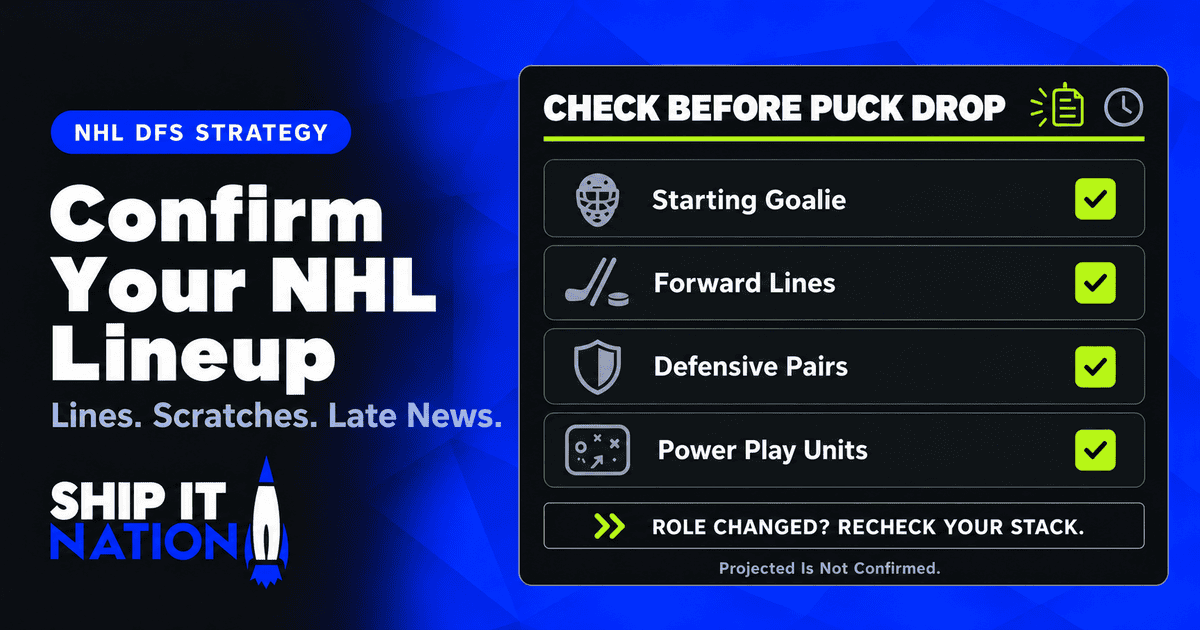
Late news matters more in hockey than in many sports. Lines can be reshuffled at warmups, a player can be scratched, and a power play unit can change without much notice. Build your stacks, then confirm the lines before you finalize.
Check the NHL schedule for which teams play.
A Quick Stack Checklist
Before you submit, run this list:
- Do my forwards actually skate on the same line?
- Is the defenseman on the same PP1 unit as my forwards?
- Is my goalie confirmed, and am I avoiding skaters against him?
- Have I checked the latest line and power play news?
- Does this stack differ enough from the most popular build to matter in a big field?
If you can answer yes to those five, you are stacking with purpose instead of guessing.
Full video courses on bankroll management, contest selection, roster construction and more, free for members.
Common Questions
What is a power play unit in NHL DFS?
A power play unit is the group of skaters a team sends out when the opponent has a penalty. These players produce far more points per minute than at even strength, so knowing who is on the first unit is one of the cheapest edges in NHL DFS.
How do you stack power play units in NHL DFS?
Start with a forward line, then add a forward or defenseman who shares the first power play unit with them. Many players also pair the stack with their own goalie. Check the current rules on the site for roster limits before building.
What is the difference between PP1 and PP2?
The first power play unit usually gets most of the penalty time, while the second often gets leftovers, sometimes a minute or less. Two similarly priced forwards can have very different upside because one is on PP1 and the other is not.
Need a term explained? The Ship It Nation DFS glossary covers every DFS term we use in plain language.

About the author
Ship It Nation StaffShip It Nation was founded in 2023 by Tyler Tamboline and Mike Petta to give DFS players the tools, projections, content, and community they need to build a winning process. Today, we're a fully remote team of active DFS players, analysts, and builders.
More from Ship It Nation Staff →Keep reading