NHL
NHL DFS Back-to-Backs and Rest: How the Schedule Affects Goalies and Lines
Published by Ship It Nation Staff · 4 min read
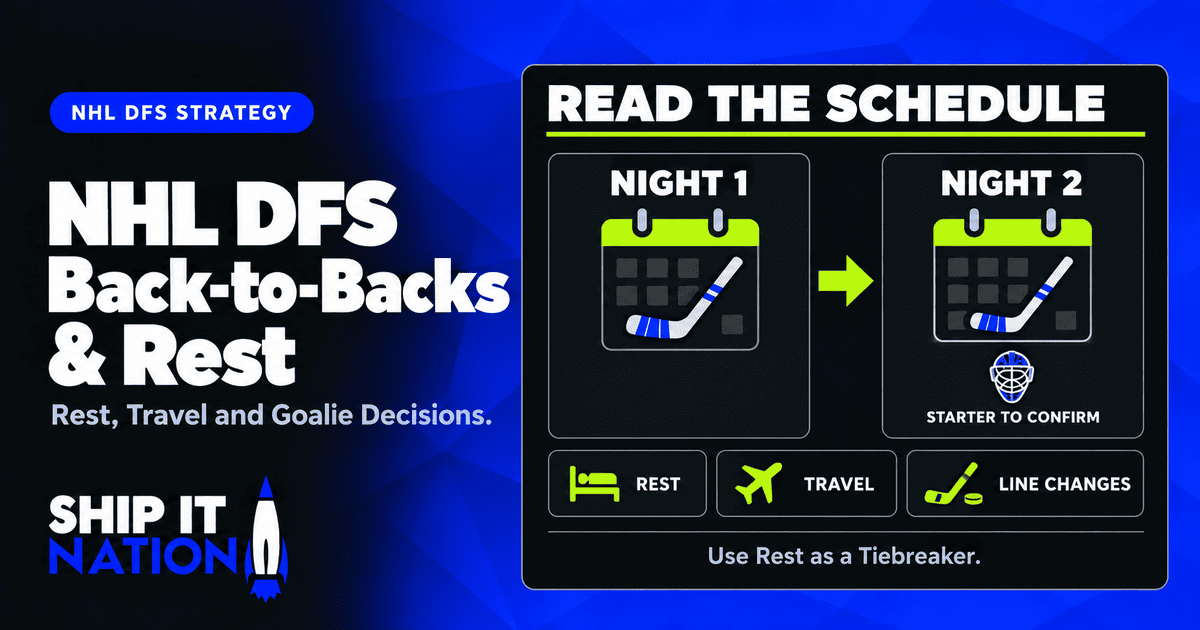
Back-to-back games often send the backup goalie to the net, and tired teams can see lineup changes that affect ice time. Check the schedule before you build, because rest and travel shape both the goalie matchup and the skaters you stack.
Key takeaways
- Back-to-back games often send the backup goalie to the net, but treat that as a lean and wait for game day confirmation.
- Use rest as a tiebreaker, not a strategy, for example to choose between two similar stacks.
- Scan the schedule before each slate for teams that played last night, traveled or face a likely backup, and revisit those games after morning skate.
Hockey schedules are packed, and the calendar gives you information that many players overlook.
Why the Schedule Matters
NHL teams play often, and some stretches put them on the ice two nights in a row. Coaches manage workload, and the easiest place to do it is in goal. That makes the schedule one of the first things worth checking when you start a slateSlateA slate in DFS is the set of games, races, fights or tournament rounds covered by a contest. It determines which events your player selections can come from and which performances count toward your score.Before building, open the contest details and check the included events, scoring period and lock rules. Do not assume two sites offer identical slates just because both call them the main slate..
The schedule will not tell you everything, and you still need game day confirmation. But it gives you a head start, which is useful when your time is limited.
Check last night’s NHL scores to see which teams played.
Back-to-Backs and the Backup Goalie
When a team plays on consecutive nights, the backup goalie often starts one of the two games. This is a common pattern, not a rule, so treat it as a lean rather than a guarantee.
Why it matters for DFS:
- A backup goalie can change how attractive his opponent’s skaters are
- A team facing a backup may be a stronger stack target
- A team starting a backup may be less appealing for your own goalie spot
- Backup goalies can still win games, so do not treat the matchup as automatic
Starting goalies are usually confirmed on game day, often after morning skate. If you see a back-to-back on the schedule, expect that news to matter and wait for it before you finalize anything involving that game.
Look at the First Night and the Second Night
The two games in a back-to-back set are not always the same. A team playing the second night of a back-to-back, especially after travel, may be more likely to rest its starter. A team that is rested after a day off may lean on its top goalie.
Ask yourself:
- Did the team play last night?
- Did they travel after that game?
- Is the opponent rested?
- Is a rested team playing a tired team?
A rested team facing a tired team with a backup in goal can be an appealing spot for skater stacks. Still, confirm the goalie before you commit.
| Situation | Likely goalie lean | DFS implication | Caution |
|---|---|---|---|
| Second night of a back-to-back | Backup more likely (common pattern) | Opposing skaters may be better stack targets | Confirm on game day |
| Rested team, day off | Top goalie more likely | Goalie may be a safer pick | Priced accordingly |
| Tired team after travel | Rest more likely | Lines and minutes may shift | Check confirmed lines |
| Rested team vs tired team | Backup possible on tired side | Appealing stack spot | Backups can still win |
How Rest Affects Skaters
Goalies are the most visible part of the rest story, but skaters feel it too. Coaches may adjust lines or limit minutes for veterans on tired nights. Lineups can also shift if a player is held out for rest or a minor injury.
Because linemates share ice time, a change at one forward spot can ripple through a stack. Check the confirmed lines on game day and look for any change in power play assignments. Projected lines can change late, so do not lock in a stack based only on the previous game.
Use Rest as a Tiebreaker, Not a Strategy
Rest and travel are useful inputs, but they should not drive your whole build. A tired team with a strong top line can still produce, and a rested team with a poor matchup can still fall flat. Use the schedule to break ties between similar options, not to override everything else.
Good uses of rest information include:
- Choosing between two similar stacks, where one faces a likely backup
- Deciding whether to wait for goalie news before building around a game
- Flagging games where late lineup changes are more likely
- Avoiding a goalie in a spot where a backup is probable
Build Your Schedule Check
Before you build, scan the slate with a short checklist:
- Which teams played last night?
- Which teams are on the second night of a back-to-back?
- Which teams traveled?
- Which goalies are likely to start, and which are uncertain?
- Which games should I revisit after morning skate?
Write down your answers. This takes only a few minutes and helps you decide where to be flexible.
Use those answers to narrow your player pool.
Plan Around Uncertainty
Some games will have a clear goalie before you build, and others will not. For the uncertain games, either wait or build in a way that lets you swap. Check the current rules on the site for how late swap works in your contest, since lock timesLineup LockLineup lock is the deadline after which you cannot change your selected players. Without late swap, your entire lineup locks together; with late swap, which allows edits after the contest begins, players lock at their games' listed deadlines.After saving an edit, reopen your entered lineups and confirm the change reached every intended entry. Check the site's displayed lock times and time zone instead of relying on the television schedule. vary. If you build early, mark the players who depend on goalie news so you can return to them quickly.
Scoring rules also matter here. Goalie scoring on DraftKings, for example, rewards wins and saves and penalizes goals against, so a goalie decision changes his valueValueValue is the fantasy production you expect from a player relative to his salary. A value play offers more production or upside than his price suggests, whether he is cheap or expensive.Identify why the salary looks wrong: workload, matchup, scoring ability or a pricing error. Then check whether that reason still holds when you submit your lineup. a lot. Check the current rules on the site before you rely on any point values.
Make the Schedule Part of Your Routine
The schedule is free information. Look at it every slate, flag the back-to-backs, and let the goalie news settle before you lock. Over time, this habit will keep you from stacking against a goalie who is not playing, or rostering one who sits.
Full video courses on bankroll management, contest selection, roster construction and more, free for members.
Common Questions
Do backup goalies start on back-to-backs?
Often, but not always. When a team plays on consecutive nights the backup frequently starts one of the two games. Treat it as a common pattern, not a rule, and wait for game day confirmation before locking anything.
How does rest affect NHL DFS lineups?
Rest mainly shows up in the goalie decision, but coaches may also adjust lines or limit minutes for veterans on tired nights. Because linemates share ice time, one change can ripple through a stack, so check confirmed lines and power play assignments.
Should I stack against a backup goalie?
A team facing a backup can be a stronger stack target, especially if it is rested and the opponent is tired. Backup goalies still win games, so confirm the starter and use rest as one input among several.
Need a term explained? The Ship It Nation DFS glossary covers every DFS term we use in plain language.

About the author
Ship It Nation StaffShip It Nation was founded in 2023 by Tyler Tamboline and Mike Petta to give DFS players the tools, projections, content, and community they need to build a winning process. Today, we're a fully remote team of active DFS players, analysts, and builders.
More from Ship It Nation Staff →Keep reading