On this page
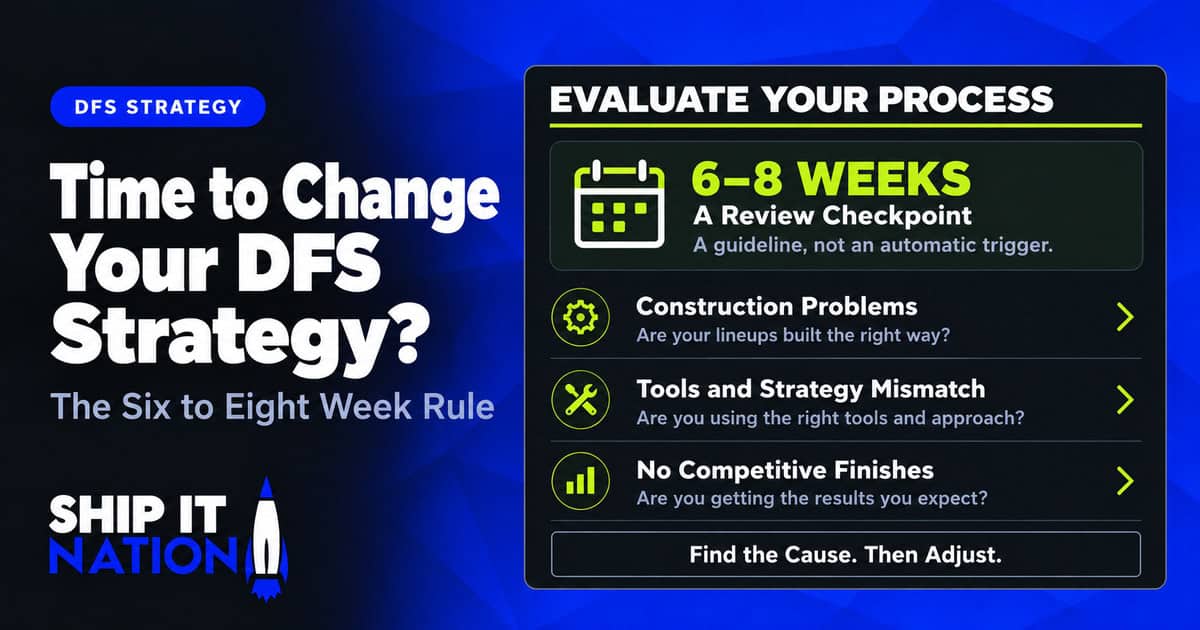
Do not change your DFS strategy after one or two bad weeks. A better guideline is to give an approach six to eight weeks of results, then change it only if your reviews show repeated lineup problems, tools that no longer fit your strategy, or results far from what good process should produce.
Key takeaways
- Give your approach time to be tested before making major strategy changes.
- Recurring lineup problems and mismatched tools deserve closer attention than a short losing stretch alone.
- Use regular reviews and specific feedback from other players to identify what needs adjusting.
How to Know When It’s Time to Change Your DFS Strategy
The first and most important rule here is patience. One or two bad weeks tells you almost nothing meaningful about whether your overall approach is working. DFS has enough built in varianceVarianceVariance in DFS describes how widely fantasy scores or contest returns can swing around their expected outcomes. It explains why a sound lineup can lose and a poor decision can sometimes win.Track results by contest type and slate, and review opportunity separately from touchdowns or other rare scoring events. Entering the same lineup in ten contests does not give you ten independent performance samples. If you build with an optimizer, its randomness setting nudges projections up or down on each build, so your lineups spread across different players instead of repeating the same top projections. that even a genuinely strong process can produce a rough couple of weeks purely by chance.
Overhauling your entire strategy after a short losing stretch means you never actually give your original approach a fair chance to prove itself over a large enough sample. Worse, it can start a pattern of constantly jumping between different strategies without ever sticking with one long enough to know whether it actually works.
The Six to Eight Week Benchmark
A more reasonable timeframe for evaluating whether an approach is genuinely working is somewhere in the range of six to eight weeks. That’s enough of a sample to smooth out some of the short term variance while still being a manageable window to actually assess and adjust within a season.
This doesn’t mean waiting exactly eight weeks no matter what before considering any changes. It means giving your process enough runway to actually be tested before drawing firm conclusions about whether it’s working.
Signals That It Might Actually Be Time to Adjust
A few specific patterns are worth paying closer attention to, separate from just the raw results. If you’re reviewing your builds honestly and consistently finding that your lineups are far off from optimal for reasons that have nothing to do with bad luck, that’s a signal worth examining. If your approach hasn’t put you anywhere near the top of a contest across a meaningful number of slatesSlateA slate in DFS is the set of games, races, fights or tournament rounds covered by a contest. It determines which events your player selections can come from and which performances count toward your score.Before building, open the contest details and check the included events, scoring period and lock rules. Do not assume two sites offer identical slates just because both call them the main slate., that’s different from simply not winning outright, since near misses still indicate a functioning process.
Another signal worth watching for is if you’ve added or removed tools from your process, like a new optimizer or a different projectionProjectionsDFS projections estimate a player's fantasy points for an upcoming slate using expected opportunities, performance and the contest's scoring rules. They describe an expected result, not a guaranteed score.Check the projection's update time and assumed role before using it. If news is already included, adjusting again for that same news can double-count its effect. source, without actually adjusting your overall strategy to account for that change. Mismatched tools and strategy can quietly create problems that look like bad luck but are actually a structural issue in how you’re using new information.
Signals That Don’t Necessarily Mean You Need to Change Anything
A rough two or three week stretch, on its own, generally isn’t enough to justify a real strategy change. Neither is a single disappointing result in an otherwise reasonable process, even if that result happened to be a particularly frustrating one. The goal is separating genuine signal from normal noise, which requires looking at a broader sample rather than reacting to the most recent slate.
| What you see | What it usually means | What to do |
|---|---|---|
| One or two bad weeks | Normal variance | Change nothing |
| A two or three week losing stretch | Normal variance | Keep your process and keep reviewing |
| Six to eight weeks with decisions that still check out | A cold stretch, not a flaw | Stay the course and check your bankroll plan |
| Lineups far from optimal for reasons that have nothing to do with luck | A process problem | Change one thing at a time and track the result |
| A new tool or projection source without a strategy change | Tools and strategy no longer match | Adjust the strategy to fit the tool, or the reverse |
Using Your Review Process to Make the Call
This is exactly where a consistent post slate review habit becomes valuable. If you’re regularly reviewing your decisions and tracking your results over time, you’ll have a much clearer, evidence based picture of whether a rough stretch reflects genuine process issues or simply normal variance, rather than trying to make that judgment purely from memory and frustration in the moment.
Getting a Second Opinion
If you’re genuinely unsure whether it’s time to adjust, this is a good moment to lean on a community of other serious players rather than making the call entirely in isolation. Sharing your actual review, the specific decisions and reasoning behind your builds, rather than just your results, tends to produce far more useful feedback than simply asking whether anyone else is also running cold this month.
The Bottom Line
If you’re losing and you genuinely don’t know why after an honest review, that’s a sign to dig deeper into your process before making changes. If you do know why and you’re still not adjusting, that’s a different problem entirely, and one that’s fully within your control to fix.
Go further: DFS PROcess 101 Members
Full video courses on bankroll management, contest selection, roster construction and more, free for members.
Common Questions
When should I change my DFS strategy?
Give a strategy six to eight weeks of results before making major changes, and treat that as a guideline rather than a fixed rule. Change sooner only if your reviews show repeated lineup problems or tools that no longer match your strategy, not because of one or two bad weeks.
Should I change my DFS strategy after two losing weeks?
A short losing stretch alone generally does not justify changing your strategy. Give your approach a fair chance and review your decisions across a broader sample.
How can I tell if my DFS strategy has a problem?
Look for recurring lineup weaknesses unrelated to bad luck, a sustained lack of competitive finishes, or a mismatch between your tools and strategy. Share your decisions and reasoning with other serious players for specific feedback.
Related articles
Stars and Scrubs vs. Balanced Builds in NFL DFSNFL DFS Cash Games: How to Build a Floor LineupHow to Build a DFS Player Pool: Wants vs. Needs FrameworkRelated terms
Need a term explained? The Ship It Nation DFS glossary covers every DFS term we use in plain language. All articles

About the author
Tyler Tamboline
Tyler Tamboline co-founded Ship It Nation and is the face of the brand across our shows and community. He is also the Founder of DFS Mastermind, helping hundreds of DFS players find their own process. He has played DFS since 2012, focusing primarily on PGA and NFL, and has created DFS content full-time since 2018 at different sites across the industry. He is known for strategy, game theory and leverage in large-field tournaments. He has been a regular on many Fantasy Sports podcasts, including weekly PGA and NFL shows with Pat Mayo.
More from Tyler Tamboline