General
How to Allocate Your DFS Bankroll Across Slates (Classic, Showdown, Primetime)
Published by Tyler Tamboline · 4 min read
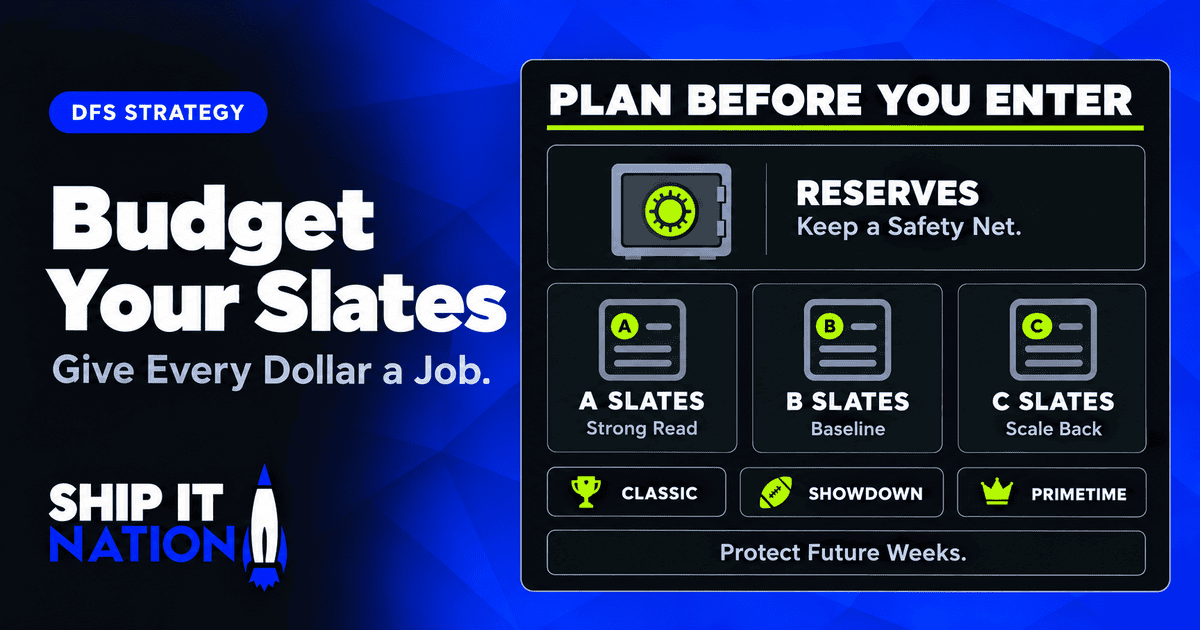
To allocate your DFS bankroll across slatesSlateA slate in DFS is the set of games, races, fights or tournament rounds covered by a contest. It determines which events your player selections can come from and which performances count toward your score.Before building, open the contest details and check the included events, scoring period and lock rules. Do not assume two sites offer identical slates just because both call them the main slate., set aside reserves first for satellites and unplanned slates, divide the rest across the weeks you plan to play, and split each week roughly 75 percent classic and 25 percent showdown as a starting point. Then tier your slates A, B, and C, and spend above, at, or below baseline.
Key takeaways
- Set aside reserves for satellites and unplanned slates first, then divide the rest across the weeks you plan to play.
- Use a roughly 75 percent classic and 25 percent showdown split as a starting point, then adjust to the format you play best.
- Tier slates A, B, and C, spend above, at, or below baseline, and pay any increase from the buffer, never by chasing losses.
Start With the Calendar
Take an NFL season as an example. A typical regular season includes about 18 weeks of main slates, plus Thursday, Sunday, and Monday night showdowns, and sometimes international games or special windows. Count the slates you actually plan to play. That list is the foundation of your plan.
Then decide how much of your total bankroll you’re willing to commit to the season. Anything outside that number stays off limits, no matter how tempting a Week 11 contest looks.
Set Aside Reserves First
Before you divide anything across slates, carve out money for two things:
- A satellite or qualifier bucket, if live finals are one of your goals
- A buffer for slates you didn’t plan for, like a special game or a contest you wouldn’t want to miss
Taking these out first keeps your weekly money from quietly disappearing into things that weren’t part of the plan.
Build a Baseline
Take what’s left and divide it across the weeks you plan to play. That gives you a baseline per week. Within each week, decide how much goes to the main slate and how much goes to showdowns. Many players find a rough split like 75 percent classic and 25 percent showdown works as a starting point, and then adjust based on which format they play best.
Tier Your Slates
Not every slate deserves the baseline. Some weeks you’ll have a strong read, a format that fits, and a pool of players you feel good about. Other weeks the slate is muddy, the injury newsInjury NewsInjury news is information about a player's health that can change whether they compete, how much they play or how effectively they perform. In DFS, it also affects opportunities for teammates and opponents.Before an uncertain player's game locks, identify an alternative you can afford at each affected position. Check whether making that change would require another player whose game starts earlier. is a mess, or you’ve got nothing figured out.
A simple tier system helps:
- A slates: clear edge, strong conviction, favorable format. Spend above baseline.
- B slates: normal weeks. Spend baseline.
- C slates: murky or uncomfortable. Spend below baseline, or play only your best formats.
A Quick Example
Say you have $5,000 for the NFL season. Set aside $500 for satellites. That leaves $4,500. Suppose you plan on 18 weeks and expect about four A slates, eight B slates, and six C slates. You might budget $300 for each A slate, $250 for each B slate, and $150 for each C slate. That adds up to $4,100, which leaves $400 as a buffer for primetime extras, international games, or a week where you want to push a little harder than planned.
This is an illustration, not a prescription. Your numbers will depend on your bankroll, your formats, and your goals. The point is that every dollar has a job before the season starts.
Be Flexible, but Not Reckless
The tiers aren’t set in stone. If Tuesday looks like a C slate and Saturday a better picture emerges, move it up. What you shouldn’t do is let a bad Sunday talk you into doubling Monday night to get it back. Chasing losses is how a controlled plan becomes a blown bankroll.
A simple rule helps: any increase above your planned amount comes out of your buffer, not out of future weeks.
For help with problem gambling, call or text 1-800-MY-RESET.
Match Format to Edge
Your best format deserves the biggest share. If you’re strongest in three-max, make sure a real portion of each week’s budget goes there, even if MME gets more attention in the content you consume. If showdown is your thing, give it room to breathe. Spreading money evenly across formats you don’t equally understand is a good way to dilute your edge.
Check the DraftKings contest rules before entering.
Review the FanDuel contest rules for your format.
Review Every Four to Six Weeks
Your first plan won’t be perfect. Check in every four to six weeks and see how you’re tracking against your tiers. If your A slates aren’t outperforming your C slates, your sense of where your edge lives might be off, and that’s worth knowing.
| Slate tier | When it applies | Spend level | Format guidance |
|---|---|---|---|
| A slate | Clear edge, strong conviction, favorable format | Above baseline | Lean into your best formats |
| B slate | Normal week | Baseline | Standard split, such as 75 and 25 as a start |
| C slate | Murky or uncomfortable | Below baseline | Play only your best formats, or skip |
Decide how many lineups to enter within each slate’s budget.
Compare the payout structure before setting each contest’s share.
Full video courses on bankroll management, contest selection, roster construction and more, free for members.
Common Questions
How should you split your DFS bankroll between classic and showdown?
Many players use a rough split of 75 percent classic and 25 percent showdown as a starting point. Then adjust based on which format you play best, because your strongest format deserves the biggest share and spreading money evenly across formats you do not equally understand dilutes your edge.
What is a DFS slate tier system?
It sorts slates into A, B, and C. A slates have a clear edge and favorable format, so you spend above baseline. B slates are normal weeks at baseline. C slates are murky, so you spend below baseline or play only your best formats. Tiers can move as the picture changes.
How often should you review your DFS bankroll plan?
Review every four to six weeks and see how you are tracking against your tiers. If your A slates are not outperforming your C slates, your sense of where your edge lives may be off, and that is worth knowing before you adjust the plan.
Need a term explained? The Ship It Nation DFS glossary covers every DFS term we use in plain language.

About the author
Tyler TambolineTyler Tamboline co-founded Ship It Nation and is the face of the brand across our shows and community. He is also the Founder of DFS Mastermind, helping hundreds of DFS players find their own process. He has played DFS since 2012, focusing primarily on PGA and NFL, and has created DFS content full-time since 2018 at different sites across the industry. He is known for strategy, game theory and leverage in large-field tournaments. He has been a regular on many Fantasy Sports podcasts, including weekly PGA and NFL shows with Pat Mayo.
More from Tyler Tamboline →Keep reading