Lineup Building
Do You Need a DFS Optimizer If You Only Play 1 to 3 Lineups?
Last updated October 7, 2026 by Tyler Tamboline · 3 min read
This question comes up constantly, and the honest answer is yes, every serious DFS player should be using an optimizer, even if you’re only entering a single lineup each week. The common misconception is that optimizers are only useful for players cranking out 150 lineups at a time. That’s simply not true.
- Use an optimizer to study likely default builds and compare your ideas against highly projected combinations.
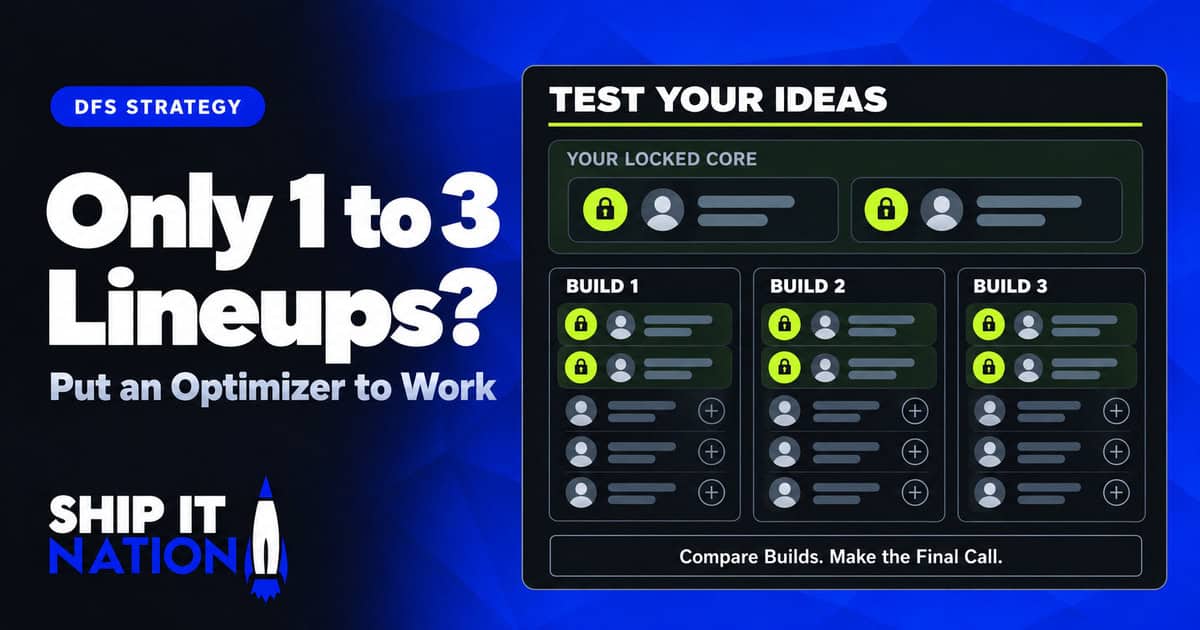
- Lock in your preferred core and let the optimizer test combinations for the remaining roster spots.
- Start with simple builds and use the results to inform your own final decisions.
What an Optimizer Actually Does for a Small Entry Player
Even if you’re only submitting one to three lineups, an optimizer gives you a way to see what the rest of the fieldThe FieldThe field is everyone else entered in a contest, the group of lineups you are competing against.Before you build, picture the typical lineup in your contest. Then decide on purpose where you'll match it and where you'll step away from it.Full explanation ↗ is likely to build. Running a quick, rules free build shows you the kind of chalkyChalkChalk is the most popular, highly owned play on a slate. The term comes from sports betting, where the favorite is called the chalk.Don't label chalk good or bad. Ask whether each popular play deserves its ownership, then decide which chalk you'll eat and which you'll fade.Full explanation ↗, default lineup a large portion of the field will land on without any manual adjustments. That alone is valuable information when you’re deciding how to differentiate your own single entrySingle-EntryA single-entry contest allows each user exactly one lineup. It can be a cash game or a tournament.In single-entry, one or two contrarian decisions are usually enough. Pair a strong, popular core with a lower-owned piece instead of fading everything the field likes.Full explanation ↗.
An optimizer also lets you stress test your own ideas before you commit real money to them. If you’ve hand built a lineup you like, you can run it through an optimizer to see how it compares against the highest projected combinations available, and whether you’re leaving obvious value on the table without realizing it.
Treat It Like Film Study
If you’re entering a single entry or three maxThree-MaxA three-max contest lets each user enter up to three lineups. It is a small step up from single-entry.Give each of your three lineups a clear role. Make sure they differ in at least one major decision, like the main stack or the most expensive player.Full explanation ↗ tournament, think of the optimizer as your film room. You’re not necessarily using it to generate your final lineup. You’re using it to understand the landscape you’re about to compete in, the same way an athlete studies game tape before facing an opponent.
This shift in mindset matters. You’re not outsourcing your decision making to software, you’re using the software to inform decisions you’re still making yourself.
Virtual Hand Building as a Middle Ground
One of the most useful applications for smaller entry players is virtual hand building. Instead of generating a fully automated lineup, you lock in the core pieces you already believe in, whether that’s a favorite value play or a specific correlationCorrelationCorrelation describes how two players' fantasy scores move together. Positively correlated players tend to have big games at the same time, usually because one player's success directly adds points for the other.When you build a tournament lineup, ask which of your players need the same thing to happen. The more of them that do, the higher your lineup's ceiling.Full explanation ↗ you want to build around, and let the optimizer fill in the remaining roster spots based on projections and salary constraints.
This approach keeps your personal convictions front and center while still benefiting from the optimizer’s ability to quickly test different combinations around your core idea, something that would take far longer to do manually with a pen and paper.
Spotting Leverage Before Lock
Optimizers also make it easier to spot leverageLeverageLeverage is the edge you gain by rostering a play the field is underweight on, compared with how often it ends up in winning lineups. When that play outscores the popular option most lineups chose instead, you gain ground on those lineups, though the rest of your roster still decides where you finish.Look for leverage on players connected to the chalk, like the other side of a popular game or a teammate who can steal the popular player's touches.Full explanation ↗ opportunities that might not be obvious just from looking at a slate. Running a few different builds and comparing salary usage, exposure, and combinations across them can highlight players or stacks that offer strong value without being obvious at first glance, something that’s much harder to catch when you’re building entirely from memory and gut feel.
You Don’t Need to Overcomplicate It
None of this means a single entry or three max player needs to master every advanced feature an optimizer offers. You don’t need complex exposure rules or massive multi lineup generation settings if you’re only building a handful of lineups. Start simple. Run a dry build to see the field’s likely default, test your own core ideas against the optimizer’s suggestions, and use that information to sharpen your final decision.
Getting Started
If you’ve never used an optimizer before, the SHIPTIMIZER tool at Ship It Nation is built to work whether you’re generating a handful of lineups or several hundred, which makes it a reasonable starting point regardless of which format you play. The goal isn’t to replace your own judgment. It’s to make sure that judgment is working with better information than a guess made in isolation.
Full video courses on bankroll management, contest selection, roster construction and more, free for members.
Common Questions
Do you need a DFS optimizer for single entry?
The article recommends using one even for a single lineup. It helps you study likely field builds, test your ideas, and identify value you might otherwise miss.
What is virtual hand building in DFS?
Virtual hand building means locking in core players or a preferred correlation, then letting the optimizer fill the remaining spots using projections and salary constraints. It keeps your convictions central while testing combinations around them.
How should a beginner use a DFS optimizer?
Start with a dry build to see the likely default lineup, then test your core ideas against the optimizer's suggestions. Use that information to refine your final lineup without needing to master advanced settings.
Keep reading