On this page
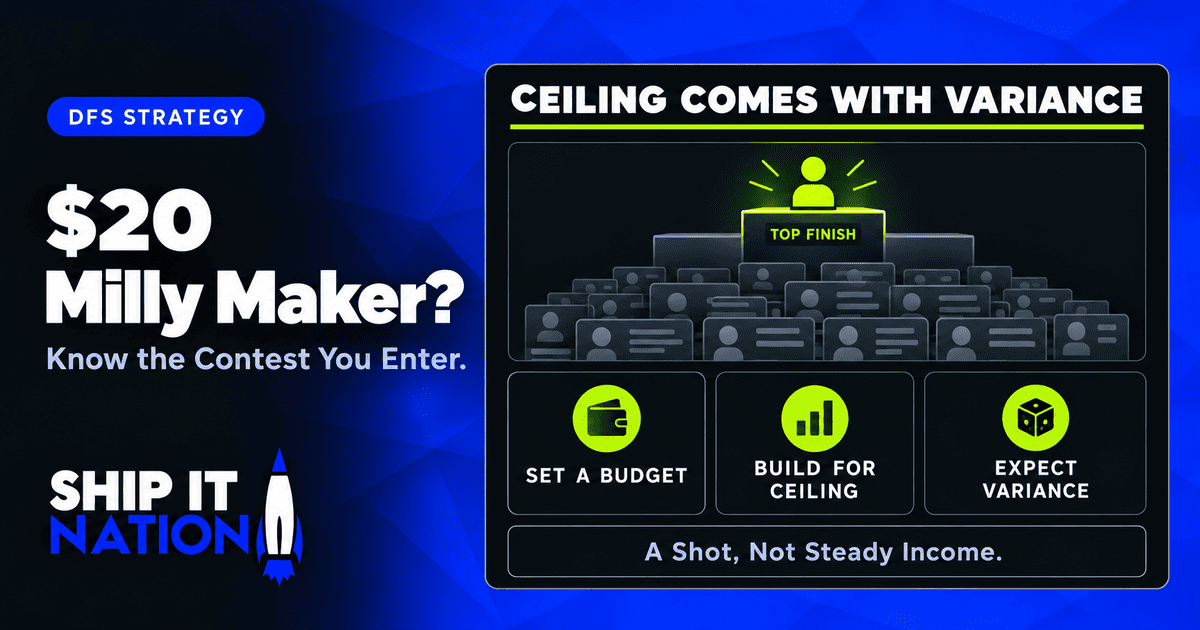
You can reasonably play the $20 Milly MakerGPP (Guaranteed Prize Pool)GPP stands for guaranteed prize pool: a tournament whose prize pool is guaranteed to pay out in full even if the contest does not fill. Payouts are steep: usually only the top 20 to 25 percent of entries get paid, and a small group at the top wins most of the money.Before you enter a tournament lineup, ask how it finishes first, not just how it cashes. If you cannot name that scenario, rebuild it. if you understand the varianceVarianceVariance in DFS describes how widely fantasy scores or contest returns can swing around their expected outcomes. It explains why a sound lineup can lose and a poor decision can sometimes win.Track results by contest type and slate, and review opportunity separately from touchdowns or other rare scoring events. Entering the same lineup in ten contests does not give you ten independent performance samples. If you build with an optimizer, its randomness setting nudges projections up or down on each build, so your lineups spread across different players instead of repeating the same top projections. and use a budget you can afford to lose. Its top heavy payout raises variance, and dead money in a large field can improve a prepared player’s odds. You will lose your entry fee most weeks, so it is not a consistent source of income.
Key takeaways
- Play the Milly Maker only if you understand the variance and use a budget you can afford to lose.
- Dead money can improve a prepared player’s odds, but a top heavy payout raises variance and you will lose your entry most weeks.
- Build for ceiling with correlated stacks and thoughtful differences, and treat the top prize as the bonus, not the plan.
What You’re Actually Entering
A Millionaire Maker is a top-heavy tournament. That means a large share of the prize pool goes to a small number of finishers at the top, while most paid places get a modest return. If you’re not in the top fraction of a percent, you’re looking at a small cash at best.
It is a lottery, with one important difference from a real lottery. Your decisions matter, which means skill can tilt the odds in your favor.
What Dead Money Means
Dead money is the share of the field that isn’t trying very hard. Think of entries made without any research, lineups built from a favorite team and a few household names, or auto-selected rosters. In a field with six figures worth of entries, that group can be sizable.
A larger pool of weak lineups means better odds for a prepared player than the raw field size suggests. That’s a big reason a contest like this can be a reasonable shot for someone who builds with a plan.
The Part Nobody Likes to Hear
A top-heavy payout doesn’t necessarily lower your expected valueValueValue is the fantasy production you expect from a player relative to his salary. A value play offers more production or upside than his price suggests, whether he is cheap or expensive. It is often measured in points per dollar, written as fantasy points per $1,000 of salary: a $5,000 player projected for 20 points is a 4x value, also called the salary multiplier.Identify why the salary looks wrong: workload, matchup, scoring ability or a pricing error. Then check whether that reason still holds when you submit your lineup.. What it does is raise variance. You can play a smart, well-built lineup and still lose your entry fee in the vast majority of weeks, and that’s the normal outcome, not a sign something’s wrong.
If you can’t tolerate a long string of losses, a contest like this isn’t a great fit for a large part of your bankroll. If you can, it’s a reasonable place to take a shot.
| Contest type | Payout shape | Build priority | Variance |
|---|---|---|---|
| Cash game | Flatter, many paid | Safe floor | Lower |
| Flat payout GPP | Flatter tournament | Balance floor and ceiling | Moderate |
| Top heavy GPP such as a Milly Maker | Most of the pool to the top | Ceiling and correlation | High |
How to Budget For It
Treat it like a lottery ticket with an edge, and size it accordingly:
- Decide how much of your weekly budget you’ll allocate to top-heavy contests
- Hold that number steady regardless of last week’s result
- Don’t pull money from your core strategy to fund extra entries
For many players, a small, consistent allocation works better than occasional large swings.
For help with problem gambling, call or text 1-800-MY-RESET.
Build for Ceiling
A lineup built to cash is not the same as a lineup built to win a Milly Maker. If your build is built around safe, high-floorFloorIn daily fantasy sports (DFS), a player's floor is an estimate of the low end of their realistic fantasy scoring range. It describes downside, not a guaranteed minimum or their average projected score.Before trusting a floor estimate, check what could change the player's role today: a returning teammate, a minutes restriction, a lineup change or a different game script. plays, you’re mostly fighting for a min cash in a contest where the top is what matters.
That means more correlated stacks, more willingness to be different in a thoughtful way, and fewer plays chosen purely because they’re safe. You still want logic behind every choice, but you want the upside to be real.
Reframe What Winning Looks Like
This one mindset shift protects you from a lot of regret. Think of the $1 million at the top as the bonus, not the plan. If you finish second and the payout is far below first place, it can feel like you lost hundreds of thousands. Flip the frame. A second-place finish is still life-changing money, and you should treat it that way.
Players who only measure success by first place tend to burn out long before they ever get close.
Should You Play It?
If you understand the variance, you’ve set a budget you can afford to lose, and you’re building lineups specifically for a top-heavy format, then yes, it’s a reasonable contest. If you’re hoping it will be a consistent source of income, it isn’t.
Set the entry as part of a budget you chose in advance, size it against your bankroll, and treat any cash you win as a bonus rather than income.
Check the DraftKings contest rules for the current payout structure.
Review the FanDuel contest rules before entering there.
Go further: DFS PROcess 101 Members
Full video courses on bankroll management, contest selection, roster construction and more, free for members.
Common Questions
Is the $20 Milly Maker worth playing?
It can be, if you understand the variance and play with a budget you can afford to lose. Dead money in a large field can improve a prepared player’s odds, but you will lose your entry most weeks, so it is not a consistent source of income.
What is dead money in DFS?
Dead money is the share of the field not trying very hard, such as entries made without research, lineups built from a favorite team and a few household names, or auto-selected rosters. In a field with six figures worth of entries, that group can be sizable.
How should I build lineups for a Milly Maker?
Build for ceiling, not just to cash. That means more correlated stacks, a willingness to be different in a thoughtful way, and fewer plays chosen purely because they are safe. Keep logic behind every choice, and set a steady budget for top heavy contests.
Need a term explained? The Ship It Nation DFS glossary covers every DFS term we use in plain language. All articles

About the author
Tyler Tamboline
Tyler Tamboline co-founded Ship It Nation and is the face of the brand across our shows and community. He is also the Founder of DFS Mastermind, helping hundreds of DFS players find their own process. He has played DFS since 2012, focusing primarily on PGA and NFL, and has created DFS content full-time since 2018 at different sites across the industry. He is known for strategy, game theory and leverage in large-field tournaments. He has been a regular on many Fantasy Sports podcasts, including weekly PGA and NFL shows with Pat Mayo.
More from Tyler Tamboline