NFL
How to Build NFL DFS Lineups for Thursday and Monday Night Slates
Published by Tyler Tamboline · 5 min read
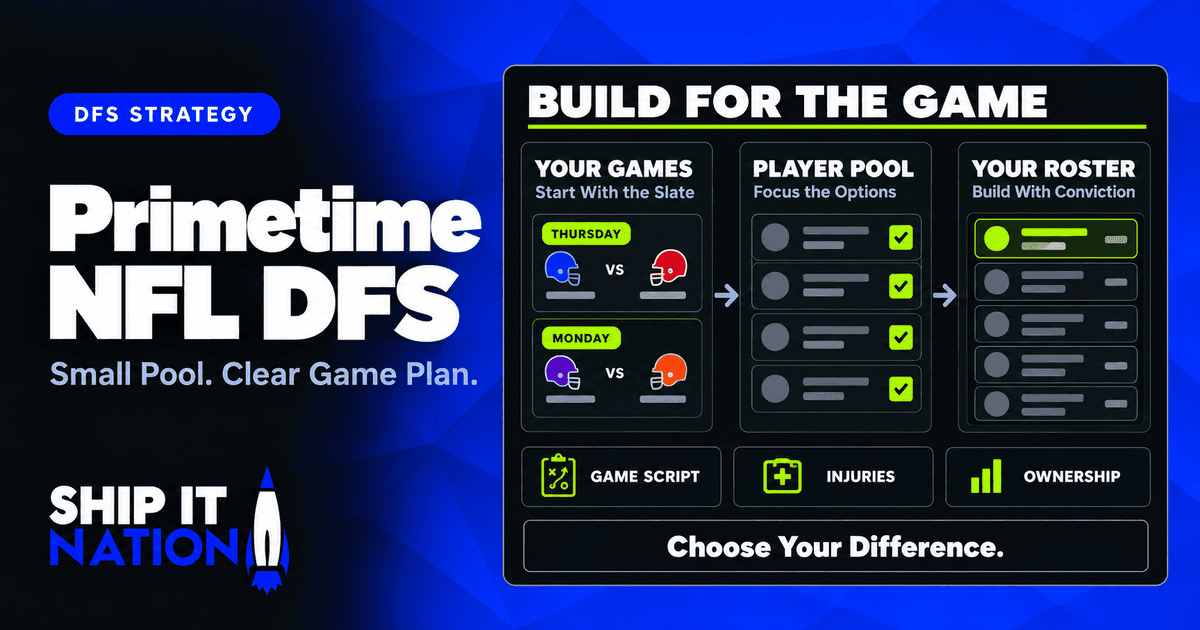
To build NFL DFS lineups for Thursday and Monday night slates, start with the game scriptGame ScriptGame script is how a game's score and time remaining influence its pace, play choices and player opportunities. In football, teams protecting a lead often run more, while teams chasing a deficit often pass more.Before locking a lineup, ask who keeps playing if your expected script reverses. Check passing-down roles and backup rotations instead of assuming a team's leading rusher handles every situation. and the injury newsInjury NewsInjury news is information about a player's health that can change whether they compete, how much they play or how effectively they perform. In DFS, it also affects opportunities for teammates and opponents.Before an uncertain player's game locks, identify an alternative you can afford at each affected position. Check whether making that change would require another player whose game starts earlier., because the smaller player pool pushes the field toward the same obvious players. Your edge comes from deciding which obvious plays to be different on. Check the contest lobby for the format, roster rules, and cap.
Key takeaways
- On a short slate the smaller player pool pushes the field toward the same obvious players, so your edge is choosing which obvious plays to be different on.
- Check the game total, spread, injuries, and depth charts first, and build a contingency plan for any key player who is questionable.
- In cash games favor high floor players with stable roles, and in tournaments build one coherent game script with a stack and a bring-back.
What Makes a Short Slate Different?
A full Sunday slate has a dozen or more games and hundreds of players. A single game or a two game window has far fewer options. That shrinks the number of choices, and it also pushes more of the field toward the same few players.
With fewer options, ownership concentratesOwnershipOwnership is the percentage of lineups in a contest that include a given player. Projected ownership is an estimate made before lock; actual ownership is posted once the contest locks.Ownership isn't something to avoid; it's something to build around. The goal is understanding how the field is likely to build, then finding your edge relative to that.. Everyone sees the same quarterback, the same top receivers, and the same obvious valueValueValue is the fantasy production you expect from a player relative to his salary. A value play offers more production or upside than his price suggests, whether he is cheap or expensive.Identify why the salary looks wrong: workload, matchup, scoring ability or a pricing error. Then check whether that reason still holds when you submit your lineup. plays. Your work shifts from finding hidden players to deciding which of the obvious ones you want to be different on.
What Format Will You Be Playing?
Short windows usually offer a Showdown or single-game format, and sometimes a classic style slate if there are multiple games. Check the contest lobby for the format, the roster rules, and the cap, since details change.
For a one game slate, you may be playing a captain format where you pick one player to score extra points. If you want help with that, our guides on captain and MVP strategy cover the slot choice. The principles below apply to any short slateSlate SizeSlate size is the number of games or matchups included in a DFS contest's schedule. In sports built around one event, it can instead describe the number of eligible competitors; it does not mean the number of contest entries.Before building, count the credible alternatives at each position. A slate with plenty of games can still leave you with very few appealing choices at one position..
How Do You Start Your Research?
Begin with the matchup itself. Short slates give you more time per game, so use it.
- Read the game total and spread to understand the expected script.
- Check injuries and practice reports for every key player.
- Note which teams lean on the pass, which lean on the run, and how those fit the matchup.
- Look at depth charts for backups who could take on larger roles.
Thursday and Monday games often come with a short week or a long week, which changes preparation and sometimes injury status. Check the latest reports closer to kickoff than you would for a Sunday lineup.
How Do You Handle Injuries on a Short Slate?
Injury news matters more here, because one player ruled out can change the whole slate. If a starting running back is out, his backup may be the most popular value play on the board, with ownership to match.
Do not just click the backup because everyone does. Ask whether his price already reflects the role and whether the offense supports a big workload. A popular value is often still good, but you want to understand why before you build around it.
Also build contingency. If a key player is questionable, think about both versions of your lineup and decide which one you prefer. Late swap, where available, can help here, but you need a plan first.
Where Does Ownership Matter?
On a short slate, the field often clusters around the same lineup constructionsRoster ConstructionRoster construction is how you organize a DFS lineup within its salary cap and roster rules. It includes where you spend or save, which positions you prioritize, and how your players fit together.Build two versions around your biggest spending decision, then compare every player who changes. Revisit the comparison when injury news changes the available value.. In a tournament, that is a chance for leverage.
Look for the places where the field is likely to go wrong. Maybe everyone is stackingStackingStacking means rostering multiple players connected by the same team, game or expected conditions. You usually build a stack so one favorable outcome helps several lineup spots, although the connection works differently across sports.Before locking a stack, explain how its players benefit together. Then check their actual roles, combined salary and whether adding another player strengthens that connection or just fills a spot. one team and ignoring the other side. Maybe the obvious captain is being overplayed. Maybe a mid-priced receiver with a good matchup is being overlooked.
You do not need to fade every popular player. You need to find two or three spots where your lineup is different for a good reason.
How Do You Build for Cash and Tournaments?
In cash games, favor high floor players and stable roles. Volume matters, so target players with predictable touches and targets. Avoid lineups that depend on a touchdown from a fringe player.
In tournaments, build around one game script and make your lineup tell a coherent story. If you expect a shootout, stack the quarterback with his pass catchers and add a bring-back from the other side. If you expect a defensive game, consider a lower scoring approach with a defense and a lead running back.
| Contest type | What to prioritize | Build approach | Main risk |
|---|---|---|---|
| Cash games | High floor players and stable roles | Predictable touches and targets | Relying on a touchdown from a fringe player |
| Tournaments, expected shootout | Game script that produces points | Stack the quarterback with pass catchers plus a bring-back | Playing the same stack as the field |
| Tournaments, expected defensive game | Lower scoring script | Defense plus a lead running back | Capping your ceiling if the game opens up |
What About Kickers and Defenses?
On a short slate, kickers and defenses can matter more because the player pool is small. A defense in a favorable matchup can be a strong play, especially if the opposing offense is turnover prone or has a weak offensive line. Check the current rules on your site to see how each position is scored.
Do not overpay just because the position feels important. Compare each option to the next best choice and decide whether the gap justifies the price.
What Should You Do Before Kickoff?
Because these games usually start in the evening, you may have more time to wait for news than on Sunday. Use it.
- Check inactive lists as soon as they are released, when the site allows changes
- Revisit your lineup if a key player is ruled out
- Confirm that late swap is available and what it allows
- Save your lineups and decisions so you can review afterward
A calm routine helps. You are not trying to build the perfect lineup. You are trying to build a lineup that makes sense for a game you understand.
Review After the Game
After a short slate, write down what you got right and wrong. Short slates give fast feedback on game script and ownership, and a short note after each one adds up over a season.
Full video courses on bankroll management, contest selection, roster construction and more, free for members.
Common Questions
How do you build NFL DFS lineups for Thursday night football?
Start with the game total, spread, and injury news, because a small player pool pushes the field toward the same players. Then pick two or three spots where your lineup is different for a good reason, and check the contest lobby for the format, roster rules, and cap.
Does ownership matter more on a short NFL DFS slate?
Yes, because ownership concentrates when there are fewer options. Everyone sees the same quarterback, top receivers, and obvious value plays. In a tournament that creates a chance for leverage, but you do not need to fade every popular player, only find a few spots where you are different on purpose.
What should you do when a starter is ruled out on a short slate?
Expect his backup to become a popular value play, then ask whether the price already reflects the role and whether the offense supports a big workload. A popular value is often still good, but understand why before building around it, and plan both versions of your lineup in advance.
Need a term explained? The Ship It Nation DFS glossary covers every DFS term we use in plain language.

About the author
Tyler TambolineTyler Tamboline co-founded Ship It Nation and is the face of the brand across our shows and community. He is also the Founder of DFS Mastermind, helping hundreds of DFS players find their own process. He has played DFS since 2012, focusing primarily on PGA and NFL, and has created DFS content full-time since 2018 at different sites across the industry. He is known for strategy, game theory and leverage in large-field tournaments. He has been a regular on many Fantasy Sports podcasts, including weekly PGA and NFL shows with Pat Mayo.
More from Tyler Tamboline →Keep reading