NBA
NBA DFS Strategy: How to Build Lineups Around Injuries and Usage
Published by Ship It Nation Staff · 5 min read
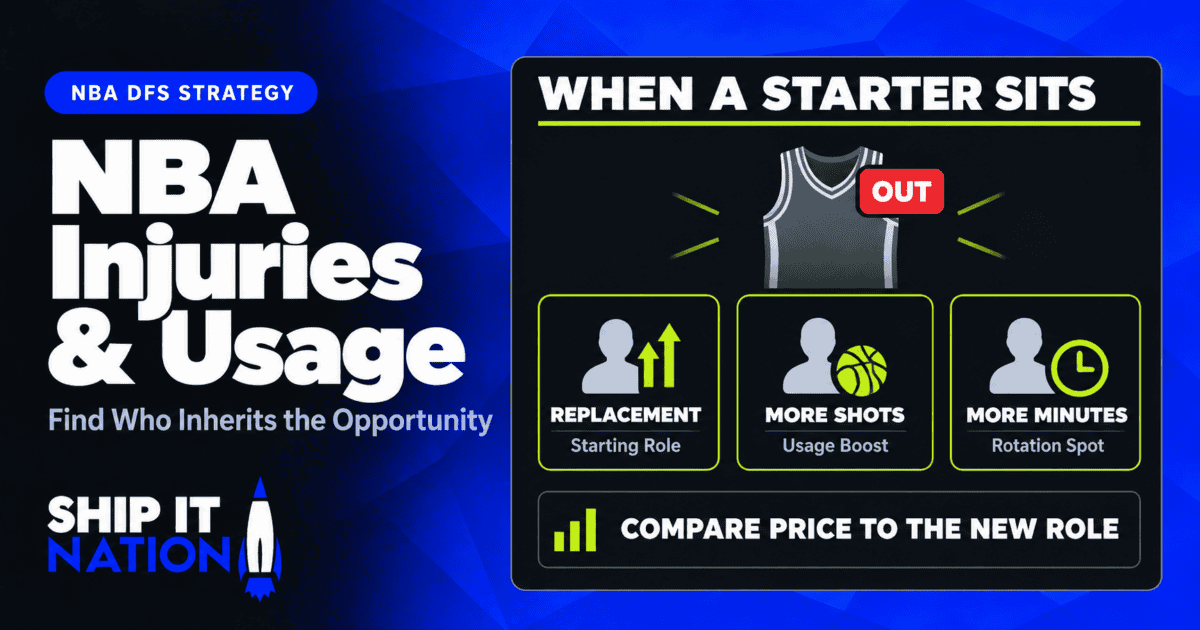
To build NBA DFS lineups around injuries and usage, target the teammates who inherit the minutes and shots when a rotation player is ruled out, before salaries catch up. Salaries adjust slowly, so a bench player who gets 30 minutes is often priced like an 18 minute player. Fantasy output is minutes times usage times efficiency.
Key takeaways
- Target teammates who inherit minutes and shots when a rotation player is out, because salaries adjust slowly.
- Estimate output as minutes times usage times efficiency, and look at games where the same player was out before.
- Once a replacement’s role is obvious the field will pile on, so pair him with less common pieces or choose the overlooked second-order beneficiary.
Why Do Injuries Matter So Much in NBA DFS?
On most sites, NBA classic contestsClassic ContestsClassic contests are the standard salary-cap DFS format: you select a full lineup from a designated set of games or events within a fixed budget. Roster requirements and scoring depend on the sport and site.Check the included games before building. A Classic contest can cover a small afternoon slate rather than the full day, changing your available players and lineup options. use eight roster spots under a salary cap (check the current rules on the site for the exact format and cap). That is a lot of roster spots to fill with real production, and the scoring rewards counting stats across the board: points, rebounds, assists, steals, blocks, and bonuses for things like threes and double-doubles. Players who play more minutes and touch the ball more get more chances at all of it.
When a starter sits, a chunk of that opportunity has to go somewhere. Salaries are set early and adjust slowly, so a bench player who suddenly gets 30 minutes is often priced like an 18 minute player. That gap between price and expected role is where valueValueValue is the fantasy production you expect from a player relative to his salary. A value play offers more production or upside than his price suggests, whether he is cheap or expensive.Identify why the salary looks wrong: workload, matchup, scoring ability or a pricing error. Then check whether that reason still holds when you submit your lineup. lives.
What Is Usage, and Why Should You Care?
Usage rateUsage RateUsage rate estimates the percentage of a team's offensive plays a player uses while on the court, based on shot attempts, free throw attempts and turnovers. It does not measure assists or time spent holding the ball.Check who shared the floor in any usage sample. Numbers collected against reserves or with several starters missing may not describe the role you are projecting tonight. is the share of a team’s possessions a player finishes with a shot, a turnover, or free throws while he is on the floorFloorIn daily fantasy sports (DFS), a player's floor is an estimate of the low end of their realistic fantasy scoring range. It describes downside, not a guaranteed minimum or their average projected score.Before trusting a floor estimate, check what could change the player's role today: a returning teammate, a minutes restriction, a lineup change or a different game script.. High usage players create the fantasy points that come from scoring and assists. Minutes are the other half of the equation. A high usage player on a minutes restrictionInjury NewsInjury news is information about a player's health that can change whether they compete, how much they play or how effectively they perform. In DFS, it also affects opportunities for teammates and opponents.Before an uncertain player's game locks, identify an alternative you can afford at each affected position. Check whether making that change would require another player whose game starts earlier. is worth less than a medium usage player who will play 36.
Think of fantasy output as minutes times usage times efficiency. You can estimate the first two with a little research:
- How many minutes has this player averaged in recent games with similar teammates available?
- When the injured player was off the floor in the past, who took the shots?
- Is the role changing because of a lineup shift, or only because of one absence?
Look for samples where the same player was out before. A few games of data is better than a season average that includes healthy lineups.
How Do You Find the Real Beneficiaries?
| Beneficiary group | Who it is | Pricing risk | How to use |
|---|---|---|---|
| Direct replacement | Backup who steps into the starting role | Price usually moves, but not always enough | Check price against realistic role |
| Usage inheritors | Star or second option who takes more shots | Expensive, upside climbs with each absence | Pair with less common pieces in large fields |
| Minutes absorbers | Deep bench players who move into the rotation | Cheap punt options | Choose those with a real role, not just a roster spot |
Start with position. If a point guard is out, the backup point guard is the obvious pick, but so is the wing who handles the ball more. Often the obvious backup is already priced up by the time you load the slateSlateA slate in DFS is the set of games, races, fights or tournament rounds covered by a contest. It determines which events your player selections can come from and which performances count toward your score.Before building, open the contest details and check the included events, scoring period and lock rules. Do not assume two sites offer identical slates just because both call them the main slate., and the second-order beneficiary is not.
Check these three groups:
The direct replacement. The backup who steps into the starting role. His price usually moves, but not always enough.
The usage inheritors. The star or second option who takes more shots when a scorer is gone. These players are expensive, but their upside climbs with every missing teammate.
The minutes absorbers. Deep bench players who move into the rotation. These are your punt options, and the ones who matter are the ones with a real role, not just a spot on the roster.
How Do You Handle Questionable Tags?
Many injury designations are uncertain until close to lock. You will face lineup decisions before the news is clear. Two approaches work.
First, you can build around players who benefit whether or not the injured player suits up. If a role player is useful in both situations, he is safe to roster early.
Second, you can lock in a lineup only after you know the news. Many players wait until the final reports before finalizing, especially in single entry and smaller contests where one wrong guess is costly. In larger multi-entry play, you can spread across both outcomes: some lineups assume the star plays, others assume he is out.
Whatever you choose, never roster a player you cannot afford to see scratched unless you have a plan to swap him or a replacement who covers the same slot.
What Does Ownership Do to Injury Value?
The edge in injury spots is real, but everyone sees the same news. Once the replacement’s role is obvious, a large share of the field will roster him. The cheap backup might be the most popular player on the slate.
That does not make him a bad play. It means his value is partly shared. In big tournaments you need a path to separate yourself. You can do that by pairing the chalk replacement with less common pieces elsewhere, or by choosing the second-order beneficiary the field overlooks.
What About Blowouts and Pace?
Injuries are one input. Game environment is another. A game with a high total and a close spread gives starters their full minutes. A lopsided game can send starters to the bench early, which hurts even a player with a big role. When you find an injury spot, check whether the game script works for it.
Pace matters too. Faster teams create more possessions, which means more shots and more rebounds to go around. A usage bump on a fast team is worth more than the same bump on a slow one.
A Simple Process for Every Slate
- Check the injury report early and again close to lock.
- List who gains minutes and who gains usage.
- Compare each candidate’s price to a realistic role.
- Check the game total and spread.
- Decide how much of the field is likely on the same plays.
- Build lineups that match your plan for ownershipOwnershipOwnership is the percentage of lineups in a contest that include a given player. Projected ownership is an estimate made before lock; actual ownership is posted once the contest locks.Ownership isn't something to avoid; it's something to build around. The goal is understanding how the field is likely to build, then finding your edge relative to that..
Injury news rewards players who prepare. The more you practice this process, the faster you will spot the situations the field gets wrong.
Full video courses on bankroll management, contest selection, roster construction and more, free for members.
Common Questions
How do injuries create value in NBA DFS?
When a starter sits, his minutes and shots go to teammates, and salaries are set early and adjust slowly. A bench player who gets 30 minutes is often priced like an 18 minute player. That gap between price and expected role is where value lives.
What is usage rate and why does it matter?
Usage rate is the share of a team’s possessions a player finishes with a shot, a turnover, or free throws while on the floor. It creates fantasy points from scoring and assists. Pair it with minutes, since a high usage player on a restriction is worth less.
What should I do with questionable players before lock?
Either build around players who benefit whether or not the injured player suits up, or lock a lineup only after you know the news. In larger multi-entry play you can spread across both outcomes. Never roster someone you cannot afford to see scratched without a swap plan.
Need a term explained? The Ship It Nation DFS glossary covers every DFS term we use in plain language.

About the author
Ship It Nation StaffShip It Nation was founded in 2023 by Tyler Tamboline and Mike Petta to give DFS players the tools, projections, content, and community they need to build a winning process. Today, we're a fully remote team of active DFS players, analysts, and builders.
More from Ship It Nation Staff →Keep reading