Lineup Building
How to Review Your DFS Slates: A Post Mortem Framework for Improvement
Published by Tyler Tamboline · 3 min read
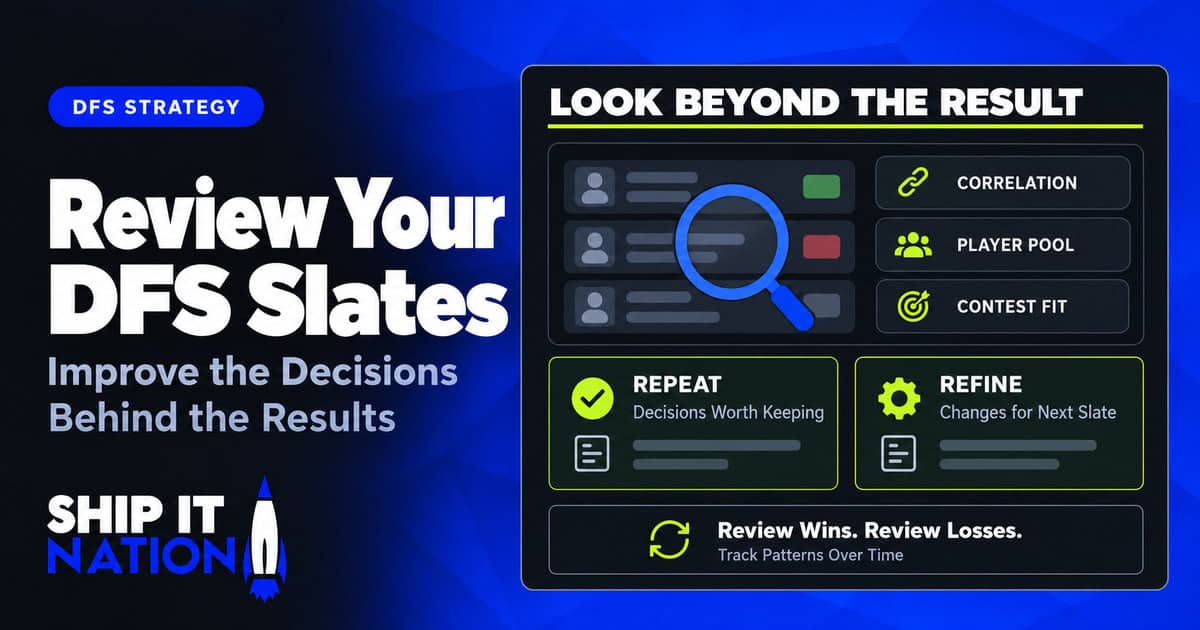
Most DFS players play a slate, see their results, and move straight on to the next one without ever really digging into why things happened the way they did. That’s a missed opportunity. The players who improve fastest are almost always the ones who build a genuine review habit into their weekly routine, regardless of whether the slate was a win, a loss, or somewhere in between.
Key takeaways
- Review the decisions behind your results, including whether your correlations and player pool fit the contest.
- Examine wins and losses to distinguish repeatable decisions from variance.
- Track patterns over time, but focus on decision quality if tracking becomes a source of anxiety.
Why Review Gets Skipped
It’s easy to understand why review gets neglected. After a losing slate, nobody wants to relive the disappointment. After a winning slate, the temptation is to just enjoy the result and move on. Either way, the actual lesson available in that slate often goes unexamined.
The Core Questions to Ask After Every Slate
A useful review doesn’t need to be complicated. After each slate, ask yourself what actually worked in your lineups and what didn’t. Ask which decisions you’d repeat next week without hesitation, and which ones you’d change if you had the chance to do it over again.
Go beyond just looking at your final result. Look at the actual decisions that led there. Did you build around a correlation that made sense, or did you force a stack just because a projection tool told you to? Did your player pool actually match the contest type you entered, or were you playing a wide MME pool inside a three max slate without realizing the mismatch?
Reviewing Wins Matters Just as Much as Reviewing Losses
It’s tempting to only dig into the slates that went badly, but reviewing your wins is just as valuable. Ask honestly whether a winning result came from a sharp, repeatable decision or largely from varianceVarianceVariance in DFS describes how widely fantasy scores or contest returns can swing around their expected outcomes. It explains why a sound lineup can lose and a poor decision can sometimes win.Track results by contest type and slate, and review opportunity separately from touchdowns or other rare scoring events. Entering the same lineup in ten contests does not give you ten independent performance samples. If you build with an optimizer, its randomness setting nudges projections up or down on each build, so your lineups spread across different players instead of repeating the same top projections. breaking your way. If it was variance, that’s fine to acknowledge, but it shouldn’t be mistaken for proof that a particular approach is reliably working.
Tracking Your Results Over Time
A review process is much more useful when it’s paired with consistent tracking. Tools like RotoTracker or a bankroll tracker like the one offered through The Solver can help you spot patterns across a larger sample than your memory alone can reliably hold onto. Over time, tracking can reveal which contest types you actually perform best in, which lineup constructionRoster ConstructionRoster construction is how you organize a DFS lineup within its salary cap and roster rules. It includes where you spend or save, which positions you prioritize, and how your players fit together.Build two versions around your biggest spending decision, then compare every player who changes. Revisit the comparison when injury news changes the available value. styles tend to produce your strongest results, and where recurring mistakes might be quietly costing you.
One word of caution here. For some players, obsessively tracking every result during a rough stretch can do more harm than good, turning review into a source of anxiety rather than a tool for learning. If that starts happening, it’s worth stepping back and focusing on the qualitative side of review, the actual decisions made, rather than fixating purely on the numbers during a cold spell.
Defining Success Beyond Just Winning
Part of a good review process is being honest about what success actually looks like for you. A lineup that finished just outside the money but had a legitimate path to a much bigger result is a different kind of outcome than a lineup that never had a real chance from the start, even if both technically lost. Recognizing near misses that reflect a sound process is important, since it’s easy to only credit yourself for outright wins and overlook the value of a strong process that simply didn’t get there this time.
Building Review Into Your Routine
Set aside dedicated time after each slate, even if it’s just fifteen minutes, to run through these questions while the decisions are still fresh in your mind. Waiting too long to review makes it harder to accurately recall why you made specific choices, which defeats much of the purpose.
A consistent review habit is one of the simplest, least glamorous parts of a strong DFS process, but it’s also one of the most reliable ways to actually improve over time instead of just repeating the same decisions slate after slate and hoping for a different outcome.
Full video courses on bankroll management, contest selection, roster construction and more, free for members.
Common Questions
How do you review a DFS slate?
Identify what worked, what failed, and which decisions you would repeat or change. Examine your correlations and whether your player pool matched the contest while your reasoning is still fresh.
Should you review winning DFS lineups?
Yes. Determine whether the win came from a sharp, repeatable decision or variance, rather than assuming a positive result proves your approach works.
How does tracking DFS results help you improve?
Consistent tracking can reveal patterns in contest performance, lineup construction, and recurring mistakes. If tracking creates anxiety during a rough stretch, step back and focus on the decisions behind your results.
Need a term explained? The Ship It Nation DFS glossary covers every DFS term we use in plain language.

About the author
Tyler TambolineTyler Tamboline co-founded Ship It Nation and is the face of the brand across our shows and community. He is also the Founder of DFS Mastermind, helping hundreds of DFS players find their own process. He has played DFS since 2012, focusing primarily on PGA and NFL, and has created DFS content full-time since 2018 at different sites across the industry. He is known for strategy, game theory and leverage in large-field tournaments. He has been a regular on many Fantasy Sports podcasts, including weekly PGA and NFL shows with Pat Mayo.
More from Tyler Tamboline →Keep reading