NFL
Tight Ends in NFL DFS: When to Pay Up and When to Punt
Published by Tyler Tamboline · 5 min read
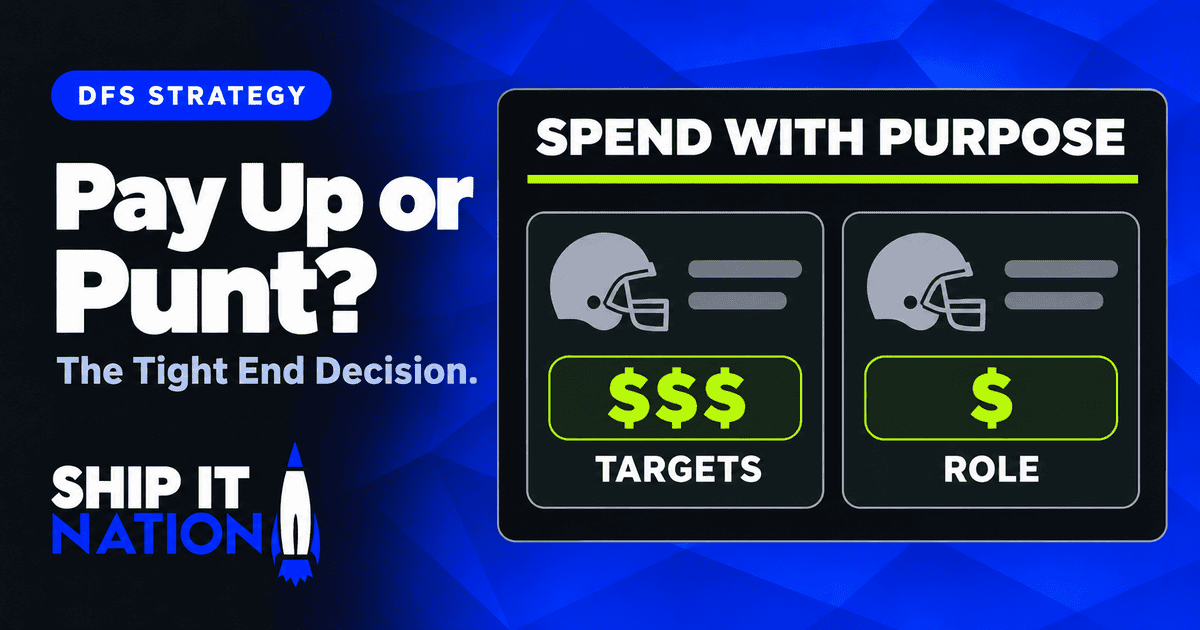
Pay upSpending UpSpending up means choosing a higher-priced player over a cheaper alternative, using more of your lineup's salary budget at that spot. You may also hear it called paying up.Build a version with your preferred expensive player and another without. Before choosing, check whether either version relies on a cheap player whose expected role still depends on unresolved injury news. for an elite tight end when his team role mirrors that of a true number-one wide receiver in a high-octane offense. Conversely, choose to punt the position when a cheap backup inherits a massive role due to an injury, or when the rest of the field is heavily overpaying for mediocre mid-tier options. Tight end is primarily a structural salary decision that can instantly set your roster apart from the field.
Key takeaways
- The Salary Seesaw: Tight end operates as a core financial valve; every dollar saved or spent at the position directly dictates the high-volume caliber of your running back and wide receiver pools.
- Unique Roster Geometry: In a large tournament, deliberately going against the field's collective strategy at tight end is an exceptional way to build a completely differentiated lineup shape.
- Leverage via Stacking: Integrating a high-target tight end into a team stack allows you to capture clean, explosive quarterback passing volume while maintaining low cumulative lineup ownership.
Why Is Tight End Such a Unique Position?
The vast majority of tight ends in the NFL are low-scoring, blocking-first options who run minimal routes. Only a select handful operate as true high-volume focal points in their team’s passing games. This massive talent and utilization gap transforms the tight end position into a crucial salary-cap allocator. Both paying up for raw volume and punting for cap relief are entirely viable; the correct choice is dictated by individual slate dynamics.
When Should You Pay Up?
You should pay up when a top-tier tight end commands a dominant target shareTarget ShareTarget share is the percentage of a team's targets (passes thrown toward an intended receiver) that go to one player. A receiver who sees 8 of his team's 32 targets has a 25 percent target share.Judge target share over the last three or four games, not the full season, especially after a trade, an injury or a quarterback change. The most recent role is the one you are paying for., runs consistent routes out of the slot, and serves as his quarterback’s primary red-zone threat. Pairing an elite tight end with an excellent matchup significantly elevates your lineup’s overall ceilingCeilingCeiling is the high end of a player's or lineup's realistic range of fantasy scores. It describes a big performance that could happen when things go well, not the expected score or an absolute maximum.Describe what must happen for each player to have a huge game. Then check whether those conditions help or hurt the other players in your lineup..
Paying up is incredibly powerful in large tournaments if the general public is collectively punting the position. If 80% of the field enters lineups with a sub-$3,000 tight end, paying up for a premium $6,500 option gives you an immediate structural advantage. If your premium tight end posts a massive score while the cheap punts fail, your roster shape instantly separates you from the masses.
When Should You Punt?
Punting means choosing a player priced near the absolute salary floor. This strategy is highly optimal when an injury opens up clear starting snaps and route volume for a cheap backup. By saving significant salary at tight end, you gain the financial flexibility to jam two premium wide receivers or an elite workhorse running back into your lineup.
However, never punt with a cheap tight end who has no defined role or targets. A punt play is only viable if the player possesses a realistic path to running consistent routes or earning red-zone looks. Rostering a zero-target tight end completely dead-weights a roster spot.
How Does Salary Pressure Work?
Every individual dollar you choose to save or spend at tight end directly impacts the structural integrity of the rest of your roster. Opting to punt the position completely relieves salary-cap pressure, immediately allowing you to afford a premium workhorse running back or a second elite, alpha wide receiver. Conversely, choosing to pay up for a premium tight end forces you to embrace cheap value options at your WR2, WR3, or FLEX positions.
When building, always evaluate the macro-geometry of the slate. Ask yourself where your marginal salary dollars produce the highest expected points-per-dollar compared to the general public. If the entire field is reflexively herd-building their lineups using the exact same strategy, the most profitable move is to locate exactly where the public is leaving immense, unowned value on the board.
Pay Up or Punt Framework
| Slate Situation | Strategic Move | Core Analytical Reason |
|---|---|---|
| Elite Target Volume & High Team Total | Pay Up | Receiver-like route participation yields a massive floor/ceiling |
| Field is Collectively Punting Heavily | Pay Up (GPP) | Instantly creates an unusual, high-leverage roster shape |
| Cheap Backup Inherits Starting Snaps | Punt | Extreme salary relief can easily outproduce a low-price tag |
| Cheap Option in Low-Volume, Block-Heavy Scheme | Avoid | Low floor with zero ceiling completely wastes a vital roster spot |
How Does Tight End Fit into a Stack?
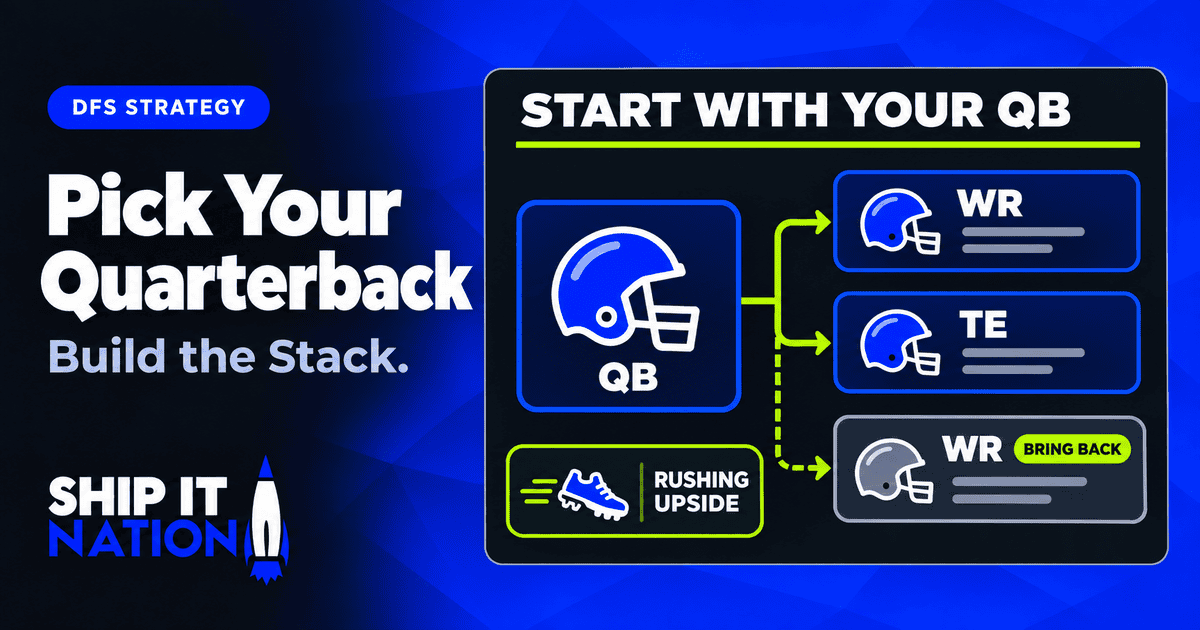
Utilizing a tight end on the same team as your quarterback introduces a highly potent, alternative correlation partner. If a team’s primary alpha wide receiver is carrying heavy projected ownership across the field, substituting or pairing him with the team’s starting tight end drastically lowers the overall ownership of the stackOwnershipOwnership is the percentage of lineups in a contest that include a given player. Projected ownership is an estimate made before lock; actual ownership is posted once the contest locks.Ownership isn't something to avoid; it's something to build around. The goal is understanding how the field is likely to build, then finding your edge relative to that. while keeping elite passing-game correlation fully intact. This structural pivot is one of the single easiest ways to keep a popular quarterback play highly unique in large tournament fields.
Furthermore, a high-volume tight end functions as an exceptional “bring-back” asset from an opposing team. This is particularly effective in fast-paced games with high implied over/under totals, where both passing offenses are expected to go back-and-forth in a high-scoring shootout environment.
What Should You Check Before Lock?
The tight end position is notoriously volatile and highly sensitive to late-breaking injury news. Closely monitor the NFL injury report and final inactive lists right up until kickoff. The unexpected absence of a starting pass-catcher instantly funnels a massive chunk of vacated targets to a cheap backup tight end, yielding an immediate value play. Also, keep tabs on the National Weather Service forecast, as sustained high winds can severely degrade a team’s downfield passing attack.
Check the current rules for your contest if you plan to use late swap to ensure you maintain pivot flexibility. If your primary low-priced punt option is officially ruled out in a late-afternoon game, ensure you have an alternate, similarly priced value pivot completely pre-planned. Never force yourself to scramble or make panicked roster modifications at the final minute.
How Should You Decide?
Rostering a tight end is mathematically a salary-allocation decision first and an individual player evaluation second. Accurately project how the field will collectively build their rosters on a given slate, decide whether to aggressively pay up or systematically punt based on where the tournament field is leaving structural leverage, and ensure your chosen target possesses a defined, locked-in route-participation role. Whichever path you deploy, utilize that structural choice to purposefully maximize the baseline ceiling of your remaining skill-position spots.
Full video courses on bankroll management, contest selection, roster construction and more, free for members.
Common Questions
When should you pay up for a tight end in NFL DFS?
You should pay premium prices when a top-tier tight end commands a dominant, wide-receiver-like target share alongside heavy red-zone utilization in a highly efficient offense. Additionally, paying up is incredibly powerful in GPP tournaments when the general public is collectively punting the position, giving your lineup an immediate structural advantage.
When should you punt at tight end in NFL DFS?
Choose to punt the position when a clear injury or depth-chart shift elevates a cheap backup into a temporary starting role with high projected route participation. Completely avoid cheap tight ends who possess zero defined targets or volume, as a sub-five-point performance completely dead-weights a vital roster slot.
How does a tight end fit into a stack?
A tight end on the same team as your quarterback serves as an excellent, direct correlation partner. Stacking a quarterback with his starting tight end instead of his highly popular wide receiver allows you to perfectly maintain elite passing-game upside while keeping your total lineup ownership extremely low.
Need a term explained? The Ship It Nation DFS glossary covers every DFS term we use in plain language.

About the author
Tyler TambolineTyler Tamboline co-founded Ship It Nation and is the face of the brand across our shows and community. He is also the Founder of DFS Mastermind, helping hundreds of DFS players find their own process. He has played DFS since 2012, focusing primarily on PGA and NFL, and has created DFS content full-time since 2018 at different sites across the industry. He is known for strategy, game theory and leverage in large-field tournaments. He has been a regular on many Fantasy Sports podcasts, including weekly PGA and NFL shows with Pat Mayo.
More from Tyler Tamboline →Keep reading