NFL
How to Pick a Quarterback in NFL DFS: Price, Rushing Upside, and Stack Partners
Published by Tyler Tamboline · 4 min read
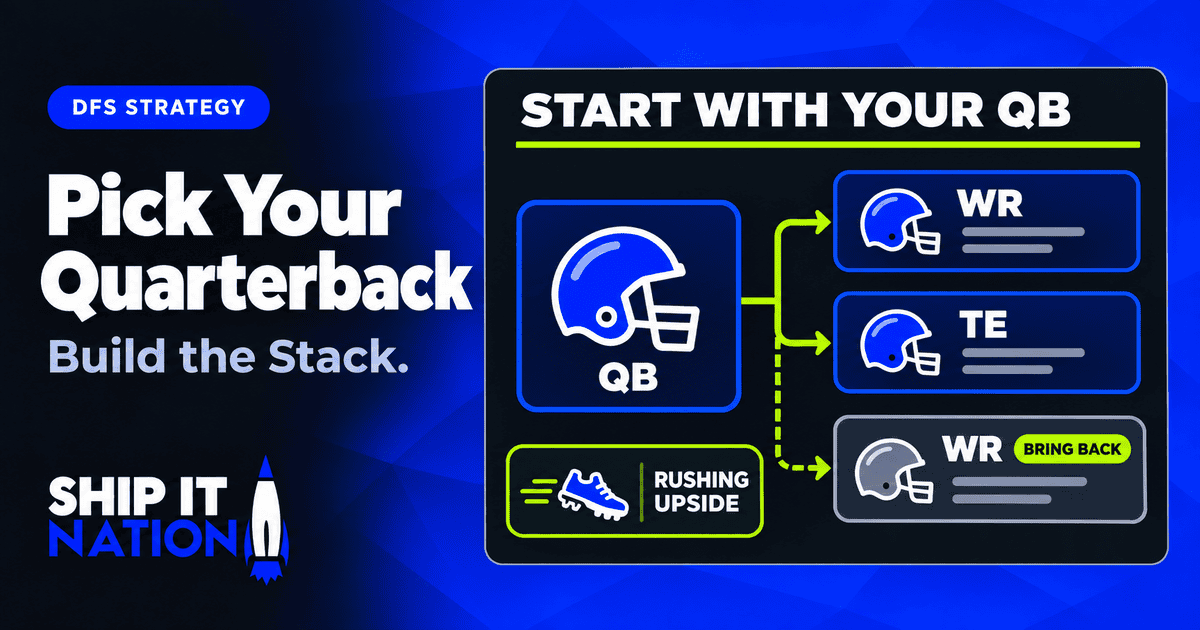
To pick a quarterback in NFL DFS, you must evaluate the overall game environment, rushing upside, potential stackingStackingStacking means rostering multiple players connected by the same team, game or expected conditions. You usually build a stack so one favorable outcome helps several lineup spots, although the connection works differently across sports.Before locking a stack, explain how its players benefit together. Then check their actual roles, combined salary and whether adding another player strengthens that connection or just fills a spot. partners, and salary constraints. Quarterbacks who accumulate points with their legs carry a substantially higher floorFloorIn daily fantasy sports (DFS), a player's floor is an estimate of the low end of their realistic fantasy scoring range. It describes downside, not a guaranteed minimum or their average projected score.Before trusting a floor estimate, check what could change the player's role today: a returning teammate, a minutes restriction, a lineup change or a different game script., and the optimalOptimal LineupAn optimal lineup is a legal roster that maximizes fantasy points under the salary cap and roster rules. After games, it uses actual scores; before games, a projected optimal uses estimated scores and any lineup restrictions you set.When reviewing an optimal, replace its most surprising scorer with a realistic pregame alternative. Check whether the remaining construction still offered a credible path to winning your contest. quarterback pick is almost always the one that correlates best with the pass-catchers you intend to stack alongside him.
Key takeaways
- Sequential Decision Making: Select your quarterback using a strict four-step analytical funnel: evaluate the game environment, isolate rushing metrics, identify stacking partners, and manage price.
- The Rushing Insulation: Dual-threat quarterbacks who accumulate fantasy value with their legs possess an elite baseline floor because rushing yards and rushing scores are heavily weighted over passing statistics.
- Roster Shape Leverage: In massive fields, evaluate general public pricing trends. Building an unusual roster shape around premium or bottom-tier quarterbacks creates massive, organic tournament leverage.
Why Is the Quarterback Decision Different?
You only roster a single quarterback in classic lineupsClassic ContestsClassic contests are the standard salary-cap DFS format: you select a full lineup from a designated set of games or events within a fixed budget. Roster requirements and scoring depend on the sport and site.Check the included games before building. A Classic contest can cover a small afternoon slate rather than the full day, changing your available players and lineup options., and he touches the ball on every single offensive snap. This makes the position far more projectable than volatile skill positions, but it also means a poor performance can single-handedly tank your lineup. Because quarterback pricing is usually tightly compressed, finding the optimal play comes down to micro-details like projected pace, team totals, and structural correlation.
Your quarterback choice also dictates the baseline structure of your lineup. His passing touchdowns score simultaneous points for your wide receivers or tight ends, directly linking multiple roster spots together through positive correlation.
What Makes a Quarterback Valuable?
Always evaluate the projected game environment first. A quarterback playing on a team with a high implied team total has significantly more opportunities to drive down the field and throw touchdowns. Analyze the defensive matchup, projected offensive pace, and the point spread to ensure the game environment supports an aggressive passing script.
Next, isolate how the quarterback scores. While passing volume provides a steady baseline, quarterbacks with significant rushing upside raise both your floor and ceiling. Rushing touchdowns are worth +6 points compared to +4 points for passing touchdowns, and rushing yardage yields a full point per 10 yards. This elite rushing floor is why cash game players heavily favor dual-threat quarterbacks.
How Much Should Price Matter?
A quarterback’s salary directly dictates the premium caliber of the rest of your roster. Opting for a mid-priced signal-caller frees up salary for running backs and receivers, allowing you to lock in elite skill-position volume. Paying premium top-tier prices for an expensive quarterback is entirely viable, but only when the game environment is flawless and you have identified high-upside value options to save cap space elsewhere.
In a large tournament, always evaluate roster construction trends. If the general public is heavily clustering around identical mid-priced quarterbacks, intentionally paying up for a premium superstar or dropping down to a cheap punt play completely alters your overall roster shape. This creates instant structural differentiation against the field. The overarching goal of tournament construction is to build uniquely in a way that remains mathematically logical, rather than chasing low-probability plays just to be different.
How Do You Choose Stack Partners?
A passing quarterback’s ceiling is deeply tied to the players catching his passes. Pair your quarterback with his team’s primary high-target wide receiver or tight end. For large tournaments, consider a “double-stack” by adding a secondary pass-catcher if the team’s implied passing volume is high enough.
To maximize tournament ceiling, integrate a “bring-back” player from the opposing team. If the game turns into a high-scoring shootout, your quarterback stack pushes the opposing team into an aggressive passing script, causing the bring-back player to rapidly accumulate points in tandem.
Quarterback Decision Rules
| Situation | What to Prefer | What to Avoid |
|---|---|---|
| Cash Games | Steady team totals, heavy rushing upside | Overpaying for pure pocket passers with low floors |
| Large Tournaments | Clear stack options + opposing bring-back options | Blindly copying the highest-owned chalk stack |
| Heavy Favorites | Fast-paced offenses in projected close matchups | Run-heavy game scripts that limit second-half pass attempts |
| Value Starters | Formidable, healthy pass-catchers around him | Minimal savings that destroy your baseline ceiling |
What Should You Check Before Lock?
Before the slate locks, execute a strict situational audit. Confirm your starting quarterback’s injury status and closely monitor the National Weather Service forecast close to kickoff. Severe sustained winds exceeding 15–20 mph and torrential downpours significantly suppress deep passing volume, driving teams into conservative, run-heavy scripts. If you intend to utilize a multi-slate late-swap strategy, verify the FanDuel contest rules or DraftKings guidelines for late-swap eligibility, as rules vary by specific contest types.
Additionally, evaluate the NFL injury report for the quarterback’s supporting cast. The unexpected absence of a star wide receiver completely shifts his primary stacking options, while a compromised, banged-up offensive line drastically elevates his sack risk, lowers his efficiency, and severely caps the overall ceiling of the entire offense.
What Mistakes Should You Avoid?
- Drafting in a Vacuum: The single biggest error is picking a quarterback in isolation. Your quarterback must seamlessly integrate into your salary-cap plan and your explicit stacking correlations.
- Chasing Fluky Box Scores: Avoid chasing last week’s outlier performance. A sudden four-touchdown game rarely indicates a fundamental change in a quarterback’s underlying volume or baseline talent.
- Blindly Absorbing Chalk: Ignoring projected ownership of the stackOwnershipOwnership is the percentage of lineups in a contest that include a given player. Projected ownership is an estimate made before lock; actual ownership is posted once the contest locks.Ownership isn't something to avoid; it's something to build around. The goal is understanding how the field is likely to build, then finding your edge relative to that. in major tournaments is a catastrophic mistake. Rostering the most popular quarterback alongside his primary receiver will frequently leave you with the exact same lineup as thousands of other entrants.
Always execute your quarterback decisions in a disciplined, sequential order: Game environment first, rushing upside second, stack availability third, and salary-cap price last. If two options project nearly identically, always break the tie by choosing the quarterback who anchors the structurally superior stack.
Full video courses on bankroll management, contest selection, roster construction and more, free for members.
Common Questions
What should you look for in an NFL DFS quarterback?
Always start by targeting games with high over/under totals and strong implied team point totals. Next, isolate quarterbacks with dual-threat rushing upside, as their legs provide a highly stable scoring floor. Finally, identify the specific wide receivers or a tight end you intend to stack alongside him to maximize lineup correlation.
Should you pay up for a quarterback in NFL DFS?
You should pay premium prices when a quarterback operates in an elite, fast-paced game script and you have identified clear value plays to protect the rest of your roster spots. Mid-priced quarterbacks are generally safer for balanced lineups because they free up the necessary salary cap to secure elite, high-volume running backs and wide receivers.
How do you lower the ownership of a quarterback stack?
To lower a popular quarterback's cumulative ownership, double-stack him with a secondary wide receiver or tight end instead of pairing him exclusively with his team's highly popular number-one wideout. You can also utilize an unconventional bring back from the opposing team to create a highly unique tournament permutation while fully maintaining elite game correlation.
Need a term explained? The Ship It Nation DFS glossary covers every DFS term we use in plain language.

About the author
Tyler TambolineTyler Tamboline co-founded Ship It Nation and is the face of the brand across our shows and community. He is also the Founder of DFS Mastermind, helping hundreds of DFS players find their own process. He has played DFS since 2012, focusing primarily on PGA and NFL, and has created DFS content full-time since 2018 at different sites across the industry. He is known for strategy, game theory and leverage in large-field tournaments. He has been a regular on many Fantasy Sports podcasts, including weekly PGA and NFL shows with Pat Mayo.
More from Tyler Tamboline →Keep reading