Lineup Building
What Are DFS Contest Sims and How Do They Work?
Published by Tyler Tamboline · 3 min read
Contest simulations have become a bigger part of DFS strategy over the past several years, but they’re also one of the most misunderstood tools in the space. Some players treat sim outputs like gospel, while others dismiss them entirely without understanding what they’re actually built to do. The truth sits somewhere in between.
Key takeaways
- Contest sims test your lineups against simulated opponents across a range of player outcomes.
- Simulation results depend on accurate projections and ownership assumptions, including how the field reacts to shared signals.
- Use sim results alongside your own slate analysis rather than automatically accepting or rejecting a lineup.
The Basic Idea Behind Sims
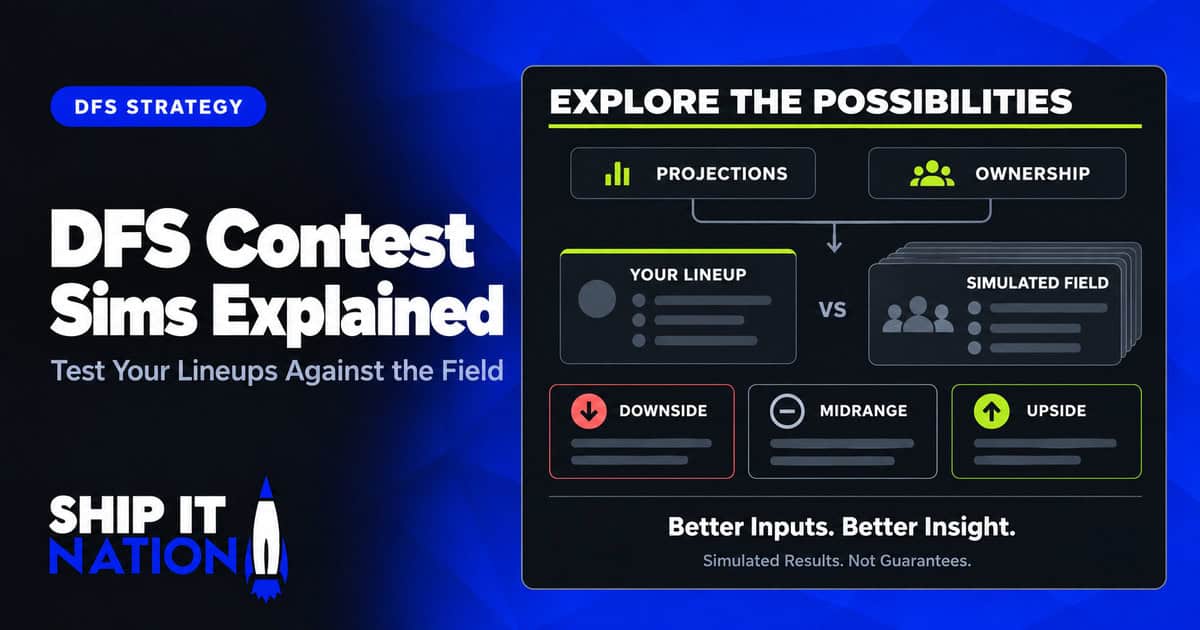
A contest sim takes your projected player pool, along with expected ownershipOwnershipOwnership is the percentage of lineups in a contest that include a given player. Projected ownership is an estimate made before lock; actual ownership is posted once the contest locks.Ownership isn't something to avoid; it's something to build around. The goal is understanding how the field is likely to build, then finding your edge relative to that. across the field, and runs a large number of simulated versions of the contest. Each simulation randomly generates outcomes for every player based on their projected performance range, then builds a simulated field of opponent lineups based on projected ownership, and sees how your lineups would have performed against that simulated field across each version of the slate.
Run enough of these simulations and you start to get a picture of how your lineups perform not just on average, but across a wide range of realistic outcomes, including the boom and bust scenarios that a single point projection can’t capture on its own.
What Sims Can Actually Tell You
A well built sim can show you how often your lineups finish in the top one percent of a contest, which is often the more useful number in a large field GPPGPP (Guaranteed Prize Pool)A GPP is a tournament whose prize pool is guaranteed to pay out in full even if the contest does not fill. Payouts are steep: a small group at the top wins most of the money.Before you enter a tournament lineup, ask how it finishes first, not just how it cashes. If you cannot name that scenario, rebuild it. than your average finishing position. It can help identify where your realistic return on investment is coming from across your pool, whether that’s a handful of high ceilingCeilingCeiling is the high end of a player's or lineup's realistic range of fantasy scores. It describes a big performance that could happen when things go well, not the expected score or an absolute maximum.Describe what must happen for each player to have a huge game. Then check whether those conditions help or hurt the other players in your lineup. builds carrying the rest or a more evenly distributed set of lineups.
Sims can also highlight which of your lineups are best suited for which type of contest, showing you that a build with a higher floorFloorIn daily fantasy sports (DFS), a player's floor is an estimate of the low end of their realistic fantasy scoring range. It describes downside, not a guaranteed minimum or their average projected score.Before trusting a floor estimate, check what could change the player's role today: a returning teammate, a minutes restriction, a lineup change or a different game script. but lower ceiling might actually be better suited for a smaller field contest than the massive GPP you originally built it for.
Why Sims Are Only as Good as Their Inputs
This is the part that gets overlooked constantly. A sim is built entirely on the ownership and projection inputs you feed into it. If those inputs are inaccurate, the output is going to be misleading no matter how sophisticated the simulation engine is behind it.
Accurate ownership projections matter enormously here. If a sim assumes a player will be owned at a certain percentage and the actual field ends up rostering that player far more or less often, the simulated results won’t reflect what actually happens in the real contest.
The Meta Game Problem
There’s an added wrinkle that more advanced players need to be aware of. If a sim shows that a certain player is a great leverage spot, and that information becomes widely known or widely used, the ownership on that player often shifts as the field reacts to the same signal. That shift can quietly remove the exact edge the sim originally identified.
This is why more experienced sim users don’t just take default ownership inputs at face value. They adjust their ownership assumptions to reflect what they expect will actually happen once a meaningful portion of the field reacts to the same widely available signals, rather than assuming the field will remain static.
Using Sims Without Over Relying on Them
Sims are a genuinely useful tool for understanding your realistic range of outcomes, but they work best as one input alongside your own read on a slate, not as a replacement for it. Treat a strong sim result as confirmation worth considering, not as an automatic green light, and treat a weak sim result as a prompt to dig deeper into your assumptions rather than an automatic reason to scrap a lineup you have real conviction in.
Used properly, sims add a layer of structure and realistic expectation setting to your process. Used blindly, they can just as easily lead you into a false sense of precision about a game that still has plenty of randomness built into it.
Full video courses on bankroll management, contest selection, roster construction and more, free for members.
Common Questions
How do DFS contest sims work?
They generate player outcomes from projected performance ranges and opponent lineups from expected ownership. They then evaluate how your lineups perform against that simulated field across different versions of the slate.
How accurate are DFS contest sims?
Their usefulness depends on the accuracy of projection and ownership inputs. Results can become misleading when actual ownership differs from expectations or the field reacts to widely shared simulation signals.
How should you use DFS contest sim results?
Use them to assess your range of outcomes and which contests fit your builds. Treat strong results as confirmation to consider and weak results as a reason to review your assumptions.
Need a term explained? The Ship It Nation DFS glossary covers every DFS term we use in plain language.

About the author
Tyler TambolineTyler Tamboline co-founded Ship It Nation and is the face of the brand across our shows and community. He is also the Founder of DFS Mastermind, helping hundreds of DFS players find their own process. He has played DFS since 2012, focusing primarily on PGA and NFL, and has created DFS content full-time since 2018 at different sites across the industry. He is known for strategy, game theory and leverage in large-field tournaments. He has been a regular on many Fantasy Sports podcasts, including weekly PGA and NFL shows with Pat Mayo.
More from Tyler Tamboline →Keep reading