NBA
NBA Scoring Differences: How Steals, Blocks, and Turnovers Change Values by Site
Published by Ship It Nation Staff · 4 min read
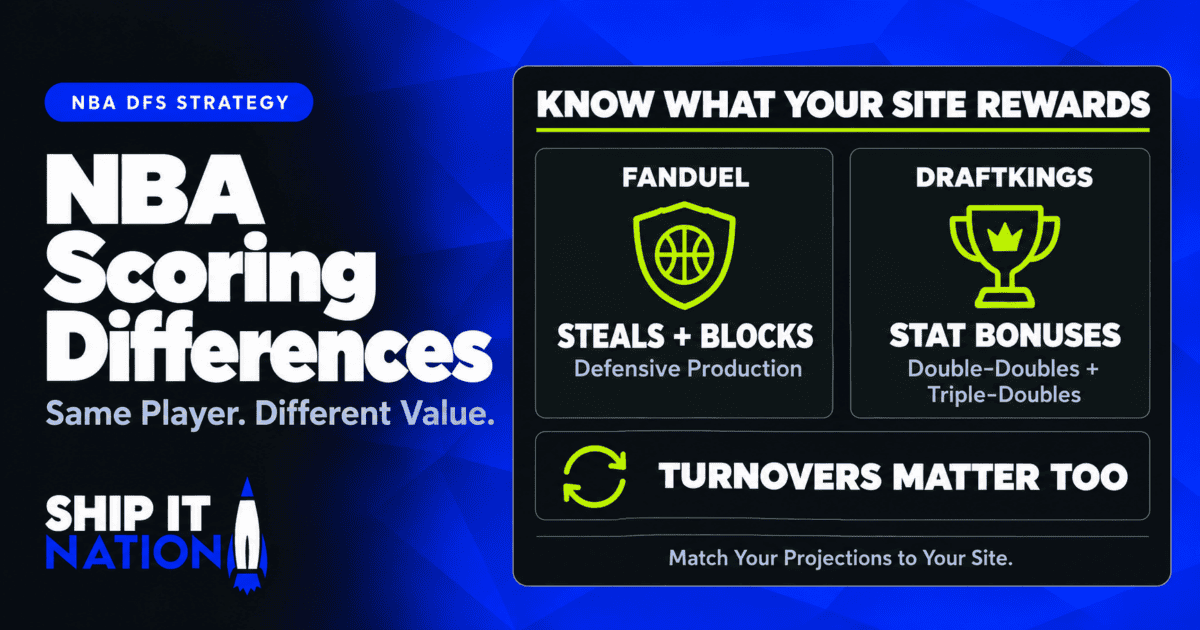
Steals, blocks, and turnovers change NBA values by site because FanDuel has traditionally paid much more for steals and blocks and penalized turnovers more heavily, while DraftKings rewards double-doubles and triple-doublesTriple-Double BonusThe triple-double bonus is extra fantasy scoring for recording at least 10 in three categories: points, rebounds, assists, steals or blocks. In DraftKings NBA Classic, it adds 3 points on top of the player's statistical scoring and double-double bonus.Check how often a player reaches all three thresholds in the same game under a similar role. Separate averages for points, rebounds and assists can overstate the likelihood. with bonus points. The same player can be strong on one site and average on the other, so check the current scoring on each site.
Key takeaways
- Steals, blocks, turnovers, and bonuses are weighted differently by site, so the same player can be strong on one and average on the other.
- Check each player by applying the site’s scoring to recent box score numbers and comparing the result with salary.
- Treat defensive stats and triple-double chances as upside on top of a solid role, not as the base projection.
The Big Differences
Points, rebounds, and assists count on both sites, but the weights are not identical, and the smaller categories separate them.
- Steals and blocks. FanDuel’s extra emphasis on steals and blocks gives a defensive specialist a real boost there.
- Turnovers. FanDuel tends to penalize turnovers more heavily. DraftKings has a turnover penalty too, but it’s usually gentler.
- Bonuses. DraftKings has long awarded bonus points for double-doubles and triple-doubles. FanDuel does not use that structure.
Always confirm the exact numbers on each site’s scoring page before the season and any time you notice a change.
| Stat | DraftKings | FanDuel | Difference |
|---|---|---|---|
| Free throw made | 1 | 1 | Same |
| 2-point shot made | 2 (1 per point) | 2 | Same |
| 3-point shot made | 3.5 (3 points plus 0.5 bonus) | 3 | DraftKings pays 0.5 more |
| Rebound | 1.25 | 1.2 | DraftKings pays 0.05 more |
| Assist | 1.5 | 1.5 | Same |
| Steal | 2 | 3 | FanDuel pays 1 more |
| Block | 2 | 3 | FanDuel pays 1 more |
| Turnover | -0.5 | -1 | FanDuel penalizes 0.5 more |
| Double-double | +1.5 | None | DraftKings only |
| Triple-double | +3 | None | DraftKings only |
Who Gains on FanDuel
Players who accumulate steals and blocks gain the most. Think of a rim-protecting big who regularly sits near multiple blocks, or a perimeter defender with a high steal rate. Their scoring comes from events that other players barely produce, and FanDuel pays more for them.
These players can also have a floorFloorIn daily fantasy sports (DFS), a player's floor is an estimate of the low end of their realistic fantasy scoring range. It describes downside, not a guaranteed minimum or their average projected score.Before trusting a floor estimate, check what could change the player's role today: a returning teammate, a minutes restriction, a lineup change or a different game script. advantage there. Even in a game with modest scoring, defensive events can keep the total respectable. That makes some of them useful in cash lineupsCash GameA cash game is a contest that pays a large share of the field, usually close to half, the same flat prize. Fifty-fifties, double-ups and head-to-heads are the common cash games.Treat cash games as the steady base of your bankroll. Use one safe core across your cash entries on a slate, and save riskier ideas for tournaments. as well as tournamentsGPP (Guaranteed Prize Pool)A GPP is a tournament whose prize pool is guaranteed to pay out in full even if the contest does not fill. Payouts are steep: a small group at the top wins most of the money.Before you enter a tournament lineup, ask how it finishes first, not just how it cashes. If you cannot name that scenario, rebuild it..
Who Gains on DraftKings
Players with the ball in their hands for long stretches tend to do better on DraftKings. High usage creates points, rebounds, and assists, and those players have the best shot at a double-double or triple-double. The bonus turns a very good night into a great one.
Turnovers are the other side of that. A high-usageUsage RateUsage rate estimates the percentage of a team's offensive plays a player uses while on the court, based on shot attempts, free throw attempts and turnovers. It does not measure assists or time spent holding the ball.Check who shared the floor in any usage sample. Numbers collected against reserves or with several starters missing may not describe the role you are projecting tonight. playmaker who gives the ball away often looks better on DraftKings because the turnover penalty is smaller, while the same game on FanDuel can look much worse. A triple-double with a large number of turnovers is a good example of the gap between sites.
Why Salary Does Not Always Keep Up
Sites price players with their own scoring in mind, but salaries are never perfectly matched to the fantasy valueValueValue is the fantasy production you expect from a player relative to his salary. A value play offers more production or upside than his price suggests, whether he is cheap or expensive.Identify why the salary looks wrong: workload, matchup, scoring ability or a pricing error. Then check whether that reason still holds when you submit your lineup.. Sometimes a defensive big is priced like an ordinary big on one site while the scoring says he is worth more. Sometimes a playmaker is priced the same on both sites but is clearly better on one.
Those gaps are worth looking for. You do not need to be precise. A rough question works: does this player’s role produce events that this site pays extra for?
How to Check a Player on Both Sites
- Look at a player’s recent box scores, not just points.
- Count the steals, blocks, turnovers, and how often he nears a double-double.
- Apply each site’s scoring to those numbers.
- Compare the result with the salary on each site.
Doing this for a handful of players builds intuition fast. After a few weeks you will know which profiles tilt which way without recalculating.
| Same stat line | DraftKings | FanDuel | Gap |
|---|---|---|---|
| Scoring guard: 25 points (4 threes), 5 rebounds, 8 assists, 2 steals, 0 blocks, 4 turnovers | 47.25 | 45.0 | DraftKings +2.25 |
| Defensive big: 8 points, 10 rebounds, 2 assists, 2 steals, 3 blocks, 2 turnovers | 32.5 | 36.0 | FanDuel +3.5 |
Don’t Overreact to the Extremes
Steals and blocks are volatile. A player who gets four blocks one night may get none the next. If you are paying a premium for those events, you are paying for something that varies a lot. Treat defensive stats as a bonus on top of a solid role, not as the reason to play someone with limited minutes.
Likewise, bonus categories are not guaranteed. A triple-double chance sounds exciting, but most nights do not produce one, even for the players who are likeliest to get them. Count the bonus as upside, not as the base projectionProjectionsDFS projections estimate a player's fantasy points for an upcoming slate using expected opportunities, performance and the contest's scoring rules. They describe an expected result, not a guaranteed score.Check the projection's update time and assumed role before using it. If news is already included, adjusting again for that same news can double-count its effect..
Keep Your Projections Site-Specific
If you use projections, make sure they reflect the scoring system you are playing. A single set of fantasy points does not translate directly across sites. Using one site’s numbers for the other site’s slateSlateA slate in DFS is the set of games, races, fights or tournament rounds covered by a contest. It determines which events your player selections can come from and which performances count toward your score.Before building, open the contest details and check the included events, scoring period and lock rules. Do not assume two sites offer identical slates just because both call them the main slate. can mislead you, especially for players at the extremes of the categories above.
Build a short habit: before each slate, ask which two or three players on the board look different between sites, and why. That small step is often where an edge starts, and it costs only a few minutes.
Check the roster structure too before turning those player comparisons into a lineup.
Use the same site-specific approach when reassessing players for NBA late swap.
Full video courses on bankroll management, contest selection, roster construction and more, free for members.
Common Questions
Do steals and blocks count the same on FanDuel and DraftKings?
No. FanDuel has historically valued steals and blocks at a much higher rate than DraftKings, which helps defensive specialists there. Always confirm the exact numbers on each site’s scoring page before the season and any time you notice a change.
Which players do better on DraftKings?
Players with the ball in their hands for long stretches tend to do better, since high usage creates points, rebounds, and assists and a shot at double-double or triple-double bonuses. A gentler turnover penalty also helps. Check the current scoring on the site.
How do I compare a player’s value across sites?
Look at recent box scores, not just points. Count steals, blocks, turnovers, and how often he nears a double-double, apply each site’s scoring, then compare the result with the salary on each site. Doing this for a handful of players builds intuition fast.
Need a term explained? The Ship It Nation DFS glossary covers every DFS term we use in plain language.

About the author
Ship It Nation StaffShip It Nation was founded in 2023 by Tyler Tamboline and Mike Petta to give DFS players the tools, projections, content, and community they need to build a winning process. Today, we're a fully remote team of active DFS players, analysts, and builders.
More from Ship It Nation Staff →Keep reading