CBB
Finding Value in College Basketball DFS: Salary Lags, Transfers, and Freshmen
Published by Ship It Nation Staff · 4 min read
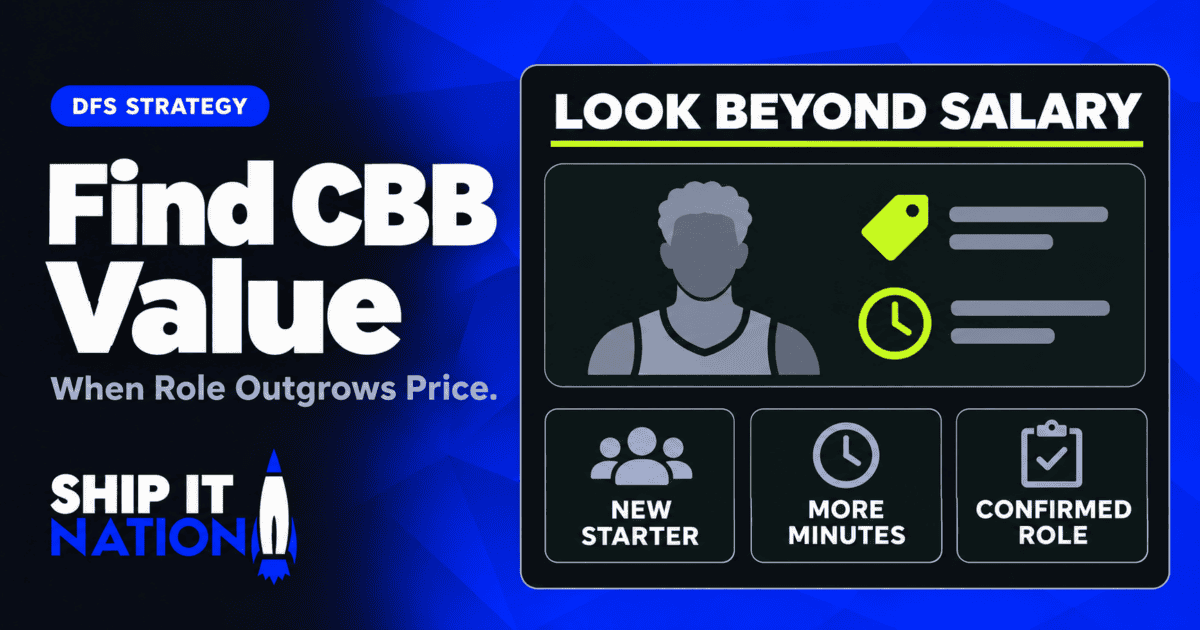
The path to winning college basketball DFS tournaments relies entirely on identifying mispriced valueValueValue is the fantasy production you expect from a player relative to his salary. A value play offers more production or upside than his price suggests, whether he is cheap or expensive.Identify why the salary looks wrong: workload, matchup, scoring ability or a pricing error. Then check whether that reason still holds when you submit your lineup.. Look for players whose role has outgrown their price. Because pricing models adjust slowly to sudden real-world role changes, sharp players can consistently find values whose mathematical projections far outpace their current platform salary.
Key takeaways
- Value comes from salary that lags role. Look for new starters, injury beneficiaries, and growing minutes.
- Early in the season, transfers and freshmen are the most uncertain, so let the first games clarify roles before you pay up.
- Value counts only when the minutes are real. Check role, minutes, and ownership before you commit.
What Are the Core Sources of Value?
Value plays allow you to save salary cap space so you can afford expensive superstar anchors elsewhere in your lineup.
| Value Archetype | Why the Value Exists | Accompanying Strategic Risk |
|---|---|---|
| New Rotation Starters | Current salary still reflects a low-minute bench role | The coach could shift the starting rotation back without notice |
| Injury Beneficiaries | A high-usage teammate has been ruled out of the game | Highly predictable, resulting in massive ownership across the field |
| Gradually Expanding Roles | Playing time has steadily climbed over a multi-game stretch | Platform algorithms may already be adjusting the price upward |
| Cross-Site Pricing Gaps | One platform priced the player significantly lower than the other | Scoring variations can sometimes negate the apparent price discount |
Early in the college season, salary caps heavily rely on historical data from the previous year. Platforms often struggle to accurately price players who have inherited brand-new responsibilities.
How Do You Handle the Transfer Portal and Freshmen?
The modern era of college basketball features high roster turnover, making early-season evaluations challenging.
- The Transfer Portal Trap: Mid-major superstars who transfer into elite Power Four conferences often see their usage ratesUsage RateUsage rate estimates the percentage of a team's offensive plays a player uses while on the court, based on shot attempts, free throw attempts and turnovers. It does not measure assists or time spent holding the ball.Check who shared the floor in any usage sample. Numbers collected against reserves or with several starters missing may not describe the role you are projecting tonight. drop significantly. Conversely, bench players transferring down to smaller schools frequently experience an immediate explosion in minutes and shot volume. Always analyze team rotation projections rather than relying solely on a player’s previous school reputation.
- Evaluating Elite Freshmen: Highly rated recruits often step directly into primary offensive roles, but their initial salaries are frequently set at a baseline discount. Look for firm confirmation of their role through preseason coach commentary or exhibition starting lineups before committing significant capital to unproven players.
How Do You Exploit Cross-Site Pricing Variations?
Always cross-reference a player’s salary across both DraftKings and FanDuel. Significant pricing discrepancies can signal a clear buying opportunity.
When exploiting a cross-site discount, ensure the platform’s specific scoring rules support the player’s statistical profile. For example, a defensive guard who forces turnovers is highly valuable on DraftKings where turnovers only cost minus-half a point, whereas a careless, high-turnover ball-handler is a major risk on FanDuel’s punitive minus-one scoring system.
Roster structure matters too. FanDuel has four guard spots and DraftKings has three guard spots plus two utility spotsFlex and UTILFlex and UTIL (utility) are roster slots that accept players from multiple eligible positions. Eligibility depends on the sport and contest; in single-game formats, these labels commonly identify the regular-scoring slots alongside a Captain or MVP.Before lock, identify affordable replacements for your latest starter. An open FLEX or UTIL slot helps only if suitable unlocked players remain within your budget., so a deep group of cheap guards can be worth more on FanDuel than a deep group of cheap forwards.
How Do You Evaluate a Value Play?
Before you commit to a cheap player, run through four questions:
- Is his role confirmed, or only expected?
- How many minutes has he played when healthy in this role?
- Is the salary gap real, or does the scoring system explain it?
- How many other lineups will have him?
Our guide to minutes, foul trouble, and blowouts covers how to answer the first two.
How Do Value Plays Fit Cash Games and Tournaments?
In cash gamesCash GameA cash game is a contest that pays a large share of the field, usually close to half, the same flat prize. Fifty-fifties, double-ups and head-to-heads are the common cash games.Treat cash games as the steady base of your bankroll. Use one safe core across your cash entries on a slate, and save riskier ideas for tournaments., value must come with a secure role. A cheap starter with heavy minutes beats a cheaper player who may not play.
In tournaments, a value play that everyone sees becomes chalk. When an injury opens a spot, many lineups will use the same replacement. You can still play him, but think about what you build around him so your lineup differs elsewhere.
How Do Single-Game Formats Change Value?
DraftKings runs a Dark Horse format built for value. Your Dark Horse scores 1.5 times the normal points and must have a UTIL salary of $6,500 or less, and the lineup has six players from both teams. The format rewards finding a cheap player with a real role, since the multiplier only helps if he gets the minutes.
FanDuel’s single-game MVP works differently. The MVP earns 1.5 times the points but also costs 1.5 times the salary, so the multiplier is a price you pay, not a discount. Value in that format usually comes from the five Flex spots, where a cheap player with a secure role frees up salary for the MVP.
Full video courses on bankroll management, contest selection, roster construction and more, free for members.
Common Questions
How do you find value in college basketball DFS?
Look for players whose salary has not caught up with their role, such as new starters, injury beneficiaries, and players with growing minutes. Confirm the minutes before you play them.
Should you play transfers and freshmen in college basketball DFS?
Be careful early in the season. Their roles are the least certain. Look for evidence such as a starting spot, and treat players without it as a gamble.
Do salaries differ between DraftKings and FanDuel in college basketball?
Yes, and so does scoring. Compare a player’s price on each site and check whether the scoring explains the gap before you act.
Need a term explained? The Ship It Nation DFS glossary covers every DFS term we use in plain language.

About the author
Ship It Nation StaffShip It Nation was founded in 2023 by Tyler Tamboline and Mike Petta to give DFS players the tools, projections, content, and community they need to build a winning process. Today, we're a fully remote team of active DFS players, analysts, and builders.
More from Ship It Nation Staff →Keep reading